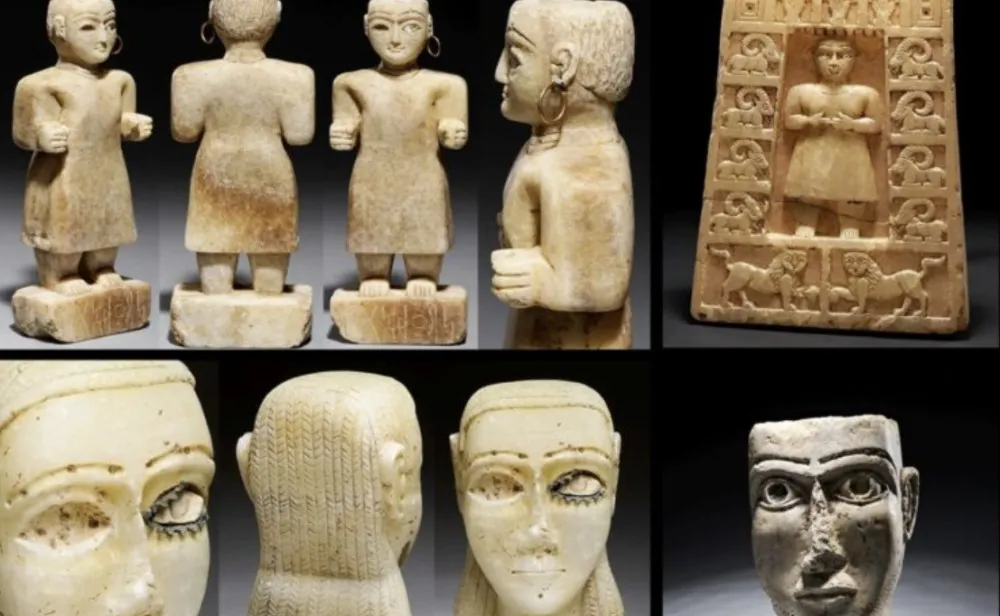
The first group of objects appeared in antiquities sales held around 2 July 2026 at Bonhams in London and at Apollo Art Auctions. The group comprises statue heads, a statue, an inscription, and funerary stelae (tombstones).
It’s common practice in auction catalogues to describe objects originating from present-day Yemen as “South Arabian” or “Ancient Arabian.”
In line with this convention, two South Arabian alabaster heads—depicting male and female figures—were included in the Bonhams catalogue and were reported as sold in the auction results.
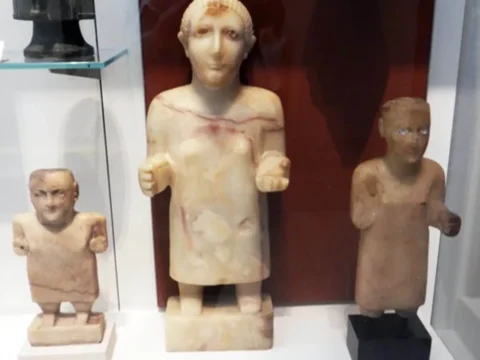
Calcite female figure (1st or 2nd C) at the British Museum. Photo Universal History Archive/Getty Images
The British Museum’s catalogue of ancient South Arabian artifacts offers clear contenders for the approximately 20 artifacts that Yemen’s antiquities authorities describe as looted: stone slabs, funerary stelae from the ancient city of Shabwa, alabaster sculptures ranging from busts and votive heads to full-bodied figurines.
Objects are recorded as entering the collection in the late 19th and early 20th centuries, often via individuals associated with British administration in Aden, including William Francis Prideaux and his son, Lieutenant L. A. R. Prideaux.
The British Museum has not responded to a request for comment.
Yemen named the 28 artifacts as part of its “Our Looted Heritage” campaign, which traces looted cultural heritage to museums, auction houses, and private collections abroad.
The Yemen authorities emphasise that efforts are ongoing to trace and recover the looted heritage, underscoring Yemen’s determination to safeguard its cultural identity despite the challenges posed by years of conflict.