Events about restitution

RM* selects the most important events in the field of colonial collections and restitution. Events in the future are listed as much as events from the recent past, provided the latter are of interest to users of the website.

Every event item is provided with
  • a short summary in English, also if it appears in another language
  • weblinks to the organizers or other sources
  • tags and attributes to easily find connected publications, news and events
The signing of the Washington Declaration in 1998 marked the starting point for the establishment of new, systematic provenance research focusing on the period between 1933 and 1945. In recent years, provenance research has increasingly intersected with other contexts of injustice, including colonialism, Soviet Occupation Zone/GDR, and is subject to public demand. Conference in Vienna.
MAC CONFERENCE 2026 invites to consider how Caribbean museums strengthen bonds across generations, landscapes, and nations. This conference examines how memory work, cultural stewardship, and community engagement can advance well‑being and sustainability in a rapidly changing world.
This conference will provide an opportunity to explore the transformative role museums can play in fostering empathy, decolonization, rematriation/repatriation, promoting human rights and cultivating a culture of peace.
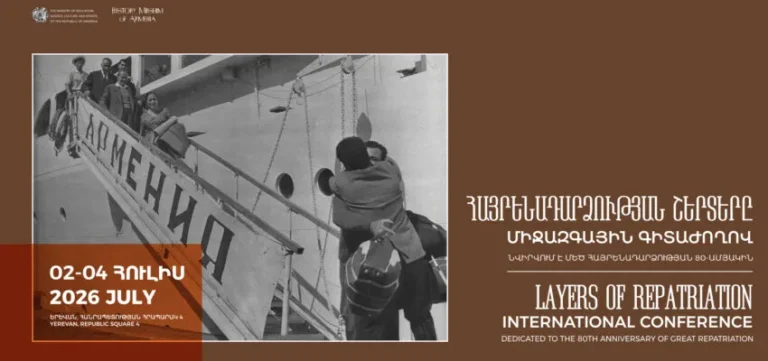
The History Museum of Armenia is organizing the “Layers of Repatriation” international conference, dedicated to the 80th anniversary of the great repatriation movement, which aims to rediscover museum collections related to the topic and discuss the different social, cultural, and historical layers of the phenomenon.
The Center for Art Collection Ethics (ACE) at the University of Denver (DU) announces a hybrid training program: Provenance Research Today: Issues, Resources, and Networks. The program is geared toward graduate students and emerging museum and art market professionals.
Call for Papers for the 12th Annual Conference of the Amsterdam School for Heritage, Memory and Material Culture. The conference 'Unsettling Heritage and Memory Futures: Decolonial Trajectories Between Crisis and Possibility', will take place on 17, 18 and 19 June, 2026.
In June 2026, Amsterdam School for Heritage, Memory and Material Culture organizes the conference “Unsettling heritage and memory futures: Decolonial trajectories between crisis and possibility”. One panel brings together scholars to reflect on the idea of “home” in relation to restitution. The panel is looking for contributors.
[in French] Session: Does the emergence of a legal framework for the restitution of African cultural property play a sufficient role in the reparation enterprise following colonization?
The Indonesian phrase pasang surut — “the tide in and out” — evokes the continuous movement of people, objects, and ideas across the seas that once linked Europe and the Indonesian archipelago. These currents shaped the emergence of colonial collections but also suggest the possibility of renewed circulation: of knowledge, accountability, and dialogue.
The conference 'Museums as Monuments to the Colonial Troops?' brings together historians, artists, curators and artists to examine the artefactual history of colonial warfare in three former German colonies: Togo, Kamerun and German East-Africa.
Disrupting and Reorienting Restitution (DRR) invites applications from Egyptian and Mozambican multidisciplinary artists to take part in a focused, practice-based artistic collaboration engaging with contested African collections held in European museums.
The Expertise Center for Restitution (ECR) of the NIOD Institute for War, Holocaust and Genocide Studies and Resistance Museum Amsterdam present Robbery Art Ontrafeld, a lecture series that focuses on the less exposed aspects of loot art and restitution. Historians associated with the NIOD present recent research and surprising insights and enter into dialogue with the public, led by moderator Yuki Kho.
In recent years human remains in museums have been the subject of increasingly critical attention, both within the museum sector itself and in public debate. This raises a large number of ethical, legal, and practical questions for European museums. 'Museum meets University' organises this meeting at the crossroads of academic museology and museum practice.
Until its restitution in November 2025, Ama O Ghe Ehen, a 18th-century bronze plaque depicting a mudfish, was held in the colelction of the Museum de Fundatie in the Dutch city of Zwolle, since its acquisition in 1937. This symposium explores the process and implications of this return, and what restitution might mean in the context of this plaque.
What can art and artists bring to researching the origins and biographies of objects? How do they shed new light on – or even unsettle – existing approaches to such questions?
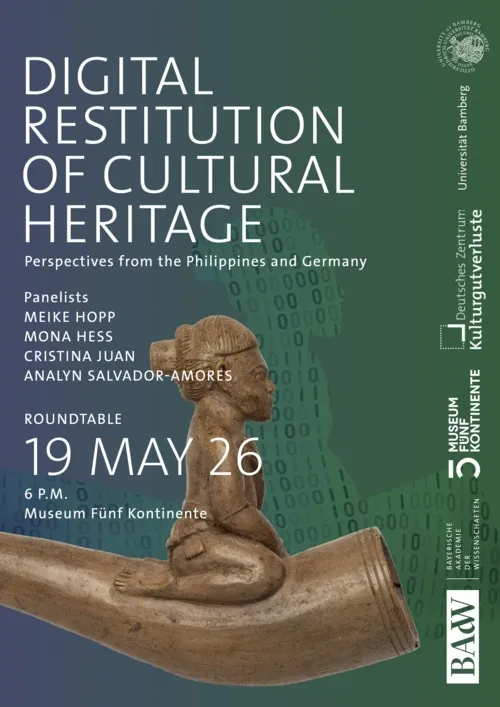
Roundtable about: From Collection to Collaboration: Revisiting the Colonial Philippine Collection of Heinrich Rothdauscher (1851–1937) at the Museum Fünf Kontinente in Munich
African and European professionals with at least two years of practical experience in a museum, heritage site or art space are invited to apply for a TheMuseumsLab 2026 Fellowship.
[ in Dutch, in French] That this issue has received increasing attention is partly due to two important issues, namely the question of the restitution of works of art looted by the Nazis to relatives of victims of the Holocaust and the question of the restitution of cultural heritage objects illegally acquired during colonization by Western countries. Three Wednesday afternoons.
28 April: Black Muse and Digital Benin: Benin Heritage & New Forms of Narratives: Digital Access & Reconnection to the Living Heritage of Benin Kingdom 3 May: Digital Benin and Kokopelli Gallery: Digital Benin: Digital heritage at the intersection of culture, data and practice
The conference theme will reflect the project’s focus on equitable collaboration, community-engagement and revisiting the ways in which collections are acquired, interpreted and shared. This year we’re rethinking what a conference can be. Dates: 23-24 April 2026.
[in French] The UNESCO Chair on the Diversity of Cultural Expressions, in partnership with CELAT and IPAC, is organizing the second Midi de la culture of the year, which will include a discussion on the restitution and repatriation of cultural objects.
Please join the Denver Art Museum’s Native Arts and Provenance departments, along with special guests from the Nelson-Atkins Museum of Art and the Art Institute of Chicago, for a lively panel discussion on the vital role provenance research plays in museums.
In this Second Parliamentary Gathering on 13 April 2026, APPCITARJ will build on the landmark November 2025 gathering and draw on international experiences of truth and justice processes to inform and deepen the movement for a genuine commission of inquiry.
This conference focuses on objectives, forms, logics, limits of and experiences with restitution, reparation, and redress as reactions to the damages and suffering from strong asymmetrical dependency relations, including violence, oppression, and economic exploitations.
Mirjam Shatanawi gives an overview of Islamic collections in the Netherlands, focusing on their presence in museums, libraries, and archives. It provides a critical overview of how these collections have been shaped, preserved, and interpreted, with particular attention to the enduring influence of colonial perspectives on Indonesian Islamic traditions. Examples will be given of objects from Java, Sumatra and South Sulawesi.
Marking the beginning of the 2026 Ocean Space exhibition season, TBA21–Academy presents Tide of Returns, an exhibition based on the artistic research of the Repatriates Collective, initiated by artist Khadija von Zinnenburg Carroll and formed of artists from Australia’s Pacific North, South, and West Africa, Europe, and Latin America.
Swiss citizens and companies were heavily involved in the colonial system from the 16th century onwards.
[in Dutch] On the occasion of the International Day of Remembrance of the Victims of Slavery and the Transatlantic Slave Trade, the Faculty of Arts and Philosophy in Antwerp is organising an event on postcolonial history and culture: we will enter into a dialogue on African cultural heritage in Western institutions.
The University of West Indies Museum in partnership with the Centre for Reparation Research presents 'Exploring Restitution, Colonial Collection and the Caribbean' in an online discussion on March 20.
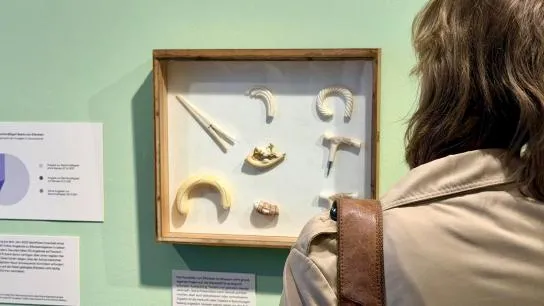
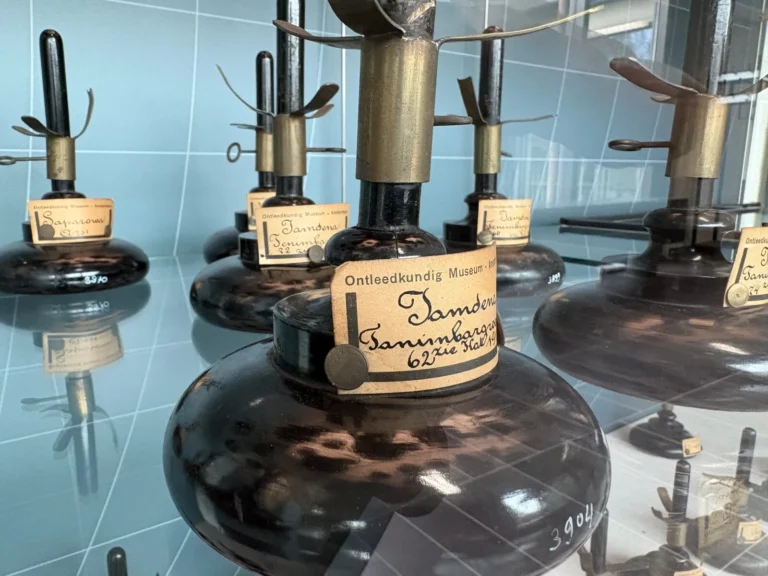
The preservation and exhibition of human remains in museums is a painful open wound for many descendant communities. Any museum that stewards such human remains, like Museum Vrolik (the anatomical museum of Amsterdam University), must respond to its racist and colonial inheritance. The result can be seen in this exhibition. The exhibition is based on the results of years of research, including origin, ways of acquisition and suppliers.
J. Kelechi Ugwuanyi about the decolonial analytical tool of coloniality of power, knowledge and being is utilised to examine the injustices and power imbalance in heritagisation within and outside museum space, in and outside Nigeria/Africa. It interrogates how decolonial engagements could begin to recognise other realities and ways of knowing and doing heritage beyond the asymmetric universality.
The main objective of this project is to create an interdisciplinary network of researchers working on the history of ancestral remains collections in museums in Germany and France from Central and Southern Africa, with a particular focus on provenance research.
The Swiss School of Latin American Studies, supported by the Centro Latinoamericano-Suizo HSG and the Swiss Society of Latin American Studies (SSLAS-SAGW), invites the community to the public workshop entitled "Contested Heritage of Latin America: Collectors, Markets, and Coloniality," taking place on February 26 and 27.
[in French] After the Porto-Novo symposiums in 2022 and Yaoundé in 2023, after several days of study in Paris, the Dakar symposium is the final stage (or almost) of 5 years of research, publications, meetings of the international program "Returns: geopolitics, economies and imaginaries of restitution".
Dan Hicks talks at the Society of Antiquaries of London (Burlington House, courtyard of the Royal Academy) about the return of ancestral human remains through the case of the Worcester College skull cup.
The handling of human remains from colonial contexts presents museums, collections and research institutions with complex professional as well as ethical challenges. According to a survey conducted by the German Contact Point, approximately 46% of the unmodified human remains recorded in German museums and university collections cannot be clearly attributed to a specific geographical origin.
Kedleston (north-west of Derby) houses an impressive collection of paintings, sculptures and furnishings, some collected by the then Viceroy of India, George Nathaniel Curzon during his travels. The exhibition sheds light on previously untold stories. Encounters, a new film by British-Tibetan artist, Nyima Murry, brings to life the artefacts.
‘Time for Papua’ brings different perspectives together: from refined wood carvings and korwar figures to prauw prows and recent film works. You see how creators make history tangible, how objects form relationships, and how a dynamic perception of time clashes with imposed boundaries and economic interests.
[in French] On 7 February 2026, an open forum at the AfricaMuseum in Tervuren follows on two public events that took place in December 2025 in Kinshasa where researchers, heritage institutions and partners from both countries engaged in discussions on various themes in connection with provenance research and restitution of cultural heritage.
[in French] This conference focuses on the spoliation of cinema and the representation of spoliation and restitution in film, within the context of 1933-1945 as well as in colonial and post-colonial situations. Punctuated by film screenings, it brings together researchers in history, film history and art history, anthropology, political science, law, and provenance studies, working on diverse cultural areas.
Join the Association on American Indian Affairs virtually for the 11th Annual Repatriation Conference! The summary agenda for the Conference is available at https://www.indian-affairs.org/11thannualagenda.html
[in French, in English] Since the 1990s, new forms of discourse and mobilization have emerged to question Belgium’s colonial past and postcolonial present. Journalists, researchers, archivists, community activists, artists, members of the African diaspora, former colonists and their descendants, national and political players, etc. have contributed to putting the issue of colonial legacy on the public agenda.
Between 1896-1916 today's Burundi was a German colony as part of what was known as ‘German East Africa’. Not only in colonial historiography, but also in provenance research, Burundi has been largely underrepresented and, similar to Rwanda, stands ‘in the shadow’ of the reappraisal of the material cultural heritage of present-day Tanzania.
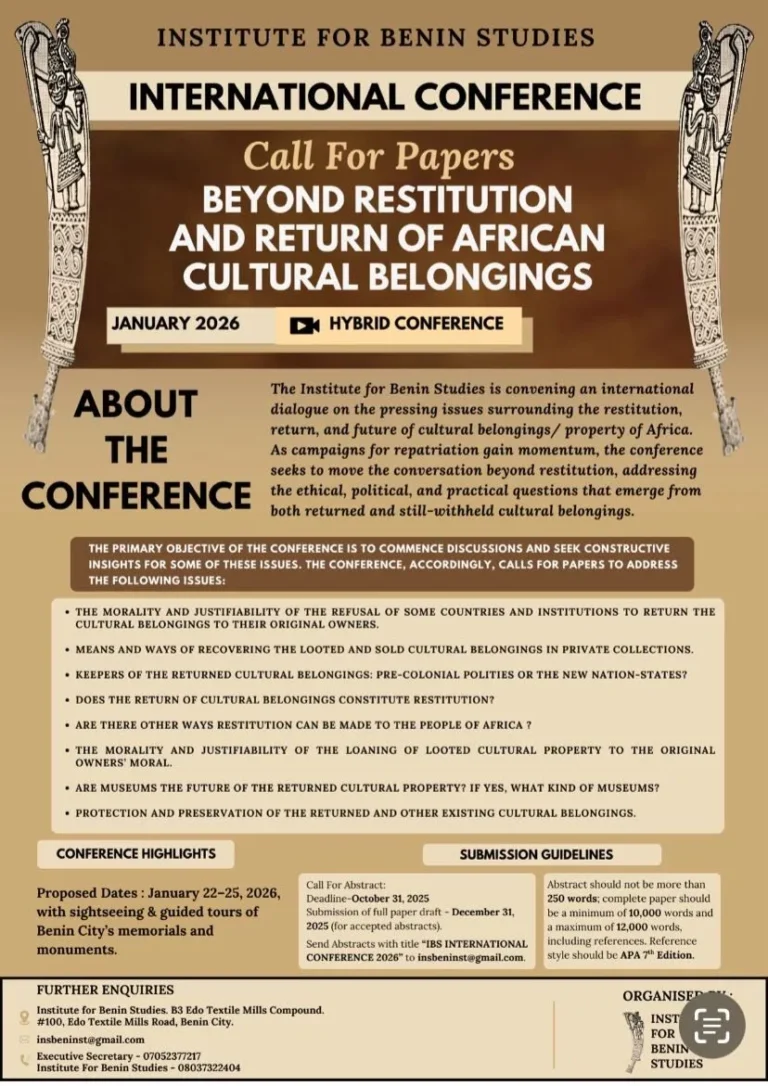
The Institute of Benin Studies in Benin City, Nigeria calls for paper for a conference from 22 to 25 January 2026. Deadline drafts 31 October 2025.
The Congo Research Network (CRN) is pleased to announce its fourth PhD workshop, which will feature a broadened regional focus on Central Africa.
The Netherlands Institute for Advanced Study (NIAS) invites you to apply to its Open Call and spend 5 or 10 months in Amsterdam, immersed in an interdisciplinary community that values curiosity-driven research in the humanities, social sciences and beyond.
A £1.1million Arts and Humanities Research Council (AHRC) standard grant has been awarded to an international team of scholars, archivists and filmmakers for a project on African film heritage restitution.
The Latin America and the Caribbean chapter of the Association of Critical Heritage Studies (LAC-ACHS), together with Centro de Patrimonio Cultural and Núcleo Milenio Nupats of Universidad Católica de Chile and the Department of Arts and Culture Studies of Erasmus University Rotterdam, warmly invites abstracts for its inaugural conference “Encounters. Collaborative Approaches to Heritage in Latin America and the Caribbean”.
December 15th, at 4 pm (Lagos time), the International Repatriation Network (IRN) will host an online session exploring what restitution and repatriation mean for diverse communities and stakeholders in Nigeria today.
The Dutch NWO will fund eight research projects “Research into collections with a colonial context”. The programme aims to redress injustices and strengthen trust and cooperation with the countries of origin.
Symposium on current debates around the spiritual artifacts collected under colonial or postcolonial conditions and housed in European ethnographic museums. It will be held Dec. 3 and 4 in Groningen with many wonderful scholars and MA and PhD students involved.
This project explores how diaspora communities from India, Nigeria, and Ethiopia engage with, shape, and are shaped by the restitution debate.
The 'Oceania and Indonesia' holdings in Altenburg (approx. 350 objects) and the entire ethnographic collection (approx. 250 objects) in Meerane will be examined. The initial check follows a research project on the Africa collection in Altenburg and the recommendation by ethnologist Ms Dolz from the State Ethnographic Collections of Saxony for Meerane.
It is the final conference of Pressing Matter, in partnership with the Research Center for Material Culture (RCMC) and the Wereldmuseum. Min theme: Rethinking the Restitutionary Moment: What Next? On 27 and 28 November in Leiden. On 26 November, Achille Mbembe will speak in Amsterdam.
Join this event - organised by the Europeana Communicators Community - to hear museum professionals across Brazil and Europe explore issues of repatriation, decolonisation, and representation of Indigenous voices.
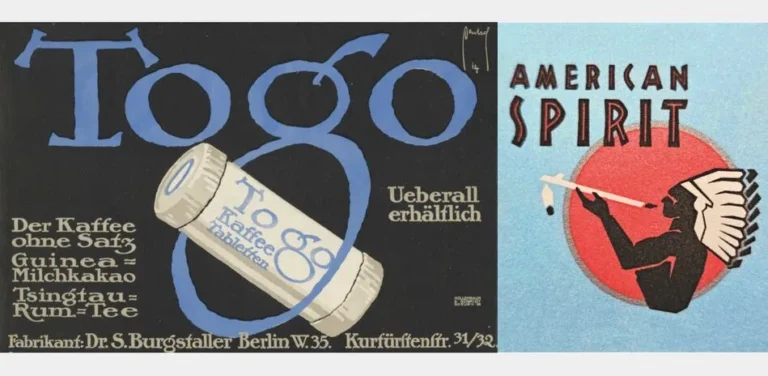
[ in English and in German ] Together with the Deutsches Historisches Museum, the Kunstbibliothek, Staatliche Museen zu Berlin is organising the international symposium “Tenacious Tropes: Colonial Narratives in Visual Advertising” on 21 and 22 November 2025 at Kulturforum Berlin.
[ in French ] The exhibition draws on more than eighty photographs from colonial archives, mainly held at the Royal Museum for Central Africa in Tervuren. But far from a simple presentation of heritage, Boma La Première offers a critical reading of these images.
Lecture by Jonatan Kurzwelly: From Racialisation to Reconciliation and Back: Ethical and conceptual dilemmas in the post-/de-colonial handling of human skeletal remains
[ in French ] The Study and Research Centre for Administrative and Political Sciences (CERSA) organizes a conference entitled “Restitutions of cultural heritage: trends, challenges, perspectives” on November 14, 2025 in Paris.
HERE is a seminar for new and experienced heritage professionals. The aim is to bring professionals together in order to stimulate knowledge exchange and innovation. HERE is on 10 November in Wereldmuseum Amsterdam.
The International Seminar on the Return of Cultural Heritage under the auspices of the 2025 Brazil BRICS Presidency will take place on 10 and 11 November and is organized by the University of São Paulo [ USP ].
Talk by Ashley Thompson, Hiram W Woodward Chair of Southeast Asian Art at SOAS University of London
[ in English and in German ] The main focus is on cultural belongings from four Cameroonian communities, the Bakoko, Bamum, Duala, and Maka, whose heritage was absorbed by these institutions during the German colonial era (1884-1919). This should also become a basis for future restitutions.
This knowledge exchange programme brings together a group of young professionals from around the world working in museums or collection-managing organisations to reflect on these questions and to exchange knowledge and experiences regarding their working practices.
This kick-off seminar, led by Pietro Sullo, discusses the legal status of colonial artefacts from Africa held in European museums, clarifying whether there is a duty to repatriate them. The research hypothesis is that European states have a legal duty to return colonial artefacts acquired without the consent of the communities of origin.
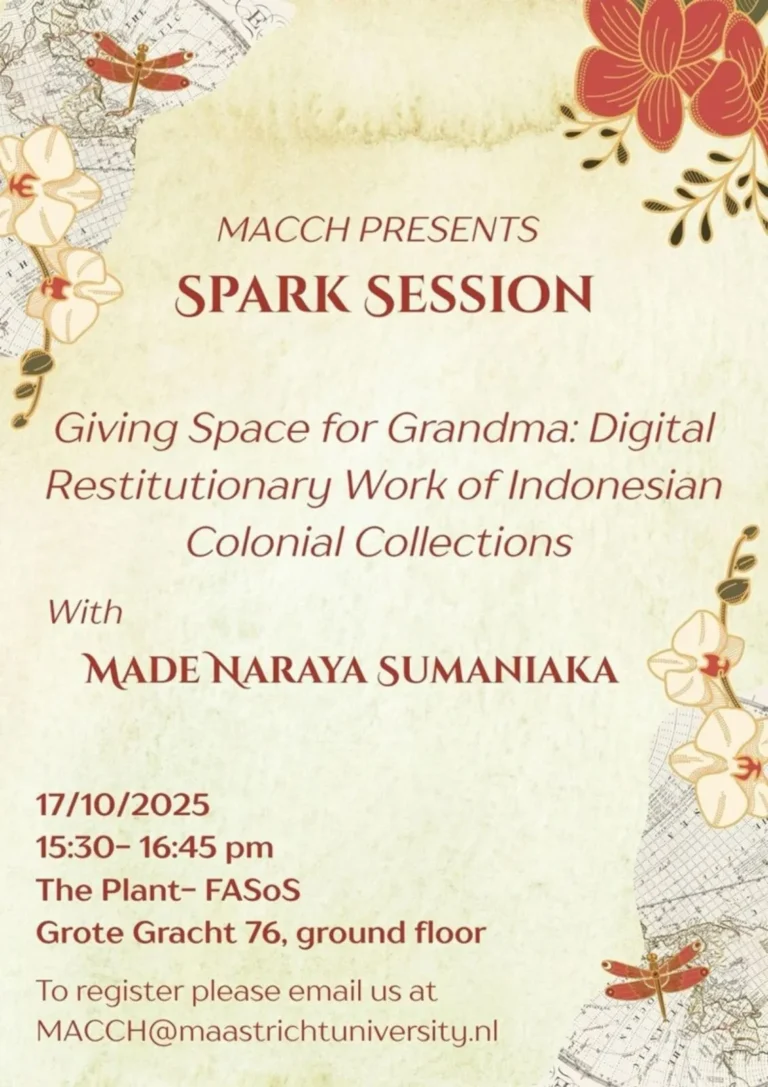
In this Spark Session Made Naraya Sumaniaka presents his thesis work, which recentres community agency by examining how digital spaces enable participation and contestation using the newly established Colonial Collections Datahub and TikTok as case studies.
In this exhibition, a group of artists examines how colonialism has shaped the ways museums, archives and other institutions of knowledge are perceived and understood, revealing the (im)material scars imposed by systemic violence.
Saturday 11 October, 14.00 - 16.00: Have you come to see the shrunken heads - Oxford University Museum of Natural History Lecture Theatre
Our third In Conversation considers restitution from an ethnographic perspective. Charlotte Joy will discuss the research for her upcoming book, drawing on interviews and her work with UNESCO, with Mirjam Shatanawi and Katarzyna Puzon. We invite you to join our conversation.
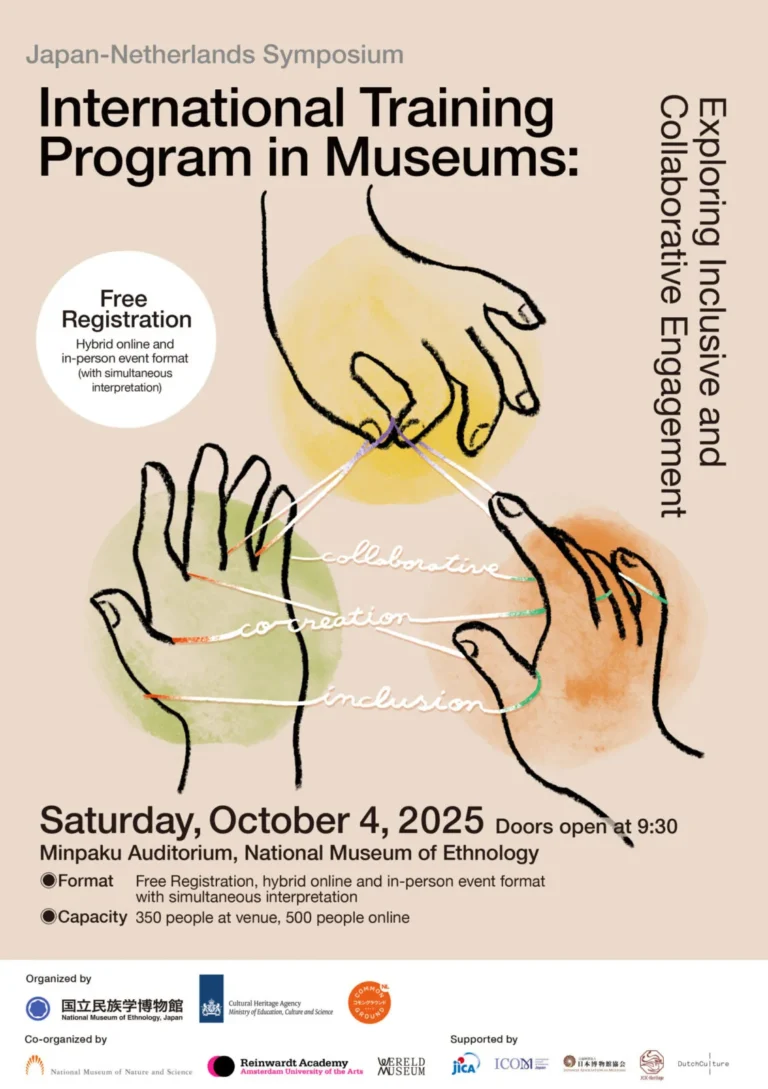
The Japan-Netherlands Symposium International Training Program in Museums: Exploring Inclusive and Collaborative Engagement focuses on international museum training programs conducted by the Netherlands and Japan, exploring new approaches to international museum collaboration that transcend the traditional hierarchy between “trainers” and “trainees.”
[ in Spanish ] The exhibition recovers key moments from the decades of 1880 and 1990, when the first restitutions of human remains and the demands for patrimonial return to our context were produced.
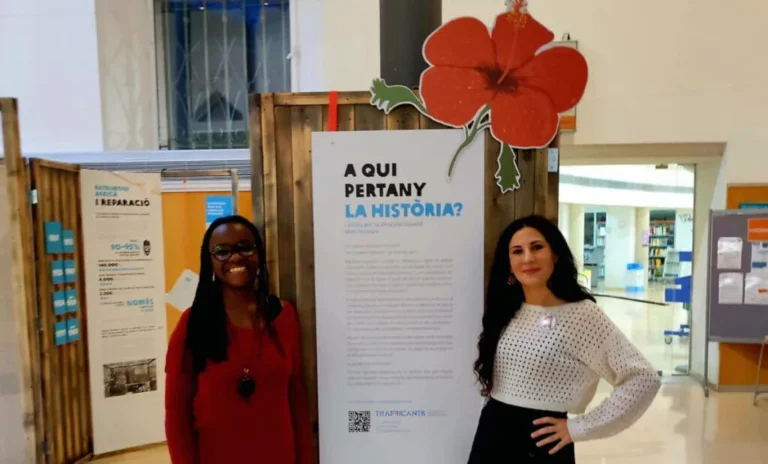
The Catalan project "(Tr)African(t)s. Museums and collections of Catalonia in the face of coloniality" has recently created a travelling exhibition titled “To whom does history belong? Struggles for the decolonization of museums". This exhibition “invites us to reflect on the role of museums in colonial history and to rethink heritage from a critical perspective."
The Colonial Collections Datahub is a digital platform that brings together, enriches and provides insights into collections from colonial contexts.
The conference “Colonial Pasts and Contempo­rary Search for Justice: Inter­disciplinary Perspec­tives on the Politics of Restitution and Redress for Colonial Violence” brings together experiences from different parts of the world, and perspec­tives in the field of transitional justice and (post-)colonial studies.
This workshop marks the conclusion of the interdisciplinary provenance research project "Human Remains from Colonial Contexts: Provenance Research in the Anthropological Collections of the University of Göttingen and MARKK Hamburg".
Many museums and institutions across Europe are custodians of objects and collections originating from colonial contexts. As professionals managing these collections, and recognizing our shared responsibility in addressing historical injustices, how can we best fulfill this role? What can we learn from each other’s experiences?
The Ethnographic Museum Zagreb presents the exhibition “Travellers” – Collection of Non-European Cultures, tracing the journeys of people and objects from colonial times to the present day.
This year’s theme explores the material return, digital reunification, and recontextualization of Philippine artefacts, manuscripts, and sound heritage kept in institutions outside of the Philippines.
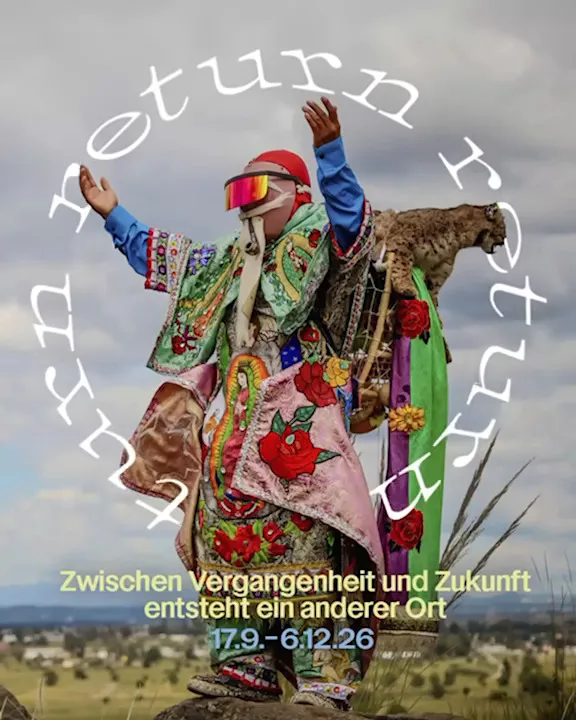
Join us on Sept 16 | 16:00–21:30 | Kulturhaus Brotfabrik - World Premieres of Eternos Retornos and other films, with installations by Repatriates, and a dinner ritual inspired by the counter vibration physics of the headdress. This is more than art. It is a call to return what was taken.
This workshop brings different approaches to historical data modelling around the history of looted African heritage found in German museums.
For several years, Bristol Museum and Art Gallery and the Australian Institute of Aboriginal and Torres Strait Islander Studies (AIATSIS) have been discussing returns of cultural heritage to Australia. This event will reflect on those discussions with community members and AIATSIS staff.
Kone Foundation supports Global South researchers’ visits to the Helsinki Collegium for Advanced Studies. The programme aims to strengthen research cooperation between the global South and North.
The Africa Institute, Global Studies University, in collaboration with the Open Society Foundations, announces its annual fellowship program themed, “Restitution and Reparation: Africa and the Post-Colonial Condition.” The program will convene scholars or practitioners interested in restitution and repatriation issues related to African art and artifacts.
[ English ] The exhibition "Benin Dues" --> Guided Tour in English with curator Alice Hertzog on 24 August 2025 [ German ] Vom Umgang mit historisch belastetem Kulturerbe – in Ethnologie und Recht on 30 September 2025
On Monday, 14.07.2025, at 6 pm, we are pleased to present the Working Paper “Missionary Societies and Religious Orders in German Colonies and Their Contribution to Ethnographic Collections” by Jan Hüsgen
The Tsilhqot’in National Government has launched its first major repatriation exhibit at the Museum of Vancouver, following the return of over 60 ancestral belongings—including baskets, tools, and cultural items—that had been held in museums and private collections for more than a century.
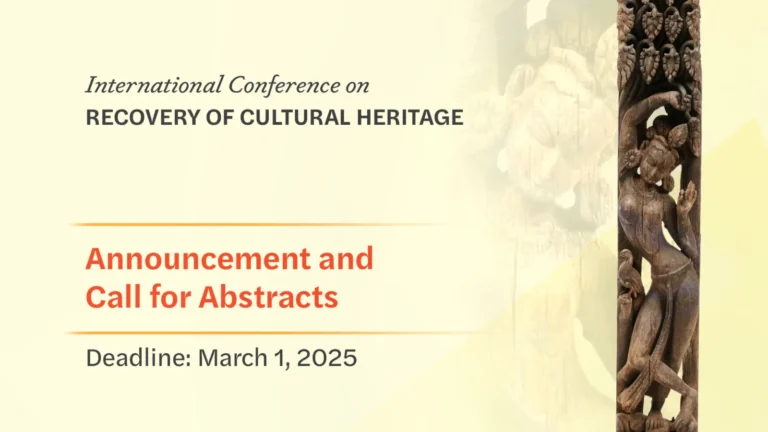
The Nepal Heritage Recovery Campaign is, in coordination with the Government of Nepal’s Department of Archaeology, organising the ‘International Conference on Recovery of Cultural Heritage’ in 16-18 June 2025.
80 Delegates from all over the world will gather at the Humboldt Forum and engage in dialogue about future collaboration and to contribute to the development of a Global Cultural Embassy (GCE).
Why should internationally active organisations concern themselves with decolonisation? How can transnational institutions meaningfully shape this process? What challenges, responsibilities and opportunities arise from this?
[ in German ] Provenance research is becoming increasingly digital: be it in the cataloguing of source material, in the use of the numerous existing databases for research or in the visual analysis of research data.
[ in French ] Conference at the occasion of the launch of the 2nd Dictionaire comparé in the Musée du quai Branly.
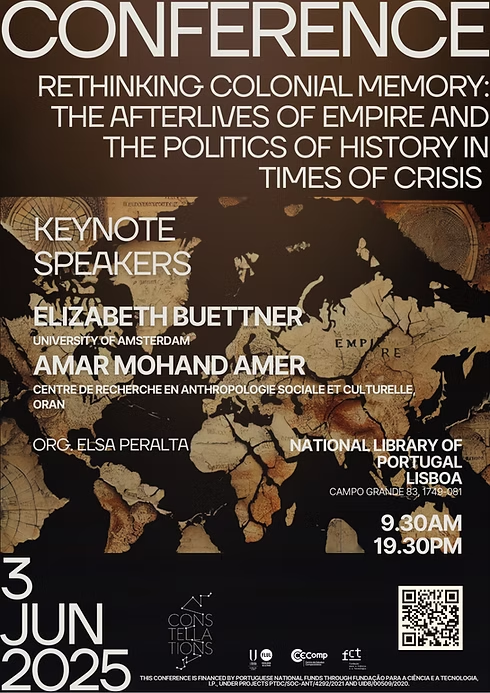
This conference explores how colonial histories continue to remain deeply embedded in the structures of today’s crises, shaping geopolitical conflicts, patterns of violence, systemic inequalities, and struggles for justice. It aims to critically engage with the intersections of colonial memory and historical narratives in relation to the pressing political and ethical dilemmas of our time.
The Atelier KITLV-Framer Framed Artist Residency programme supports innovative and societally relevant projects at the intersection of art and academic research in Southeast Asian and/or Caribbean Studies, with a focus on (post)colonial theory and discourse.
This conference will explore how accessing archives and museum collections can enable communities to recover their past and rekindle “alternative stories” as well as disrupt the discourses constructed by Western views.
At the global Museum & Heritage Awards 2025 the Pitt Rivers Museum won Partnership of the Year for the Maasai Living Cultures Project. The annual award celebrates the best in the world of museums, galleries plus cultural heritage visitor attractions.
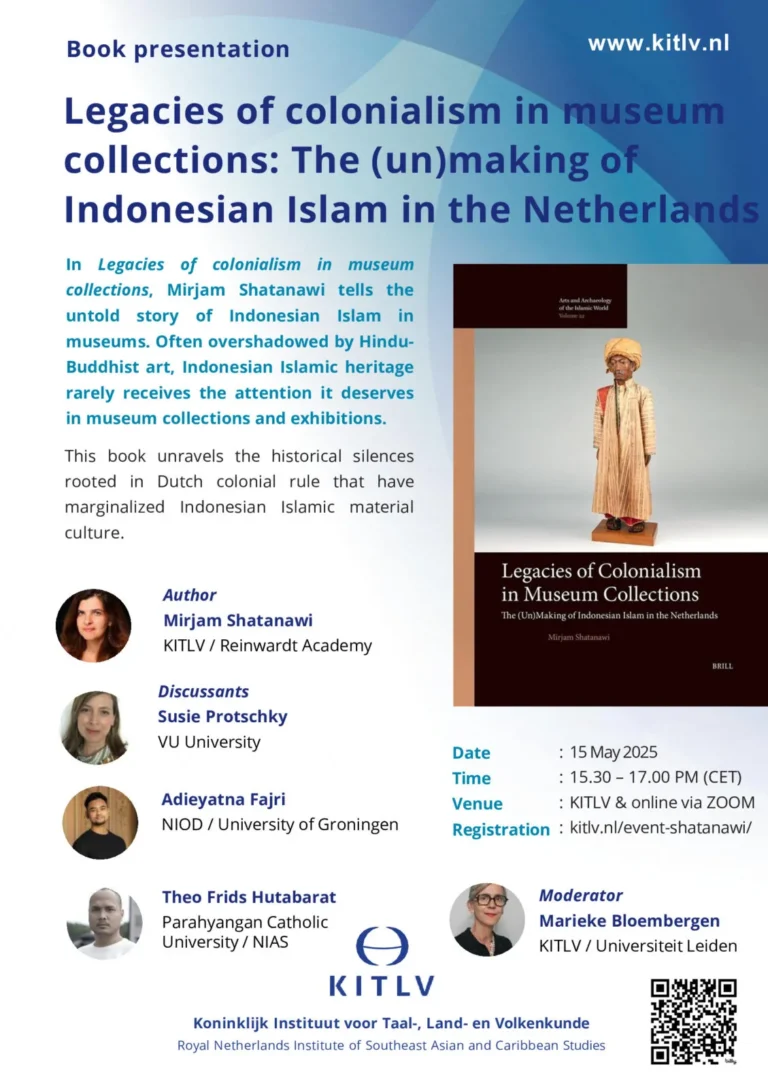
Legacies of colonialism in museum collections: The (un)making of Indonesian Islam in the Netherlands tells the untold story of Indonesian Islam in museums. Often overshadowed by Hindu-Buddhist art, Indonesian Islamic heritage rarely receives the attention it deserves in museum collections and exhibitions.
The exhibition explores the current debate surrounding collections gathered during the colonial period and the question of restitution. Visitors not only learn about the provenance of cultural objects but also to reflect on ownership, value, and the ethical implications of a colonial history that continues to resonate in museum collections today. [ English version and Dutch version ]
Restitution and repatriation are topics of much attention and debate in the world of museums, archives, and cultural heritage institutions. How do music, intangible heritage, and historical sound recordings from colonial contexts fit into these debates?
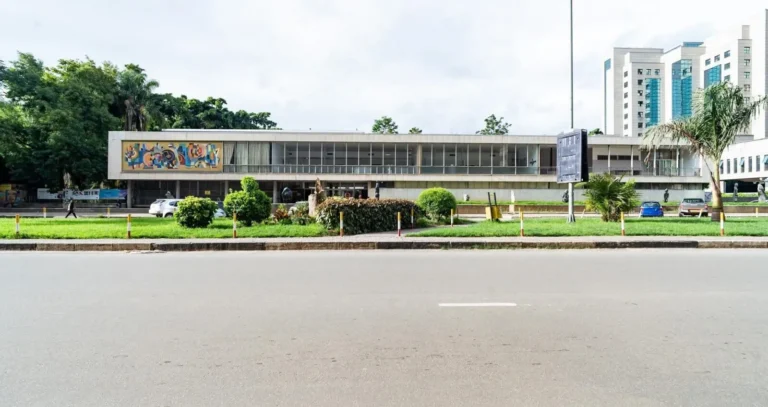
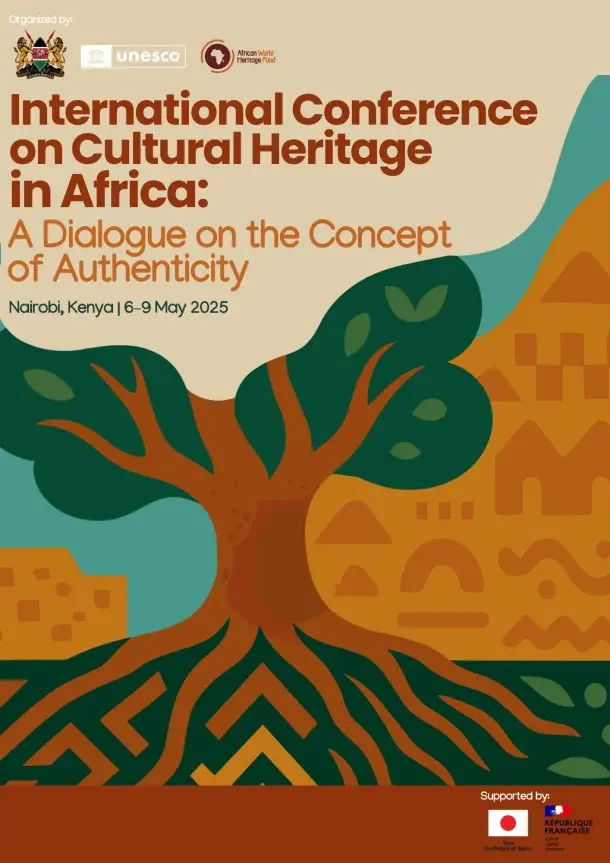
The International Conference on Cultural Heritage in Africa: A Dialogue on the Concept of Authenticity will take place in Nairobi, Kenya, from 6 to 9 May 2025.
International Conference. - Decolonising Cultural Heritage: State of the Art, Methodologies, and Practices”. University for Foreigners of Siena, Italy.
A 1000-year-old statue of the Boddhisattva Guan Yin lives in The British Museum. When it emerges that the statue was stolen from its original home, the museum attempts to deflect both the public response and controversial repatriation claims from the Chinese government.
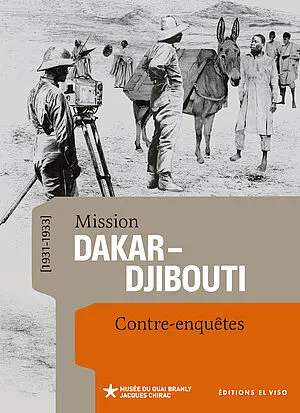
The Paris museum has invited African researchers to study the archives of the expedition, which took place between 1931 and 1933, and to carry out field studies to retrace the conditions of the undercover raid on artifacts.
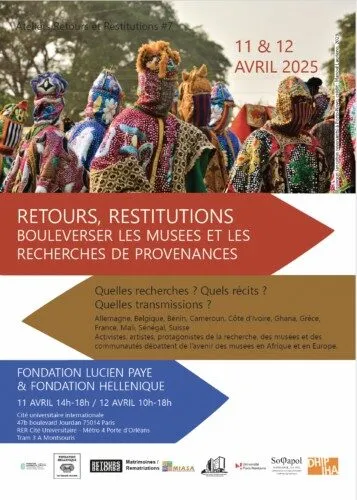
[ conference in French ] Germany, Benin, Cameroon, Ghana, Greece, France, Ivory Coast, Mali, Sénégal, Switzerland - Academics, activists, artists, experts from communities and museum actors debate the future of museums in Africa and in Europe.
The Memory & Heritage Network of Utrecht University and the ERC project Ecologies of Violence: Crimes Against Nature in the Contemporary Cultural Imagination (Eco-Violence) are organizing a workshop on the representation of colonial and ecological violence in museums.
[ simultaneous translation into German, French and English ] 'Hidden paths and emerging networks - Provenance research between memory and responsibility' is the title of the event on the occasion of the 7th International Research Day on the Provenance of Cultural Objects, the Franco-German Research Fund on the Provenance of Sub-Saharan African Objects invites leading scientists and experts working at the intersection of provenance research, restitution issues and museum practices.
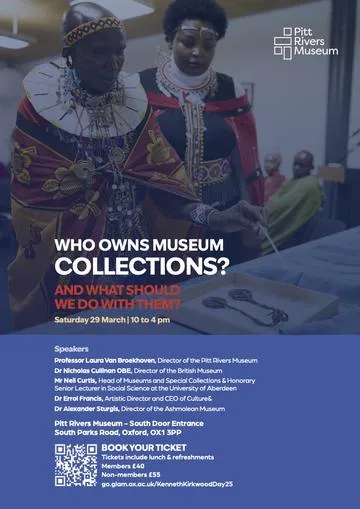
The 2025 Kenneth Kirkwood Day will explore the theme of repatriations, looking at how different museums are approaching this, the language used and if, how and why returns should be made.
[ in French ] Study day organised as part of the PRD-ARES project (ULB-UNILU-UCLouvain) ‘Towards the psychosocial reappropriation and resocialisation by the source-communities of Katanga of the remains of former soldiers to be repatriated and the cultural objects to be recovered’.
The 41st anniversary of the Mary L. Cornille (GRS ’87) Boston University Graduate Symposium in the History of Art & Architecture invites proposals for papers exploring themes of alterity through critically interrogating dominant historical narratives, canonical art prejudices and hegemonic power structures in visual and material culture, and in the field of art history. Deadline 01 February 2025.
How can academics and museum professionals research the provenance of a colonial museum collection? And can we trace possible ‘involuntary loss of possession’ or looted objects?
“Black Paris” retraces the presence and influence of Black artists in France from the 1950s to 2000. The exhibition celebrates 150 black artists coming from Africa, the Americas and the Caribbean.
[ in English and in Dutch ] Science museums are full of skeletons, skulls and other human and animal remains. How were these obtained? Colonial heritage researchers shed new light on that question and come to painful conclusions.
Open Restitution Africa is undertaking a large-scale research project to map past and current restitution undertakings for belongings (material heritage) and human ancestors from the African continent. Deadline 14 March 2025.
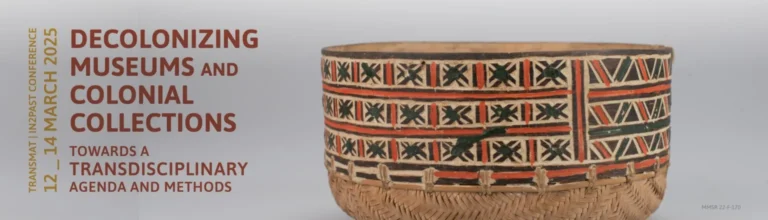
TRANSMAT | IN2PAST 2025 Conference set to take place in March 2025, in Figueira da Foz (Portugal), this international conference is a collaborative effort between colleagues from Institute of Contemporary History, NOVA University, and Évora University (Portugal), Queens College, City University of New York (USA), University of São Paulo (Brazil), and Pitt Rivers Museum, University of Oxford (UK), supported by TheMuseumsLab.
The Symposium will draw together discussion of Holocaust-era looted art and cultural property, antiquities taken in the Colonial-era and subsequently, as well as Native American cultural and religious artifacts, ancestors, and repatriation.
The Cultural Heritage and the Arts Interest Group and the Interest Group on International Law of Culture of the European Society of International Law invite members and interested individuals to a webinar exploring the meanings and significance of provenance research in the current legal debate on the return and restitution of looted cultural objects.
The team of the French-Romanian MA "Politics in a Global Age: States, Borders and Societies", in collaboration with lecturers and researchers from Senegal, Switzerland, France, Belgium is organising a training programme that will take place online and in Marseille and Aix-en-Provence.
Who owns stolen art? Today on the show, the bloody journey of a Benin Bronze from West Africa to the halls of one of England's most elite universities — a tale of imperialism, betrayal, and the making of the modern world.
After receiving a letter from the Thai government, it was not difficult for the Asian Art Museum in San Francisco to determine it was showing looted objects. Before their return the museum holds an exhibition. Is this becoming a trend?
UNESCO, in collaboration with the AfricanUnion and the United Nations Economic Commission for Africa, is hosting a regional dialogue in Addis Ababa, Ethiopia on the new forms of cooperation and agreements in the field of the return and restitution of cultural property in Africa.
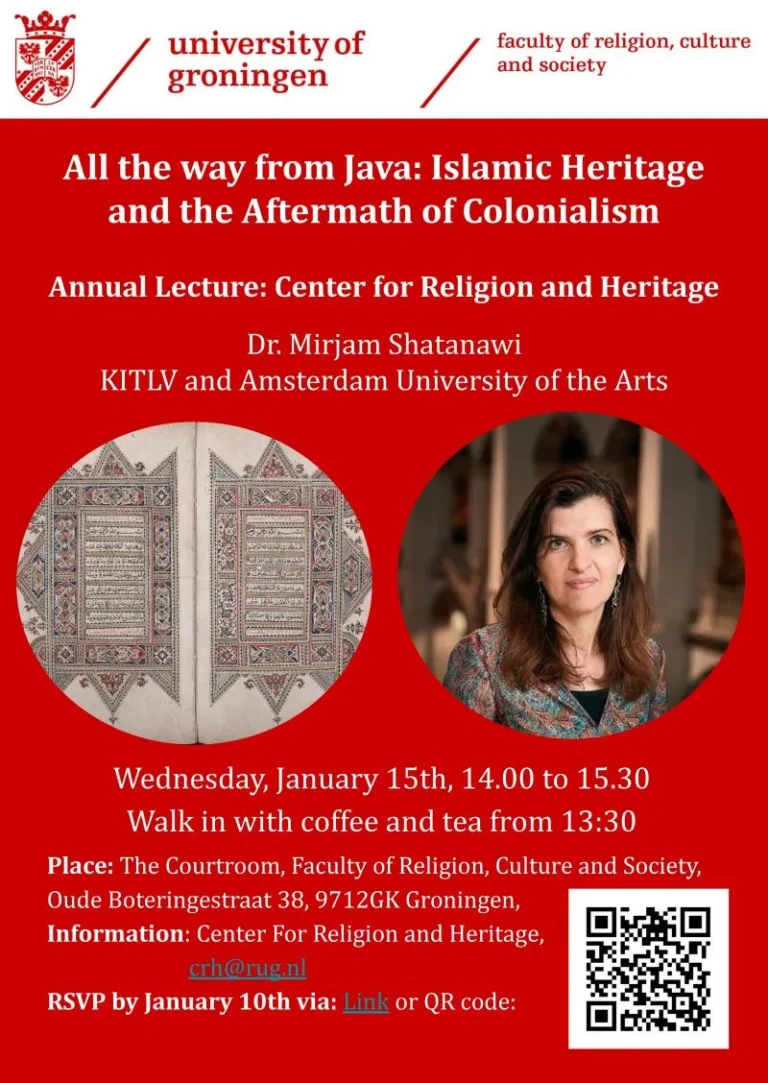
Annual Lecture: Centre for Religion and Heritage by dr. Mirjam Shatanawi
January 15 2025, 14.00-15.30 (coffee and tea, from 13.30)
The “De Grote Indonesië Tentoonstelling” at De Nieuwe Kerk in Amsterdam has faced scrutiny due to its display of seven Buddha heads, allegedly from the Borobudur, lacking contextualisation.
Twelve dadikwakwa-kwa given to Manchester Museum on condition they are not permanently kept behind glass.
This project explores the colonial framework that has shaped our understanding and knowledge of historical objects, focusing on the Lombok Treasures looted from Cakranegara Palace in 1894. Adopting a decolonial perspective, this project reframes these heritage objects as living entities endowed with knowledge and cultural significance, rather than mere relics.
Author Henning Melber in conversation with René Aguigah about his new book "The Long Shadow of German Colonialism".
Conference Sensitive Legacy in University Collections: Adaptation and Restitution, organized by the ANU Centre for European Studies in collaboration with The Urban Memory Foundation and the University of Wroclaw, Poland.
Exactly 130 years ago, the World Exhibition took place in Antwerp. For that occasion, 144 Congolese were exhibited at the KMSKA. Seven Congolese died. The AfricaMuseum, which has a similar colonial history in Tervuren, organizes an online MuseumTalk about the memory and commemoration of this tragedy. The speakers are a researcher, an activist and an artist.
Special exhibition running from 8 November 2024 until 18 May 2025 in Museum Fünf Kontinente, Munich
ETH Zurich's natural history collections house thousands of artefacts from former overseas colonies, including rocks and minerals, insects, animal and plant specimens.
The workshop “People, Objects and Ideas Circulation: Transnational Entanglements between Brazil and Germany”, held in the context of the 200th anniversary of German-speaking people’s immigration to Brazil, offered a fresh perspective to reflect upon the relations between Brazil and Germany.
How did Geneva live through the colonial period? In what ways was the Ethnography Museum a major cultural actor in the colonial context? What is the future of the collections held there? Can we understand today the real identity of an object, sometimes centuries after it entered the Genevan museum collections?
His curation of Benin's Venice Biennale pavilion will draw on the ancient Gelede philosophy of Yoruba Feminism. Beninois artists will produce site-specific works for Benin’s debut pavilion, which will be co-curated by Madame Yassine Lassissi and Franck Houndegla.
The Friends of African and African American Art of the Detroit Institute of Arts’ 2023 nominee for the Margaret Herz Demant African Art Award, Dr. Kwame Tua Opoku, is a retired United Nations Legal Advisor and a recognized voice in African repatriations.
Timor-Leste has a long and complex history of colonial entanglements with the Portuguese, and the number of Portuguese documents related to this is rather big. Their digitalisation will help on both sides.
By looking into museum inventories and archives, The Restitution of Knowledge wishes to document and rethink the history of ‘plunder’ in ethnological collections.
[ in German ] The Roman-Catholic (RC) Institute for World-Church and Mission (IWM) in Frankfurt am Main is running a two-years pilot-project "Mission-History Collections", funded by two RC organisations.
 Françoise Vergès asks if we would not imagine something else for the 21st century that can answer current challenges – climate disaster, neoliberalism, imperialism, financialisation, increasing poverty, new forms of looting and destruction of art – that would not be on the hegemonic model of the Western museum.
At Galeria Avenida da Índia in Lisbon, Uriel Orlow’s exhibition Memória Colateral unfolds like a sensory mapping of historical violence and of how memory is inscribed – or erased – within Western structures.
The Saba Archaeological Center Foundation and the St. Eustatius Department of Culture is looking for a passionate Archaeologist to join our team! Application deadline 25 May 2025
Earn a graduate qualification in Heritage and Memory Studies, and explore issues of remembering the past in the modern world.
[ in Dutch ] As project coordinator participatory appreciation path in Kina museum, Ghent,, you will set up a process that creates space for reflection, discussion and future-oriented proposals that the museum can take forward.
The Franco-German Fund for Provenance Research on cultural belonging from Sub-Saharan Africa has announced the funding of networking and parthership initiatives aimed at fostering the creation of international research teams and strengthening existing partnerships between Germany, France, and Sub-Saharan Africa.
[ in French ] Are you an academic researcher, a person from the museum, private or public, political-diplomatic, community and government sectors, or from the sphere of regional and international cooperation?
This call for contributions to Terroirs, African Journal of Social Sciences and Philosophy, aims to give greater consideration to African perspectives by analyzing citizen mobilizations, artistic initiatives, state strategies, and community practices that shape the return of heritage.
The Allard Pierson is conducting research into the provenance history of the archaeological collections over the period 2023-2027. There is little or no information on the provenance of many of these approximately 19,000 artefacts.
PhD grant associated with the project "Beyond Restitution: Appropriation, Replication, Life, and Exhibition of Colonial Objects in Latin America" in Barcelona. Focus: Colonised countries.
This is a double call: one for Provenance research projects, and one for Networking and partnerships.
The Restituting, Reconnecting, Reimagining Sound Heritage (Re:Sound) project invites applications for three short-term research fellowships aimed at scholars, curators, artists, and source community members from Southeast Asia.
[ in Portuguese ] The exhibition "The Photographic Impulse. (Dis)arrangement of the Colonial Archive" proposes a decolonial reading of the images and scientific objects from geodesy and anthropology expeditions carried out in territories colonized by Portugal.
The lecture series “Heritage and Justice: Unpacking Legal Narratives in Natural History” brings together international scholars with diverse perspectives across legal, ethical, and professional frameworks. It aims to open up a research field and map the complexities that lie at the intersection of law, ethics, politics, sovereignty, and natural history collections.
Central to the project is the repatriation of Papuan artifacts and indigenous technologies from the Baliem, collected by Dr. O.W. Hampton. The collection has received repatriation approval from the Indonesian Ministry of Education, Culture, Research, and Technology and will be transferred to at the Museum Loka Budaya in Papua.
The Botanic Garden Berlin is looking for a Scientific Research Associate for its collections from Togo and Ghana.
Event type
Organiser
Collection
Origin
Currently in
Ownership
Restitution mode
Stakeholders
See More See Less