What changes when museums adopt the language of decolonisation but retain the authority to name, classify and decide?
Adwa Memorial Museum, Addis Ababa:
At the Adwa Memorial Museum in Addis Ababa, the disagreement began after the galleries. In the amphitheatre, Menelik II had been presented by some guides as a “father of Pan-Africanism”. The room did not simply accept the formula. Other genealogies were brought into the discussion: West African, Caribbean, diasporic, intellectual, religious. The exchange became intense enough to expose something larger than a disagreement over one historical figure: even a museum built around resistance can produce a version of history that asks to be believed rather than questioned. In short, an African narrative is not automatically an innocent narrative.
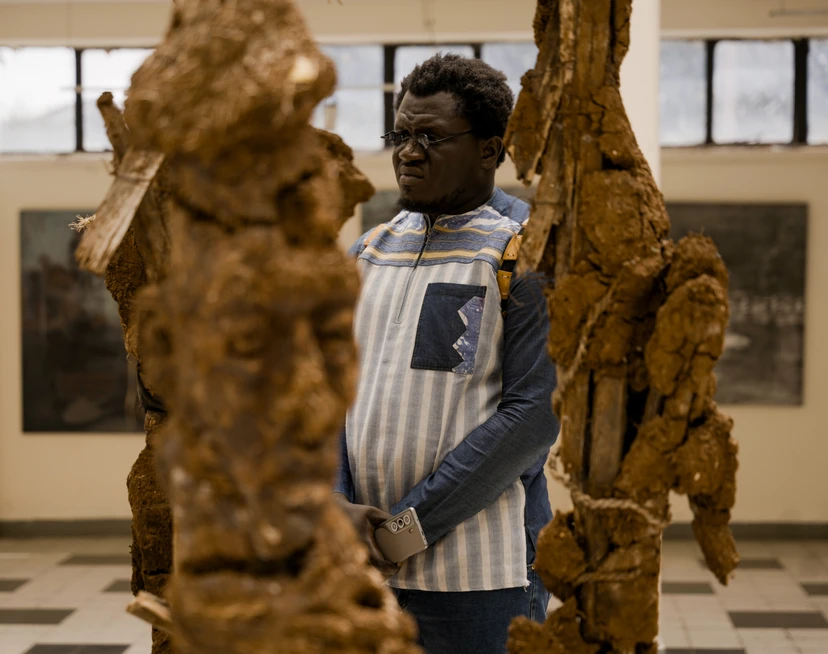
 Discussion in Addis Ababa – Photo by Leul Mekonnen
Museum für Naturkunde, Berlin:
At the Museum für Naturkunde in Berlin, one of our sessions dealt with what were described as “awkward archives”. The phrase stayed with me.
We were not debating whether colonial violence had existed. The harder problem was what museums do once that violence has been acknowledged. Collections can be recontextualised, archives reopened, labels rewritten and provenance investigated. And yet the institution may still remain the final authority on what the material is, what it means and how it should be known.
Museum of World Culture, Gothenburg:
My residency at the Museum of World Culture in Gothenburg placed me in a different situation. Here, the discomfort did not come from an institution ignoring communities. On the contrary.
I encountered serious attempts to reconsider representation, collaboration and the relationship between the museum and the people whose cultures appear in its collections. The Crossroads project brought these questions directly into our discussions. And precisely because participation was already present, another question became unavoidable: Where does community authority stop?
Alioune Samb is museum curator and Haed of the Conservation and Documentation Unit of the Centre de Recherche et de Documentation du Sénégal [CRDS] and alumnus and residency host of TheMuseumsLab.
His journey through museums in three cities inspired him to write the song Debate and Unity.