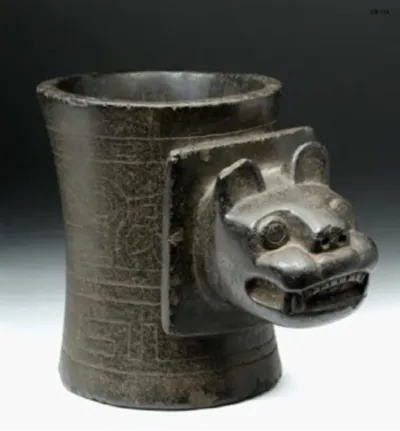
An artefact taken from the ruins of Tiwanaku and illegally exported from Bolivia more than 70 years ago has been seized by Australian customs officers and found by Australia’s highest court to be liable to forfeiture under modern movable heritage laws.
The artefact had been bought online by an Australian company, Palmanova Pty Ltd, from a gallery in Colorado in June 2020 for USD$17,340.

The pre-Columbian artefact from Tiwanaku
The item was shipped to Australia where it was intercepted by customs officers on arrival. The Australian Commonwealth Government subsequently received a request from the Government of Bolivia for the artefact to be returned to Bolivia. Australian Customs provided the artefact to an inspector appointed under the Act.
Their Honours noted, at [37]-[38] of the High Court judgment, that the first instance trial judge:
“found on the balance of probabilities that the Artefact is pre-Columbian in origin, having been manufactured by people of the Tiwanaku civilisation whose culture centred around the ancient city of Tiwanaku on the shore of Lake Titicaca in what is now modern-day Bolivia and rose to prominence between 600 and 1000 AD. His Honour characterised the Artefact as ‘an exceptional and unique piece of archaeological significance’. On that basis, his Honour found the Artefact to form part of the ‘movable cultural heritage’ of Bolivia and therefore to be a ‘protected object of a foreign country’ within the meaning of the Act.
Perram J further found on the balance of probabilities that the Artefact was removed from the ruins of the city of Tiwanaku in contravention of a Bolivian statute of 1906 entitled ‘Law of Property of the Nation, Ruins of Tiahuanaco and Lake Titicaca’. The removal was either by an identified archaeologist in the course of excavating the site in 1934 or by looters in or around 1950. Whether removed in 1934 or in or around 1950, the Artefact had been exported from Bolivia to Argentina by some time in the 1950s.”