Since 2012, Lukas Eleuwarin and others in the Netherlands have been putting together pieces of the story behind an object of a famous ancestor, Toran Knir. Eleuwarin works at the Dutch Centre for Intangible Heritage, is creative founder of the Knowledge By Roots (KBR) brand and a member of the Moluccan-Dutch diaspora foundation Sukarela Dian Darat. Dian on Kei Kecil Island is the name of his ancestors’ village.
Customary law
Eleuwarin shows a lengthy letter by the chief of the sub-district in which Dian lies, dated August 2023, in which the chief expresses his wish for the object to return to the region. He underpins his wish with a reference to Indonesia’s constitution and the role of customary law, Adat.
According to the constitution, a village can be a customary law community ‘bound because of genealogical and territorial relationships’, can ‘regulate and decide on issues related to Adat and culture’ and possesses a certain autonomy. In a letter, dated October 2023, the Southeast Maluku District Cultural Office builds on the chief’s letter and confirms that the object in question was indeed a historical object from Dian village.
More than a trident
At that moment, all that is known is that the object is in the Netherlands but no one knows where. Is it in a museum, in the trade, gathering dust in an attic, or – worse – disappeared in a dustbin somewhere?
In June 2015, something happened. ‘First, I had a dream in which I held the object in my hand. In the same week I received a message from my cousin that she had found something in the archives of the Wereldmuseum Amsterdam: inventory number TM-1427-6. It was the object we were looking for.’ Eleuwarin sought contact with the museum, which was willing to cooperate.
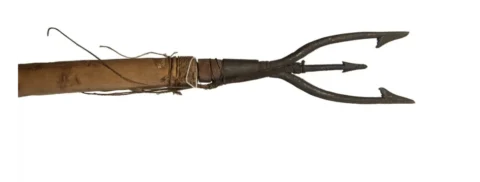
On the Wereldmuseum’s website, TM-1427-6 reads: ‘hunting with weapons’, the Dutch version mentions ‘drietandige harpoen bestemd voor de visvangst’ (three-toothed harpoon intended for fishing). Origine: Kei Islands, Indonesian province of Maluku. Arrival at Wereldmuseum Amsterdam. Donation in 1929.
The harpoon is one of the museum’s nearly 450,000 objects, and one of the very, very many that have never been exhibited because the museum knew nothing about it.
Eleuwarin: ‘The harpoon was a fish-catching instrument in peacetime and became a spear in wars. For us the spear is more important than the harpoon.’
Fighting the Dutch East India Company
In a film made in 2021, Knowledge by Roots, Eleuwarin recounts a vision one of his cousins had about the need to bring back the spear and other items of their ancestors to their village. Some of his relatives began to search in 2010, and found objects on Ceram, other nearby islands and even as far as Saparua island.
Eleuwarin: ‘The Eleuw-clan has a famous ancestor, Toran Knir, who lived around 1450, and TM-1427-6 is his spear. It passed from generation to generation, and was used in the infamous Huamual War (1602-1656) by another Eleuw-ancestor, Waneran. Huamual was a kingdom with 99 villages. The war was a major confrontation over the clove trade which the Moluccans fought against the Portuguese and later against the Dutch East India Company (VOC). Villages were burnt down, its inhabitants murdered, enslaved or expelled.’
‘Later, a local captain from Ceram Island brought the spear to Saparua. There, Pattimura (nowadays a national hero in Indonesia) dealt a big blow to the Dutch military, but was captured and executed shortly afterwards. This occurred in 1817. Knir’s weapon was said to have been seized then and there, and taken to the Netherlands as a war trophy.’ Whereas some ancient objects have been found in nearby villages and brought back to Dian village, the spear is still missing there.
Lengthy road 1: Indonesia
Since the Wereldmuseum’s collection is part of the Dutch national collection, returning an item is a matter between two governments. Instead of directly negotiating with the Wereldmuseum, the local authorities, helped by the Sukarela Dian Darat foundation, therefore have to take the royal and the presidential route. To begin with, they have to submit the claim to the Tim Repatriasi, Indonesia’s government restitution committee in Jakarta, and to make sure it passes it to the Netherlands.
They have done this already, but that was to the former Tim Repatriasi that functioned until the 2024 elections. With the new government, officials in the Tim have been replaced by new ones. Unlike the old Tim, the new one is fully integrated in the Ministry of Culture. New minister Fadli Zon told me recently that he will intensify the number of claims to the Netherlands. Apparently, he is keen to keep an eye on it.
To ensure that the new Tim Repatriasi is aware of the claim, Lukas Eleuwarin and Gerry Keroeboen, also of the Moluccan-Dutch diaspora group Sukarela Dian Darat, handed it over to Ratih Astary, cultural attaché of the Indonesian embassy in The Hague, on 13 June 2025.
Lengthy road 2: Netherlands
They will have to wait until the new Tim passes on the claim to the Netherlands. As soon as the Dutch minister for Culture receives it, his advisory Committee Colonial Collections will get to work and ask the Wereldmuseum ‘to send provenance research already available or put out a request for provenance research to the collection manager if it is not yet available’.
It will complement the findings of the local authorities and the Sukarela Dian Darat foundation with its own, and submit its report to Indonesian and local authorities for comments.
The advisory Committee will then conclude whether there has been ‘involuntary loss of possession’. That seems pretty clear in this case. If the minister adopts the advice, the road to restitution on the Dutch side is open.
The Wereldmuseum works closely with the Moluccan-Dutch diaspora group and in 2024 Knowledge By Roots made a film, The 1621 Saga continues, about the spear inside the museum (1621 is the year of the Genocide on Banda).
Currently, the museum is doing its own research into the object’s history and into the age of the wood, iron and fiber it is made of, and then will compare its findings with those of the Moluccans.
Lengthy road 3: Indonesia
Now a crucial phase begins. Indonesia’s culture minister must decide where the object will stay after its return: at the Museum Nasional Indonesia or at the regional Siwa Lima Museum in Maluku. So far, all objects that are returned have remained in Jakarta, despite protests from the descendants of, for example, the king of Klungkung who find it hard to accept that a precious king’s kris has not been returned to them.
To increase the chances of the spear/triangle returning to Maluku Province, the Siwa Lima Museum in Ambon will have to petition the Ministry of Culture. If successful, it will be the first time that an object negotiated between the governments of Indonesia and the Netherlands will be returned directly to its community of origin.
-.-
Giving back is important, concludes Eleuwarin. ‘The community in Dian is full of hope for it, both as an heirloom and as a living symbol of pride, belonging and restoration of historical dignity.’
The spear/trident is a real test-case, for the Netherlands and even more so for Indonesia.
- P.S. This Blog is partially based on Lukas Eleuwarin’s archive, which contains the correspondence in Bahasa from district and sub-district authorities in Maluku with Tim Repatriasi.

