An independent commission has revealed that the Dutch Royal Family possesses one thousand objects from the former colonies. Although most were ‘donated’ at the time, a few dozens of objects are booty of war and were taken by colonial officials and soldiers during military confrontations.
The 'Oceania and Indonesia' holdings in Altenburg (approx. 350 objects) and the entire ethnographic collection (approx. 250 objects) in Meerane will be examined. The initial check follows a research project on the Africa collection in Altenburg and the recommendation by ethnologist Ms Dolz from the State Ethnographic Collections of Saxony for Meerane.
The Expertise Center for Restitution (ECR) of the NIOD Institute for War, Holocaust and Genocide Studies and Resistance Museum Amsterdam present Robbery Art Ontrafeld, a lecture series that focuses on the less exposed aspects of loot art and restitution.
Historians associated with the NIOD present recent research and surprising insights and enter into dialogue with the public, led by moderator Yuki Kho.
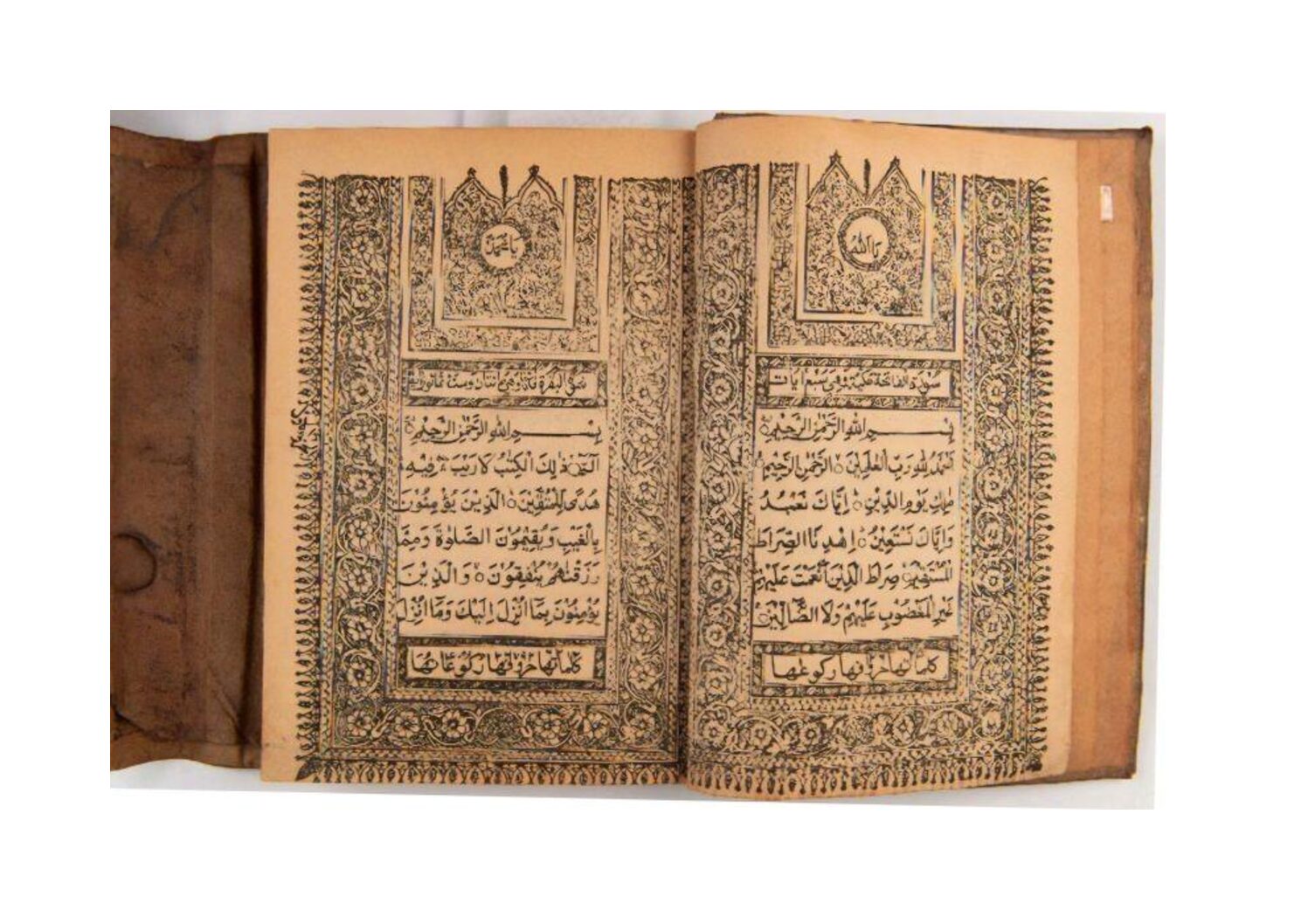
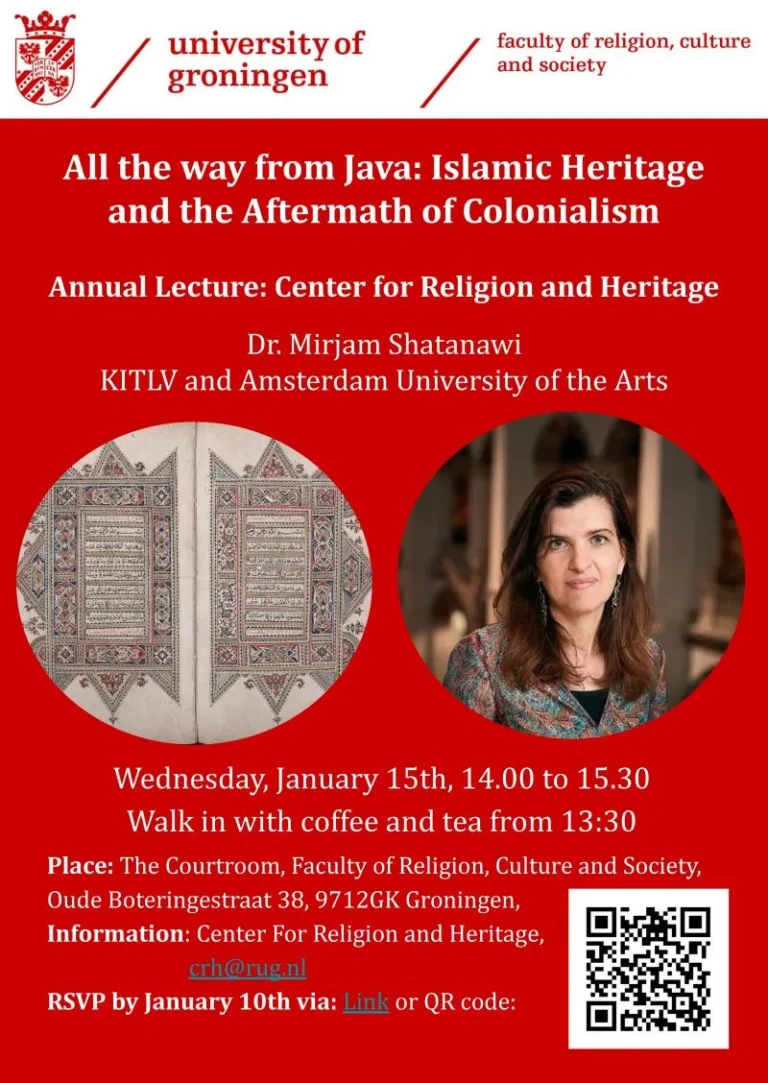
Mirjam Shatanawi gives an overview of Islamic collections in the Netherlands, focusing on their presence in museums, libraries, and archives. It provides a critical overview of how these collections have been shaped, preserved, and interpreted, with particular attention to the enduring influence of colonial perspectives on Indonesian Islamic traditions. Examples will be given of objects from Java, Sumatra and South Sulawesi.
Prof. I Nyoman Aryawibawa emphasized that lontar manuscripts are invaluable sources of traditional knowledge with significant historical, philological, and cultural value. This donation is considered a strategic step in strengthening the faculty’s academic functions, particularly in supporting research, teaching, and community service based on local cultural heritage.
In 2022, the Republic of Indonesia submitted an official application for the collection’s restitution after which the Dutch State Secretary for Culture requested the Colonial Collections Committee to provide advice on this request. In 2025, the Netherlands transferred it to Indonesia. This Blog offers a reflection.
This paper investigates the political and cultural grounds in disseminating manuscripts’ digital copies and ask what kinds of shifting assumptions about the nature of textuality and manuscripts are indicated by digital returns. This is especially relevant given that some manuscripts in traditional Java, those designated as pusaka, are not merely media transmitting textual information. Rather, their materiality contains a power of its own.
Through the case of the Palembang Sultanate in Sumatra, Alan Darmawan investigates the extant manuscripts originating from the palace library. Some moved into the hands of private owners in Palembang, while others were dispersed into colonial collections in Europe and Southeast Asia.
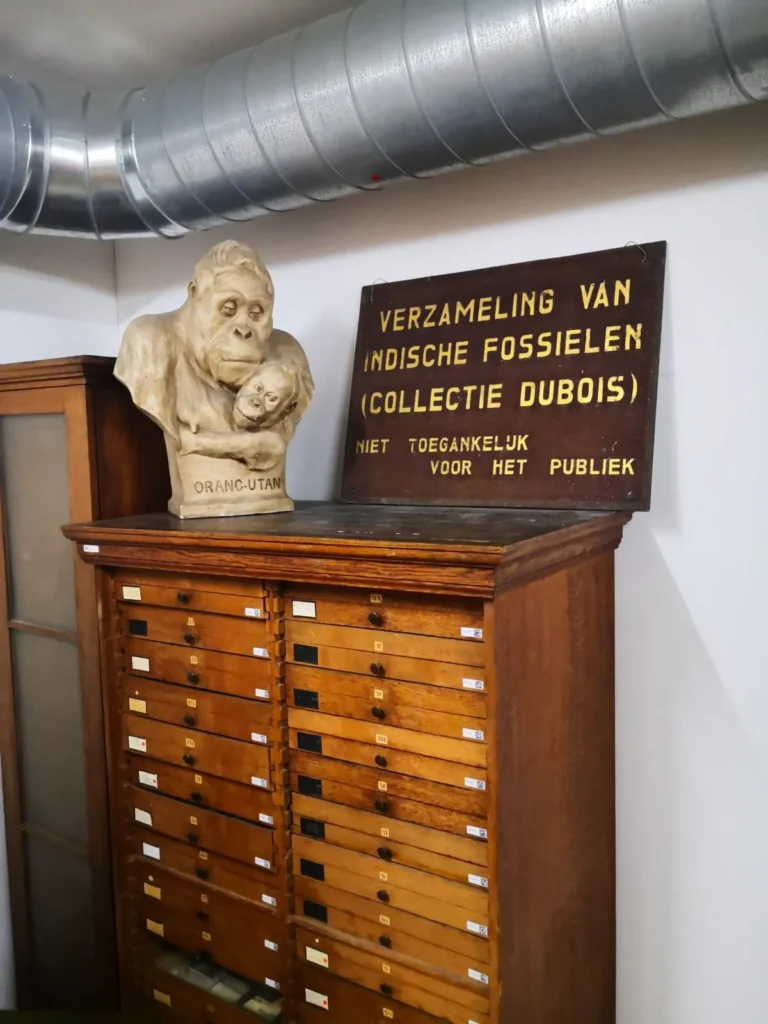
Naturalis Marcel Beukeboom: “We will take time to think of a new story to tell. That story will most likely include references to the evolution and early humans, and may also address colonialism and perhaps even the influence of Dubois. But without his collection, and with everything we have learned, this will be a different story.”
Rodney Westerlaken writes: The return of the Dubois Collection: principled restitution, unresolved policy questions: – At what point does scientific heritage become cultural heritage? – Which criteria should govern this classification, and by whom are they determined? - How can restitution frameworks avoid becoming normatively expansive without sufficient conceptual precision?
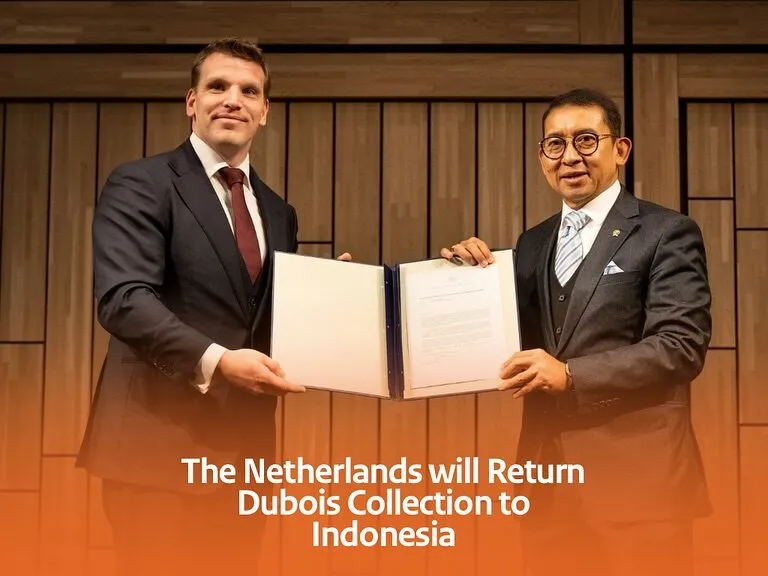
Four important objects from the Dubois collection were handed over to Indonesia on Wednesday 17 December. The handover ceremony took place at the National Museum of Indonesia in Jakarta, which will exhibit the objects.
The Indonesian phrase pasang surut — “the tide in and out” — evokes the continuous movement of people, objects, and ideas across the seas that once linked Europe and the Indonesian archipelago. These currents shaped the emergence of colonial collections but also suggest the possibility of renewed circulation: of knowledge, accountability, and dialogue.
All too often, the literature on the restitution of colonial cultural objects tends to focus on the public international law (PubIIL) aspects of the debate. With a few notable exceptions, the PubIIL and private international law (PIL) dimensions of the debate are rarely considered together. This article makes the case for a coordinated approach.
[ in Dutch] Due to the death of Otto van der Mieden on February 1, 2024, the founder and director of the Puppetry Museum, the museum is closed and the collection is being deaccessioned.
In this Spark Session Made Naraya Sumaniaka presents his thesis work, which recentres community agency by examining how digital spaces enable participation and contestation using the newly established Colonial Collections Datahub and TikTok as case studies.
This project explores the colonial framework that has shaped our understanding and knowledge of historical objects, focusing on the Lombok Treasures looted from Cakranegara Palace in 1894. Adopting a decolonial perspective, this project reframes these heritage objects as living entities endowed with knowledge and cultural significance, rather than mere relics.
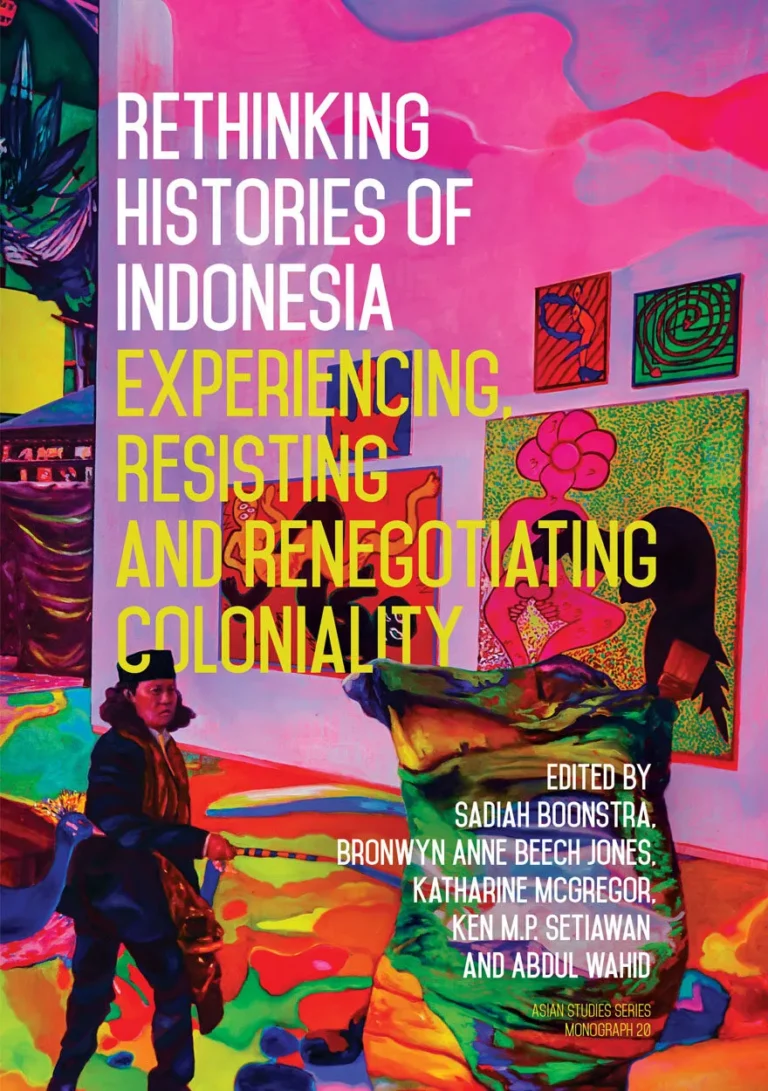
In 'Rethinking Histories of Indonesia - Experiencing, Resisting and Renegotiating Coloniality', editors Sadiah Boonstra and others provide a critical evaluation of histories of Indonesia from the formal period of colonisation to the present day. The volume approaches Indonesian history through the lens of coloniality, or the structures of power and control that underpin colonisation and which persist into the present.
[ in Dutch ]'Dutch' fossils soon to be seen again in Indonesia: 'Young people here only know the Javaman from textbooks'
Indonesia will soon receive thousands of fossils that are still in museum Naturalis. It is a historic moment for his country, says Indonesian paleontologist Sofwan Noerwidi.
On 26 September 2025, the Dutch government returned 28,000 fossils, including the famous skullcap, a molar, and a thighbone (the so-called Java Man), to Indonesia following an official claim submitted by the Indonesian state in July 2022. They were part of the collection of Naturalis Biodiversity Centre in Leiden. With this, the government followed the advice of the Colonial Collections Committee. Now that the dust about this massive return has begun to settle, it is time for some reflection. I consider the acceptance of the advice of the independent Colonial Collections Committee groundbreaking in several respects.
[ in Dutch ] At the Indonesian Ministry of Culture, they can't count on their luck. The Netherlands returns an important archaeological find to Indonesia. It concerns the skullcap of Dubois, named after the Dutch finder Eugène Dubois. This proved in 1891 that other humanos had existed, which Dubois called the Javamen.
[ in Dutch ] The restitution process of the Dubois collection took an unusually long time. The responsible advisory committee and Naturalis point out the complexity of the case, experts make sharp accusations against the museum.
[ links are in Dutch or in English ] Today, Dutch Minister Moes (Education, Culture and Science) presented a letter to Indonesian Minister Fadli Zon (Culture) announcing this decision. The so-called Dubois collection is now managed by Naturalis Biodiversity Center in the city of Leiden.
‘The most valuable Buginese manuscript of La Galigo, is held at Leiden University Library’ in the Netherlands, the university proudly communicates. It has come from Makassar on the Indonesian island of Sulawesi. For the Bugis who live there, it is an essential part of their history. But they have no access to it. A local group with academics, heritage professionals and activists in Makassar has begun to discuss its future. For them the repatriation of meaning is crucial. And this is only possible if the Dutch recognise their responsibility.
Restitutions of colonial loot by Japan to former colonial possessions? Yes, that has happened and is still happening: manuscripts and objects to South Korea and China, ancestral remains to groups within Japan’s own borders. News about it is quite rare. What is actually known about the colonial collections and restitution practice of this former colonial power in the Far East?
This article about 500 palm-leaf manuscripts, looted during the conquest of Lombok by the Netherlands East Indies in 1894, is especially urgent as the demand for provenance research grows. It helps to better understand the complex historical trajectories of these cultural heritage objects.
La Galigo, an Bugis text, is poetry, written on palm leaves in Bugis language and is considered to be the most voluminous literary work in the world. But the majority of the manuscripts are stored in Leiden University, The Netherlands.
The international seminar Critical Studies on Provenance, History, and Cultural Heritage focused on the role of provenance research in cultural heritage and repatriation efforts. Organized with several Indonesian universities and professional associations, the event highlighted how tracing the origin of cultural artifacts is essential for repatriation claims—particularly in light of Dutch colonial history and recent returns of Indonesian objects.
A diaspora group discovers an object in the Wereldmuseum Amsterdam’s collection that the village of origin in Indonesia dearly misses. As it belongs to the Dutch national collection, its return requires the signature of the minister of Education, Culture and Science. But he only signs if the Indonesian minister of Culture supports the claim. After return, the latter must decide whether to deviate from the policy that returned objects are kept at the Museum Nasional Indonesia in Jakarta. Only then can the object go back to its village of origin. An interim report about a journey whose outcome no one yet knows.
Minister of Culture Fadli Zon announced significant progress in repatriating Indonesian cultural artifacts from the Netherlands after bilateral talks with the Dutch Colonial Collections Committee (CCC) in Jakarta.
Within the national museum context, the Repatriasi exhibition risks becoming a missed opportunity to critically engage with the afterlives of returned objects, beyond marking their physical return.
Experts in Basel have found four plant collections belonging to the two naturalists Fritz and Paul Sarasin that were thought to be lost. Until now, scientists had assumed that these pocket herbaria were destroyed in Berlin during the Second World War.
During the 19th century colonial wars, the library of the rulers of Palembang in Sumatra was looted by British and Dutch troops; its manuscripts were transported to other places and some of them are lost. Alan Darmawan looks for traces of some of these mishandled treasures.
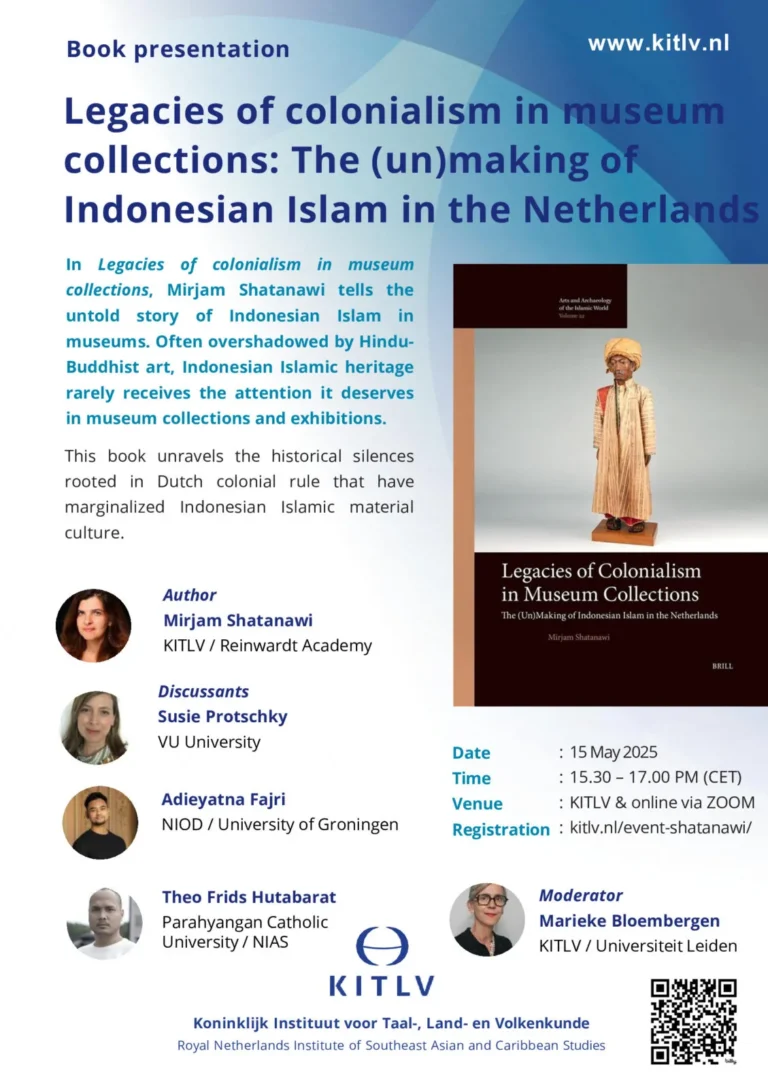
Legacies of colonialism in museum collections: The (un)making of Indonesian Islam in the Netherlands tells the untold story of Indonesian Islam in museums. Often overshadowed by Hindu-Buddhist art, Indonesian Islamic heritage rarely receives the attention it deserves in museum collections and exhibitions.
Zainab Tahir: The Marine Heritage Gallery, a gallery managed by the Ministry of Marine Affairs and Fisheries in Jakarta, sparked conversation about the complexities surrounding the display of three thousand commercially salvaged artefacts.
Restitution and repatriation are topics of much attention and debate in the world of museums, archives, and cultural heritage institutions. How do music, intangible heritage, and historical sound recordings from colonial contexts fit into these debates?
A European art collector challenged Conan Cheong's commendation of the Dutch Government’s return of the Singhosari stone Bhairava, Nandi, Ganesha and Brahma statues to Indonesia the year before.
European governments negotiate restitutions only with the governments of countries of origin. The collections they negotiate usually are state-owned and contain valuable, not rarely iconic objects. The path followed by governments of former colonies is quite similar. It is the path of what Laurajane Smith called the authorized heritage discourse (AHD), where only a limited part of a country’s heritage dominates in national narratives and public policies. This approach has serious limitations.
When repatriation has been largely framed within nation-state contexts, what does it mean to truly foster inclusivity in this process? Is it essential to involve the communities directly affected for such inclusivity to be achieved? What insights can we gain from community-led repatriations regarding local priorities, needs, and cultural practices?
The report offers an overview of the restitutions and claims processed in the Netherlands until recently, and the legal framework in which they took place.
The State-centric discourse that surrounds Indonesia’s cultural heritage protection and repatriation policies impede locally-led activism related to cultural heritage.
Jakarta welcomes the Dutch returns. ‘The return is part of a broader agreement between Indonesia and the Netherlands in 1975. That deal, though, faced many obstacles in its implementation, said Sri Margana, a member of Indonesia’s Repatriation Committee and professor of history at Gadjah Mada University in Yogyakarta.
‘In 1894, two colonising powers faced each other across the narrow strait between the islands of Bali and Lombok. One was the Netherlands East Indies, the other the kingdom of Lombok, ruled by a settler regime from Bali that dominated the island’s indigenous Sasak population.'
[ in English and in Dutch ] The Indonesian Repatriasi Commission and Naturalis will work together to explore how the importance of the Homo erectus fossils from the Dubois collection can best be safeguarded for Indonesia, the Netherlands and the rest of the world.
During the European expansion constant fighting and violence and the taking of spoils of war went hand-in-hand. Palaces, shrines, homesteads and entire villages were plundered and destroyed. In the restitution debate, the focus is mostly on state-collections resulting from these confrontations. There is ample evidence, however, that many more parties were involved. This blogpost has some of the evidence.
Many European countries deal with their colonial history and their collections of ethnographic material. As much as human remains seem like the essence of the need to do reparations to indigenous cultures, they are but a small part of the responsibility to understand our entangled histories
[ in Dutch ] This thesis on the Watson collection shows that even smaller non-ethnographic museums such as the Noordbrabants Museum of art, culture and history have collections from colonial areas.
[ in French ] Indonesia is pursuing a process of complete repatriation of cultural works looted during the colonial period. By mid-December, 828 objects had been returned by the Netherlands, according to the Indonesian Heritage Agency.
Hundreds of Indonesian artefacts that were in the Netherlands for more than a century - the bulk of which were looted by the Dutch during their colonial rule - are now on display at Indonesia’s National Museum in Jakarta. They are among the latest batch of items returned after a lengthy process involving both countries.
This e-report of the international conference 'Museum Forward International Best Practice Forum on Museums & Heritage' in Jakarta gives a clear insight into Indonesia's cultural policy.
Cynthia Scott analyzes the history of the negotiations that led to the atypical return of colonial-era cultural property from the Netherlands to Indonesia in the 1970s. By doing so, the book shows that competing visions of post-colonial redress were contested throughout the era of post-World War II decolonization.
[ in Dutch ] The Dutch city of Rotterdam returns 66 looted objects from the municipal collection to Indonesia. They were looted by the Dutch army. The municipal government chooses to follow the State's return rules.
Culture Minister Fadli Zon told lawmakers that the United Kingdom is unwilling to repatriate historical artifacts and other antiquities taken from Indonesia in the 19th century. UK troops, led by Thomas Stamford Raffles, raided the Yogyakarta Palace in June 1812, seizing valuable items, including historic manuscripts.
[ in Dutch ] Fifteen skulls originating from the Moluccas have been returned to the island group Tanimbar. These skulls had been part of the collection of Museum Vrolik, the anatomical museum of Amsterdam University Medical Centre, since the very early 20th century.
[ in Dutch ] In colonial times, thousands of human remains ended up in Dutch museums. Soon, Moluccan activists will bring back 15 skulls single-handedly.
Advisory reports from the Colonial Collections Committee on objects for which restitution has been requested by Indonesia. The provenance reports have been added as an appendix.
The “De Grote Indonesië Tentoonstelling” at De Nieuwe Kerk in Amsterdam has faced scrutiny due to its display of seven Buddha heads, allegedly from the Borobudur, lacking contextualisation.