In 2000, the Louvre inaugurated the Pavillon des Sessions to display artworks from Africa, Asia, Oceania and the Americas. This ‘universal’ museum thereby extended its reach to include the cultures of every continent.
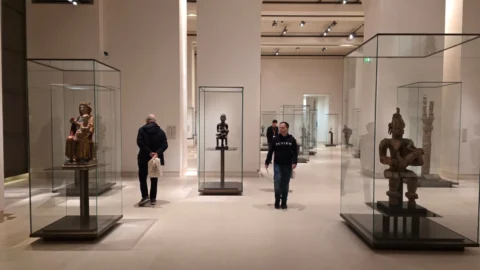
A quarter century later, it reopened and renamed it into Gallery of the Five Continents. The architect is French, Jean-Michel Wilmotte. The museums shows its new intentions with a statement of the Senegalese philosopher, Souleymane Bachir Diagne: ‘The universal to be invented together must arise from the world’s plurality’.
Many of the 120 pieces at display echo a manifesto by Jacques Kerchache, who made the first layout of the Pavillion in the 1990s, entitled ‘The world’s masterpieces are born free and equal’. Maybe they were born free and equal, but the acquisition of many occurred in a violent context.

The layout emphasizes the main feature of a layout that aims to be fully ‘inclusive’: non-European objects are now accompanied by objects created in Europe to illustrate ‘universal’ themes whose transversality across different cultures is highlighted: birth/death, belief, authority, prestige, fate, understanding the world, appeasing nature, passing through worlds.
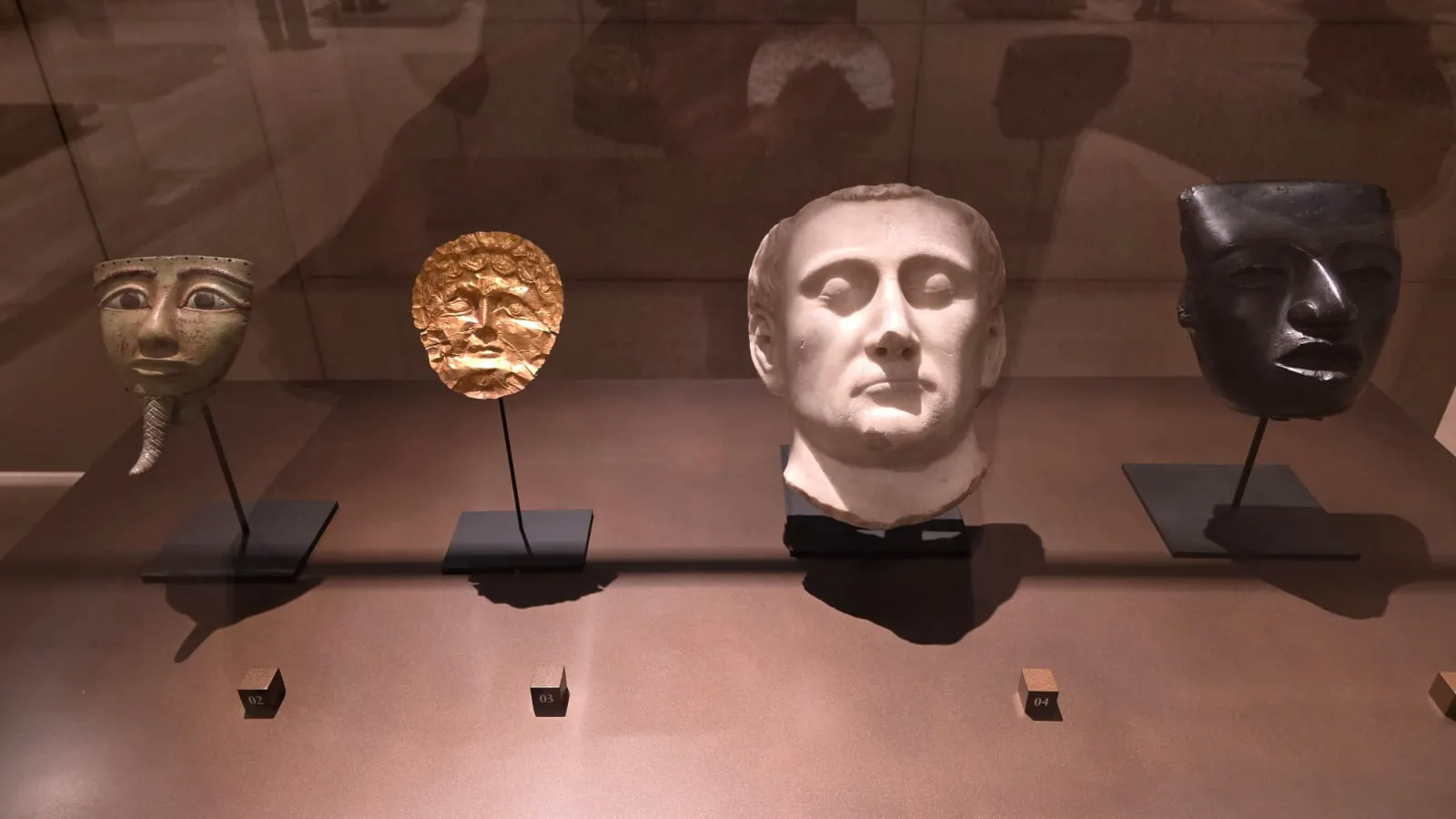
Thus, for example, in the section called “naître, mourir” (to be born, to die), a display case contains:
- an Egyptian faience mask made between 760 and 520 BC
- a gold leaf mask from Syria from the 1st-2nd century AD
- a marble head from Champagne from the 14th century
- a stone mask from the Teotihuacan culture dating from between 200 and 600

Risky dialogue
Unfortunately, the goal that the juxtaposition of objects distant in time and space can produce a ‘dialogue’ between cultural traditions so far apart risks becoming a simplification that flattens rather than expresses the complexity of specific cultures without managing to illuminate any connections. (Incidentally, from a museographic point of view, the solution adopted in Paris reproduces, without innovations, the one adopted in the permanent collection of the Louvre Abu Dhabi).
The objects, all of great cultural importance and visual impact, are displayed in a way that continues to inexorably characterize them as ‘masterpieces’, in full continuity with the aesthetic re- semantization typical of the Western gaze.
It is, after all, the exhibition logic of the Western museum that almost never manages to overcome a categorization that does not exist in other cultures (works of art, ethnographic materials, naturalistic finds, etc.).
Meanwhile, the exhibition texts define 19th- and 20th-century colonial archaeology in exclusively positive terms as a discipline that broadened horizons and transformed ‘curiosities’ into ‘antiquities’.
Amputated objects biographies
In this context, it is no surprise that where the captions of the objects refer to the history of the collections, there is no mention of any requests for restitution.

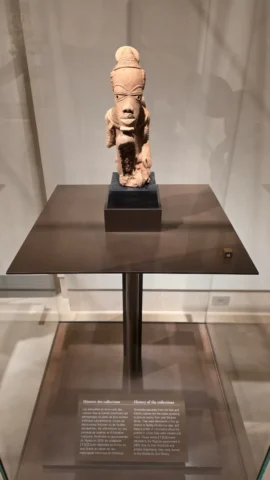
- Not even in reference to the Benin plaque, whose violent acquisition by British army in 1897 is mentioned, but not the repeated requests by Nigeria and the Benin Court for restitution.
- Nor in reference to the Nok culture sculpture, at the centre of a diplomatic scandal between France and Nigeria in the late 1990s, because it was a purchase (together with two Sokoto pieces) from a dealer in Brussels, even though it was known to be the result of illicit export. The buyer was Jacques Kerchache, who had President Jacques Chirac’s approval.
Hierarchy continued
In the writer’s opinion (I visited the Gallery more times during the last week of December) the ‘new’ universal proposed by the Galerie des Cinq Continents continues to express a Western vision that claims to ‘elevate’ other cultures by granting them admission to the sancta sanctorum of European art.
Also due to the many gaps and ambiguities in the exhibition texts, the Galerie as a whole does not depart as it should have from either the exhibition grammar or the epistemological ideology of the previous Pavillon du Sessions.
For these reasons this re-organization fails to produce an updated reflection on the theme of decolonization, nor to offer a pluriversal, or at least not exclusively Western, reading of the non-European materials.
All pictures by Maria Pia Guermandi and Daniele Longo