[in Dutch] Based on a November 2024 advise of the Council for Culture, the Dutch Minister for Culture has adopted a new policy on dealing with archives, which are the property of the Dutch State, but are considered shared heritage with their regions of origin. Two restitution requests have been submitted already.
Livia Solaro investigates how a museum—especially one with a problematic past, such as an ethnographic institution—can critically confront its colonial heritage while keeping the public informed and actively involved in the process.
In this moderator-led discussion, we examine the mechanics of memory, looking at how history is recorded and retrieved. With Kwame Boafo, scholar and artist from Accra, Ghana, and Peter Jegede, Nigerian archaeologist and museum curator.
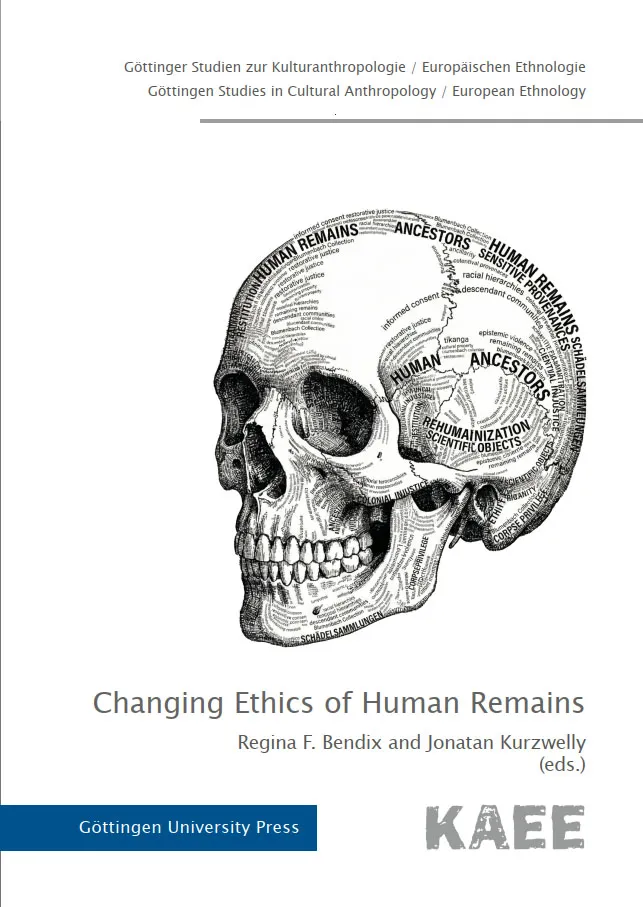
This book, edited by Regina F. Bendix and Jonatan Kurzwelly explores the complex and contentious transition from this legacy to the contemporary imperative of rehumanisation and restorative dignity. It recognises that restitution offers a necessary, yet only partial, redress to the profound disruptions of the past.
How do museum-exhibitions enable visitors to critically engage with the complex histories of colonial collections and reflect on their potential (re)distribution? The Wereldmuseum Amsterdam’s Unfinished Pasts: Return, Keep, or...? brings this question into curatorial focus. Pao-Yi Yang assesses how its interpretive design both deepens and complicates the viewing experience.
Andreas Giorgallis argues that prevailing approaches often frame decolonisation as a series of discrete corrective interventions, rather than as a challenge to the structural foundations through which heritage is constituted and governed. Unless the enduring colonial architectures embedded in these frameworks are addressed, decolonisation risks remaining symbolic rather than transformative.
Sierrea Kinsey-Lawton argues: Museums and art houses have never acknowledged that the living descendants of enslaved Africans are, themselves, looted cultural heritage. Solutions for stolen people are not analogous to solutions for stolen bronzes. You cannot deaccession a person.
Emotional Provenance refers to the emotional, spiritual, ritual, and affective histories embedded within artefacts through their creation, use, displacement, performance, and institutional representation.
According to Parisian lawyer, Celia Chauffray, the new French restitution law does not change the rules of evidence that continue to weigh on requesting states, does not ratify any additional international conventions, and does not affect the due diligence obligations of dealers and collectors.
Ahmed Mohammad examines Germany's new Coordination Council for Returns of Cultural Property and Human Remains from Colonial Contexts — weighing what it genuinely achieves against the structural challenges that remain. The council's limitation is that it remains unclarified whether it will issue binding rulings or operate in an advisory capacity. The question of human remains is where this limitation is sharpest.
The landscape of cultural property restitution has undergone a fundamental transformation over the past three decades. What was once a world governed by gentlemanly agreements between dealers, collectors, and museum curators has become a forensic battleground where digitized trafficking archives, scientific testing, and aggressive legal enforcement determine the fate of objects. This document provides a comprehensive analysis of the current state.
The Restitution Law, approved by the French parliament, evokes all sorts of reactions. Most are quite similar (and positive). Senegalese philosopher Souleymane Bachir Diagne has serious doubts about it.
Paul P. Stewens wonders: The restitution of cultural property has become a hot topic. Museums grapple with restitution claims and colonial legacies. Did I say museums? I meant to say: cultural museums that house artworks, antiquities, or ethnological collections. Natural history museums, on the other hand, have barely been touched by the general turn to restitution. Why is that?
In recent years human remains in museums have been the subject of increasingly critical attention, both within the museum sector itself and in public debate. This raises a large number of ethical, legal, and practical questions for European museums. 'Museum meets University' organises this meeting at the crossroads of academic museology and museum practice.
The French parliament has unanimously adopted on 13 April a framework legislation for the deaccession of cultural items plundered from former colonies. Nine years after President Emmanuel Macron pledged repatriation of African heritage, the new law finally opens the way for the return of items illegitimately taken by force. The bill was initiated in 2023, but it has been delayed by political instability and changes of government as well as the sensitivity of the subject.
Thomas Fues (Dekolonial Erinnern) is monitoring all restitutions from German museums and universities to former colonial regions. Wherever possible, with a source. In 2026, Māori taonga („Pou of Hinematioro“) was returned to New Zealand by the University of Tübingen.
[in French] The UNESCO Chair on the Diversity of Cultural Expressions, in partnership with CELAT and IPAC, is organizing the second Midi de la culture of the year, which will include a discussion on the restitution and repatriation of cultural objects.
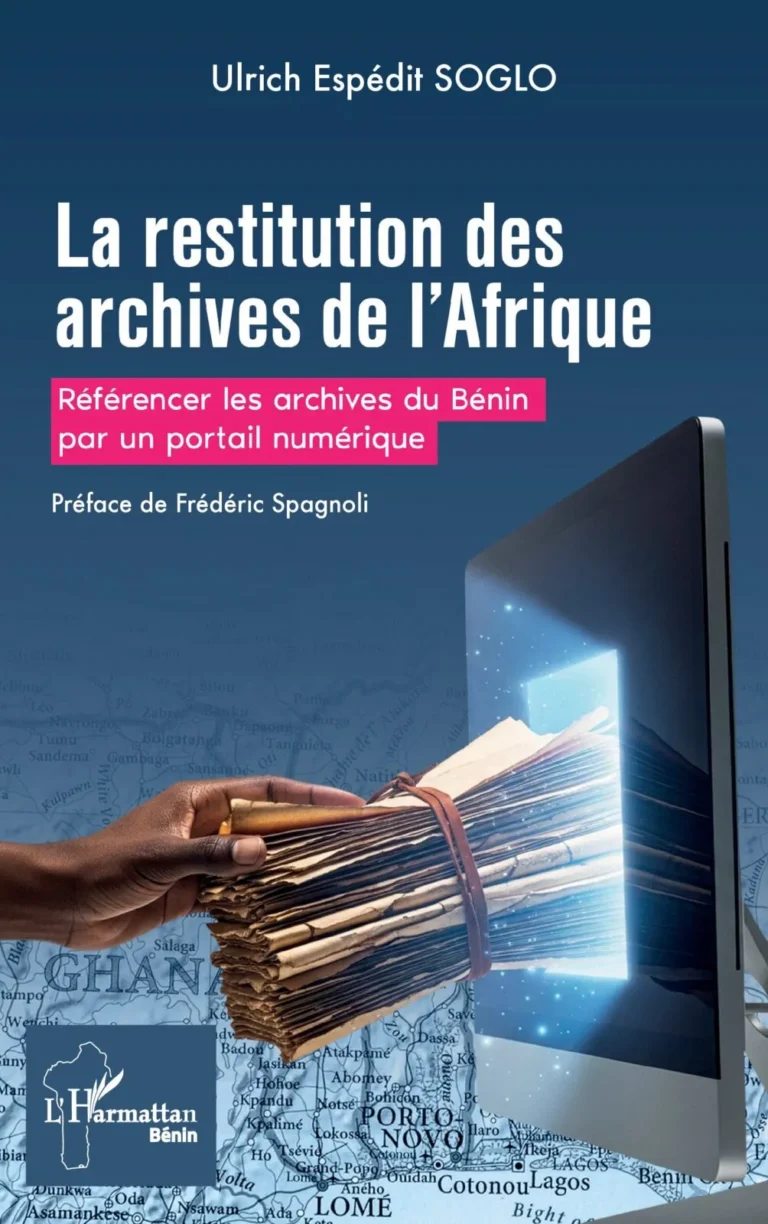
[in French] Recently, the restitution of cultural belonging has been stirring up the web. We talk about treasures, but there is no treasure without archives. However, colonial archives, true treasures of history, are often forgotten in discussions about restitution. This book offers a suggestion...
[English version, French version] In 2025, the tribal art market returned to its cruising speed. With a turnover of €42.7 million, it followed the trajectory of previous years: more selective, more demanding, yet also more cautious.
[ in Dutch, in French] That this issue has received increasing attention is partly due to two important issues, namely the question of the restitution of works of art looted by the Nazis to relatives of victims of the Holocaust and the question of the restitution of cultural heritage objects illegally acquired during colonization by Western countries. Three Wednesday afternoons.
In this Second Parliamentary Gathering on 13 April 2026, APPCITARJ will build on the landmark November 2025 gathering and draw on international experiences of truth and justice processes to inform and deepen the movement for a genuine commission of inquiry.
Institutions are grappling with the human remains in their collections that were used to justify debunked theories about race. To understand this better, Nina Siegal visits Museum Vrolik in Amsterdam and its exhibition “Imagine: The Future of Human Remains from Colonial Contexts,” which runs up to 27 June 2027.
Laura Petersen argues that authors and artists have also taken up a responsibility for restitution. Deploying the literal translation ‘making-good-again’, this book focuses on the ‘making’ of law, literature and visual art to argue that restitution is a practice which is found in different genres, sites and temporalities.
[in English, in German] For the reconstruction of more than 90 % of human history, there are no other sources than archaeological ones. The ethical questions that arise in connection with the excavation, investigation, and exhibition of this central source group have been the subject of intensive study in English speaking countries for decades. Remains of colonial regions are part of this. How are these questions dealt with in Saxony Anhalt and other German speaking places?
Please join the Denver Art Museum’s Native Arts and Provenance departments, along with special guests from the Nelson-Atkins Museum of Art and the Art Institute of Chicago, for a lively panel discussion on the vital role provenance research plays in museums.
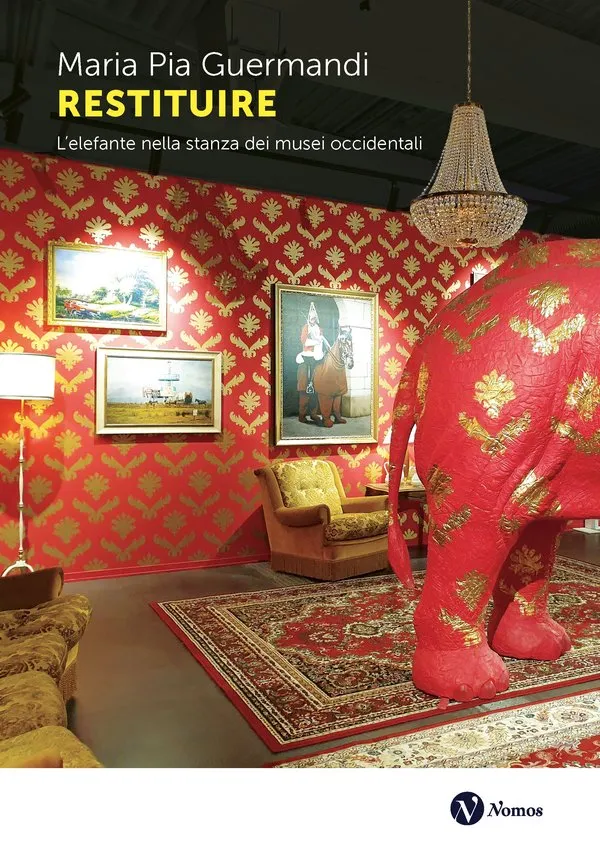
[Italian] In “Restituire”, Maria ia Guermandi reconstructs, with historical precision and critical clarity, the complex path that has brought the issue of restitution from the halls of the UN to museum policies, from the claims of African countries to the struggles of indigenous communities in so-called settlement colonies.
[in German, partially in English] In Germany, the federal, state and local governments decided to establish the "Coordination Council for Returns of Cultural Property and Human Remains from Colonial Contexts". The secretariat will be located at the Federal Foreign Office.
The Africa Institute, Global Studies University, in collaboration with the Open Society Foundations, announces its annual fellowship program themed, “Restitution and Reparation: Africa and the Post-Colonial Condition.” The program will convene scholars or practitioners interested in restitution and repatriation issues related to African art and artifacts.
Marking the beginning of the 2026 Ocean Space exhibition season, TBA21–Academy presents Tide of Returns, an exhibition based on the artistic research of the Repatriates Collective, initiated by artist Khadija von Zinnenburg Carroll and formed of artists from Australia’s Pacific North, South, and West Africa, Europe, and Latin America.
The chair, which will be launched on 22 June 2026, will address issues related to illicit trafficking, restitution and the management of collections originating from colonial contexts.
The Center for Art Collection Ethics (ACE) at the University of Denver (DU) announces a hybrid training program: Provenance Research Today: Issues, Resources, and Networks. The program is geared toward graduate students and emerging museum and art market professionals.
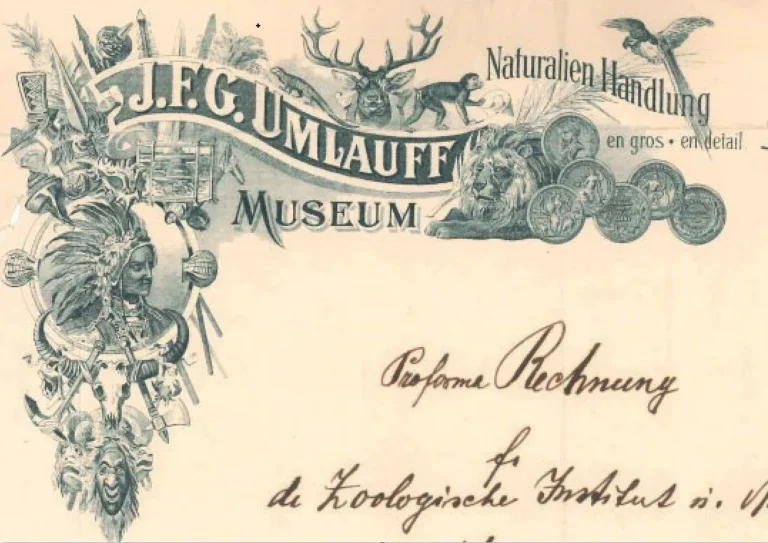
In addition to private and institutional collectors, natural history traders have historically been important sources of specimens and information for natural history museums in the past. However, the history and significance of the natural history traders is still little known and researched. One such naturalia trader with worldwide trading partners was the long-established Hamburg company of the J. F. G. Umlauff family.
How can we trace and reconstruct the provenance of objects, collections and ancestral remains that were amassed in the past, and are now placed in museums as mundane and lifeless objects frozen in a timeless past without adequate information and context? The renewed interest in provenance research can be understood as part of the broader agenda to decolonise these museums.
Alioune Samb writes: As part of my research, I developed and tested a system called SYDOCOM. Not to “add voices”. But to create conditions where different forms of knowledge can exist without being reduced to a single authorised version.
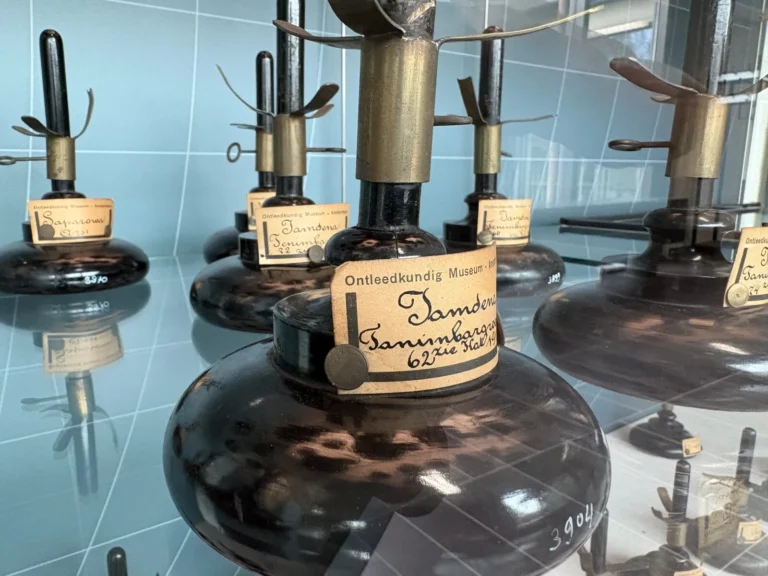
The PAESE project (Provenance Research in Collections from Colonial Contexts in Lower Saxony) ran from 2018-2022. As part of the next phase, PAESE 3.0, we are updating and expanding this database. They do so recognising that the data concern the people, communities, and descendants from the regions where these *objects* come from.
The preservation and exhibition of human remains in museums is a painful open wound for many descendant communities. Any museum that stewards such human remains, like Museum Vrolik (the anatomical museum of Amsterdam University), must respond to its racist and colonial inheritance. The result can be seen in this exhibition. The exhibition is based on the results of years of research, including origin, ways of acquisition and suppliers.
[in Dutch] On the occasion of the International Day of Remembrance of the Victims of Slavery and the Transatlantic Slave Trade, the Faculty of Arts and Philosophy in Antwerp is organising an event on postcolonial history and culture: we will enter into a dialogue on African cultural heritage in Western institutions.
[in French] Congolese and Belgian experts presented their recommendations for the future of institution-based research at an open forum: "The current framework is insufficient". The provenance search is relevant, but it must neither condition nor delay the restitution. Today, Belgium and the DRC must move forward with concrete actions.
This DARCA decision aid is designed to support trustees of cultural institutions in coming to a decision about whether they might be under a moral obligation to return a cultural artefact in their possession.
Exclusive Guardian study finds UK museums hold more than 260,000 items of remains, often in sacrilegious ways. MPs and archaeologists protest: It is a shameful legacy of colonialism.
The signing of the Washington Declaration in 1998 marked the starting point for the establishment of new, systematic provenance research focusing on the period between 1933 and 1945. In recent years, provenance research has increasingly intersected with other contexts of injustice, including colonialism, Soviet Occupation Zone/GDR, and is subject to public demand. Conference in Vienna.
Ahmad Mohammed: Digital collections have become core infrastructure for heritage work. But as collections move online and become more searchable, recombinable, and transferable, “good stewardship” is no longer only a technical matter of storage and backups.
Lewis McNaught writes: Britain’s Department for Culture, Media and Sport (DCMS) will review the exclusion it imposed on national collections that prevents them from returning cultural objects on moral grounds. The review provides an opportunity to reverse an unwelcome inconsistency in the UK Charities Act 2022.
Repatriation is urgent and important work and should be recognised as one of the UK museum sector’s top priorities. It is widely acknowledged that a lack of funding and capacity are two of the main reasons that more museums in the UK do not engage with repatriation, writes Amy Shakespeare.
[in French] The 60-page guide is meant for directors and scientific officers of museums in France, and public collections under the jurisdiction of the Ministry of Culture. The guide focusses on Nazi-looted art works, human remains, colonial collections and the ongoing illicit trade in art and antiquities.
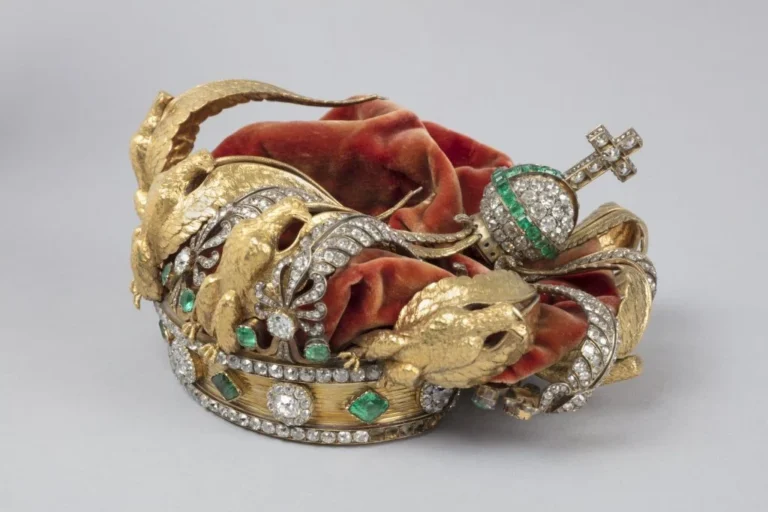
The Louvre will restore Empress Eugénie’s crown, which was damaged during the $102 million heist in October 2025. Experts found the diamond-and-emerald crown deformed, but most stones remain intact after violent theft.
In June 2026, Amsterdam School for Heritage, Memory and Material Culture organizes the conference “Unsettling heritage and memory futures: Decolonial trajectories between crisis and possibility”. One panel brings together scholars to reflect on the idea of “home” in relation to restitution. The panel is looking for contributors.
[in French] Issue 2025/8 of L’essor des contre-muséologies is about several types of museums. Confronting the dominant model of the museum—born of the French Revolution and rooted in bourgeois values—reformist museologists strive to democratize it, while popular or community-based initiatives attest to its rejection.
The Swiss School of Latin American Studies, supported by the Centro Latinoamericano-Suizo HSG and the Swiss Society of Latin American Studies (SSLAS-SAGW), invites the community to the public workshop entitled "Contested Heritage of Latin America: Collectors, Markets, and Coloniality," taking place on February 26 and 27.
Cultural heritage occupies a paradoxical position in law: It is protected as property but experienced as a repository of identity, memory, and dignity. This article examines whether cultural heritage could, in principle, be recognized as a subject of law, drawing on emerging developments in environmental and nonhuman personhood.
To Sell or Not to Sell: The British Association for Biological Anthropology and Osteoarchaeology’s Position on the Trade and Sales of Human Remains in the UK pleads for improved legislation if the UK is to end this industry.
The French Senate on Wednesday adopted a draft legislation to facilitate the return of artworks and other prized artefacts looted during the country’s colonial era. This new procedure could help address requests already submitted by various countries, including Morocco, Mali, Algeria and Benin.
Centuries of colonisation and exploitation have substantially determined the fact that museums in the West own collections of art that originated from their former colonies. Anaïs Mattez historicises the development of restitution from museums. She sheds light on the mutual influence of post-colonial studies, art crime, and international law.
The handling of human remains from colonial contexts presents museums, collections and research institutions with complex professional as well as ethical challenges. According to a survey conducted by the German Contact Point, approximately 46% of the unmodified human remains recorded in German museums and university collections cannot be clearly attributed to a specific geographical origin.
[in French, in English] Since the 1990s, new forms of discourse and mobilization have emerged to question Belgium’s colonial past and postcolonial present. Journalists, researchers, archivists, community activists, artists, members of the African diaspora, former colonists and their descendants, national and political players, etc. have contributed to putting the issue of colonial legacy on the public agenda.
While Britain has shown little inclination to even seriously consider restitution of the Kohinoor or other cultural artefacts taken from India, several European countries have begun doing so, with the Netherlands emerging at the forefront. While doing so, all sorts of challenges pop up.
Early in 2025, Patty Gerstenblith published 'Cultural Objects and Reparative Justice. A Legal and Historical Analysis'. She proposes an innovative paradigm for determining reparations, including restitution of cultural objects appropriated during the nineteenth century. This is a review of her book by Annaïs Mattez with both positive and critical points.
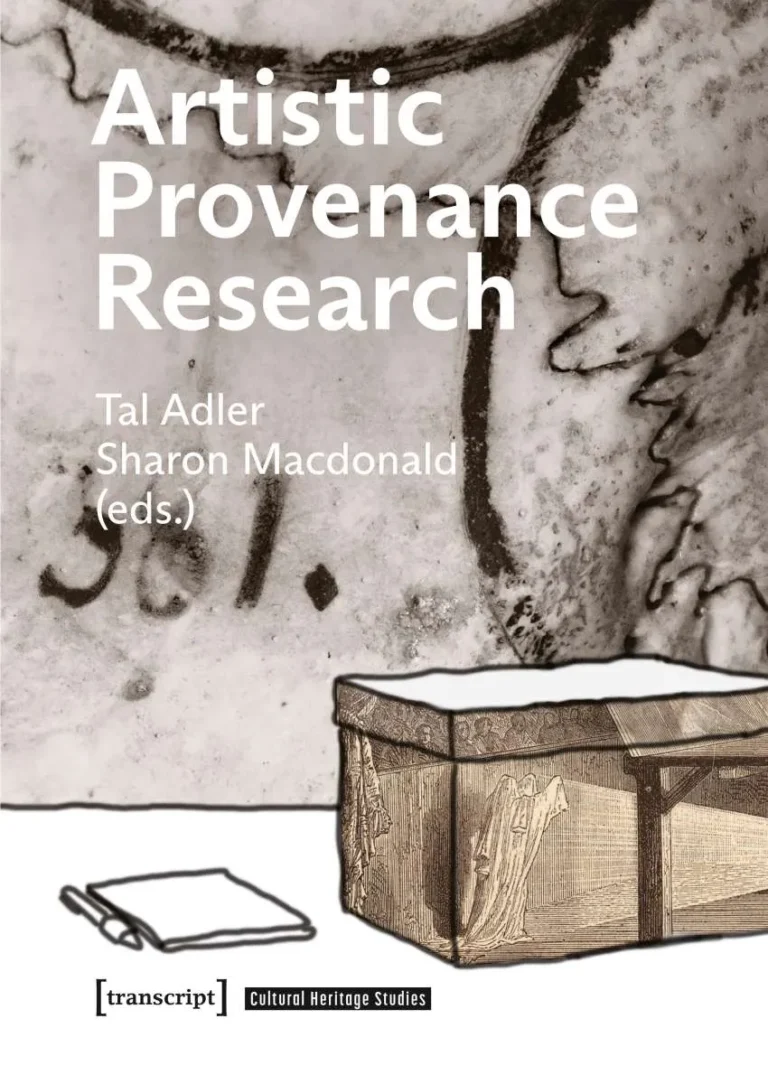
What can art and artists bring to researching the origins and biographies of objects? How do they shed new light on – or even unsettle – existing approaches to such questions? 'What is not said or shown – absences and gaps – needs attention and can itself open up new avenues of investigation.' [ open access ]
On December 3, 2025, the Pavillon des Sessions at the Louvre reopened its new layout, now called the Galerie des Cinq Continents or Gallery of the Five Continents. In Maria Pia Guermandi’s opinion, the layout continues to express a Western vision that claims to ‘elevate’ other cultures by granting them admission to the sancta sanctorum of European art.
For several years, the Wereldmuseum in the Netherlands has actively engaged in provenance research, focusing on the unequal power dynamics that shaped the collection of objects amidst European colonialism. Daantje van de Linde and Karolien Nédée investigate this approach. 'The broader discipline is still in its infant years, and its goals and research methods are continuously developing.'
For an issue about 'Measuring Cultural Heritage: Indicators for Cultural Heritage Law and Policy Development', the e-journal Santander Art, Culture & Law Review welcomes contributions from legal scholars, policymakers, cultural heritage practitioners, and interdisciplinary researchers. Submissions should offer original research, comparative analysis, or innovative methodologies that contribute to the understanding, assessment, and governance of cultural heritage.
The Freer Research Center at the Smithsonian’s National Museum of Asian Art and the Zentralarchiv and Museum für Asiatische Kunst (Staatliche Museen zu Berlin) of the Stiftung Preußischer Kulturbesitz announce their second in-person symposium dedicated to the provenance of Asian art, occurring November 11–13, 2026, on Museum Island in Berlin, Germany.
[ in Spanish ] In 'Arte secuestrado' or Abducted art, Catharine Titi (CNRS, France) and Katia Fach Gómez (Uni Zaragoza) recount the stories of six iconic collections, from the Parthenon Marbles to Moctezuma's headdress, the Benin Bronzes, and the Bust of Nefertiti, to shed light on how they ended up in the museums where they now reside, and to open the debate about their repatriation.
A new gallery at the Manchester Museum displays thousands of African artefacts, aiming to spark discussion on colonial-era looting and restitution. The initiative seeks public input on the origins and returns of these items, amid growing calls for repatriation of looted cultural heritage.
In recent years, there has been growing recognition that these collections carry painful legacies. In all these engagements, two words are often used: repatriation and restitution.
At first glance they may seem to mean the same thing, and both involve the return of something. But as South African scholars, working in the fields of history, museum studies and human biology, Victoria Ribbon and Ciraj Rassool argue that the difference between these terms is not just semantic. The choice of word reflects deeper politics of justice, recognition and repair.
The conference theme will reflect the project’s focus on equitable collaboration, community-engagement and revisiting the ways in which collections are acquired, interpreted and shared. This year we’re rethinking what a conference can be. Dates: 23-24 April 2026.
To exhibit taonga is not simply to interpret the past. It is to enter a living relationship with an ancestral presence. Museums do not own taonga. At best, they are temporary caregivers, and increasingly, digital co-stewards.
Susan Tallman writes: What does a fair policy of museum repatriation look like? A new book considers the issue in terms of human rights, cultural sovereignty, and stewardship.
The Wereldmuseum collection includes 3,647 objects that contain ancestral human remains. Particularly harrowing are the 26 premature and newborn babies preserved in fluid. Together with members of various communities, Manuwi C. Tokai created an altar in the Wereldmuseum Amsterdam to serve as a place of remembrance for the ancestors held in the museum’s collection.
Emeline Smith writes: Long-term loans to former colonies are not restitution. They do not acknowledge historical wrongdoing, nor do they restore agency to source communities. The loan program is a rebranding exercise that preserves colonial power structures while pretending to dismantle them.
[ in Dutch ] Heritage organizations preserve and make accessible archives, publications, and objects that tell interesting or moving stories. At the same time, these same collections often contain heritage that reflects painful and poignant histories. This heritage raises questions or even comes under fire.
Call for Papers for the 12th Annual Conference of the Amsterdam School for Heritage, Memory and Material Culture. The conference 'Unsettling Heritage and Memory Futures: Decolonial Trajectories Between Crisis and Possibility', will take place on 17, 18 and 19 June, 2026.
The All-Party Parliamentary Group for Afrikan Reparations (APPG-AR) is calling for a ban on the public display of human remains without consent.
The group also recommended the establishment of a framework for museums to transparently audit their collections of human remains across the country as part of a briefing at the House of Commons last week.
[ in English and in German ] The Museum der Kulturen Basel is systematically examining its collection for coloniality and highlighting the central importance of collaborating with communities in the Global South.
In January 2023, an online seminar was held to investigate the Vatican collections, their legal structure and how repatriation might be possible to countries and communities of origin. In particular we looked at the principle of ‘inalienability’ which governs the collections under Vatican civil law, Alexander Herman writes.
In an address delivered in Algiers, the Caribbean Community (Caricom), unveiled a comprehensive ten-point plan calling for concrete reparations for the crimes of colonialism. This intervention strongly underscored the necessity of a unified, coordinated effort between Africa and its diaspora to confront centuries-long injustices, restore historical rights, and secure meaningful mechanisms for recognition, compensation, and restitution.
[ in French ] Marie-Anne Léourier administered a questionnaire focused on these questions to visitors of the permanent collections area of the Quai Branly – Jacques Chirac Museum (MQB).
'Investigating Online Heritage Crime - New Directions, New Technologies, Emerging Markets' offers an introduction to a crucial new field of interest to all heritage researchers.
Findings suggest that whilst there is strong support for retaining objects, namely under the guise of guaranteeing access for all peoples, there is also opposition from volunteers who feel that the British Museum is morally obliged to return objects.
Through diverse voices, this (open access) Abécédaire rethinks the history of art and museums as an experimental space, transcending disciplinary and geographical boundaries. It offers a fresh, nuanced perspective on contemporary issues in the study of the past while paving new pathways for the future.
[ in Dutch ] Collaborative research between heritage institutions in Europe and heritage communities outside Europe offer a unique opportunity to democratise the production of knowledge about the past, the present ,and the future, writes Katrijn D'Hamers (p. 72 ff).
A £1.1million Arts and Humanities Research Council (AHRC) standard grant has been awarded to an international team of scholars, archivists and filmmakers for a project on African film heritage restitution.
The Art of Status: Looted Treasures and the Global Politics of Restitution examines the relationship between looted art and international status, by focusing on the debates about acquisition and restitution of the Parthenon Marbles, Benin Bronzes, and a never before written about collection of Nazi-looted art housed in the National Museum of Serbia.
There’s a shift in museums of the global north. They have begun to decolonise. Finally! But the weird thing is the ones who are leading this shift are the descendants of those who stole, murdered, oppressed. Is this one of our blind spots? It is high time to sit in our discomfort, for serious self-examination, and for a shifting of power dynamics.
[ in Spanish ] The work of the two expert committees created by Ernest Urtasun, Minister of Culture, to "overcome and challenge the Eurocentrism" of these two institutions, has concluded after six months with the delivery of two projects outlining concrete guidelines for renewing their museographic narratives.
The UK Government is to implement a change in law that will make it easier for museums in England and Wales to restitute objects from their collections on moral grounds. But national museums will be excluded from new rules.
University collections are more than any others, linked to the definition and transmission of knowledge. The Musée L, UCLouvain's university museum, is launching a new open-access online scientific journal dedicated to university collections and museums: UniMusea – Research and Practices on University Collections.
Symposium on current debates around the spiritual artifacts collected under colonial or postcolonial conditions and housed in European ethnographic museums. It will be held Dec. 3 and 4 in Groningen with many wonderful scholars and MA and PhD students involved.
[in English, in German] Thomas Fues sees many positive elements in the Joint Guidelines. which the federal government, the states and local authority associations adopted on 14 October 2025. They have some good guidelines but challenges remain as well.
Elias Feroz interviews Dan Hicks: Monuments, museums, and cultural institutions were often created in the image of “militarist realism,” presenting colonialism and enslavement as eternal. Undoing this legacy is not erasing the past but combating a pernicious ideology.
The theft of the Louvre’s crown jewels has increased calls for the museum to be more transparent about the colonial origins of the treasures it displays. Their routes to Paris run through the shadows of empire, an uncomfortable history that France has only begun to confront.
It is the final conference of Pressing Matter, in partnership with the Research Center for Material Culture (RCMC) and the Wereldmuseum. Min theme: Rethinking the Restitutionary Moment: What Next? On 27 and 28 November in Leiden. On 26 November, Achille Mbembe will speak in Amsterdam.
The International Seminar on the Return of Cultural Heritage under the auspices of the 2025 Brazil BRICS Presidency will take place on 10 and 11 November and is organized by the University of São Paulo [ USP ].
There is growing debate around the ethics of displaying human remains. Against this background, the Museums Association (MA) has reviewed its Code of Ethics, and questions around storage and display of human remains are a key aspect.
Nikolaus Perneczky examines three archival films produced in the 1960s and 1970s, locating them within struggles over the historical memory of colonialism and political contestations of the post-independence era. These works were some of the earliest African-directed films to employ found (still and moving) images.
[ in German ] Berlin Postkolonial, Decolonize Berlin, and Flinn Works welcome the update of the “Joint Guidelines on Dealing with Cultural Property and Human Remains from Colonial Contexts.” Clearer procedures and the establishment of unconditional returns are steps in the right direction. At the same time, the guidelines fall far short of a human rights- and international law-based understanding of restitution and repatriation.
[ in French ] The Study and Research Centre for Administrative and Political Sciences (CERSA) organizes a conference entitled “Restitutions of cultural heritage: trends, challenges, perspectives” on November 14, 2025 in Paris.
[ in French ] The French government intends to go further with a bill that could become a landmark law in this area. What are the terms of the bill, and why does it potentially represent a historic turning point? Catharine Titi writes....
The British Museum has hosted a lavish fundraiser at 2,000 pounds ($2,668) per ticket, dubbed the "Pink Ball," in the room housing the Parthenon Marbles, igniting fierce criticism and reviving long-standing debates over cultural ethics and colonial restitution. Greek Culture Minister Lina Mendoni condemned as 'provocative indifference'. Here follows a comment by Global Times reporter Chen Xi.
The stolen jewels are also products of a long history of colonial extraction. The sapphires, emeralds, diamonds, pearls, and other gemstones they contained were mined across Asia, Africa, and South America.
[ in German ] The 2025 Guidelines promote dialogue with societies of origin and descendants, interdisciplinary provenance research, and proactive roles for museums, while they acknowledge the cultural, spiritual, and epistemological singularities of each case. They expand on communication channels for restitution requests, specifically notably requiring the consent of the state of origin, and call for a need to streamline procedures and call for an expert advisory body to be established to support restitution efforts. Further details on governance and the body’s specific mandate remain to be defined.
This kick-off seminar, led by Pietro Sullo, discusses the legal status of colonial artefacts from Africa held in European museums, clarifying whether there is a duty to repatriate them. The research hypothesis is that European states have a legal duty to return colonial artefacts acquired without the consent of the communities of origin.
[ in Spanish ] The exhibition recovers key moments from the decades of 1880 and 1990, when the first restitutions of human remains and the demands for patrimonial return to our context were produced.
The British Museum has announced that it will be holding a charity ball on 18 October 2025 to collect funds to further, inter alia, its international partnerships. This makes Kwame Opoku having a closer look at it.
The Director of the Museum of Black Civilisations in Dakar Mohamed Abdallah Ly reflects on the urgent need to decolonize cultural institutions, the symbolism of absence, and the politics of restitution. He also discusses efforts to reconnect the museum with diaspora communities and reimagine its role in Africa’s cultural and intellectual future.
This special exhibition is dedicated to a long-overlooked collecting practice: The collection of objects by Catholic and Protestant missionary societies – primarily during the 19th and early 20th centuries.
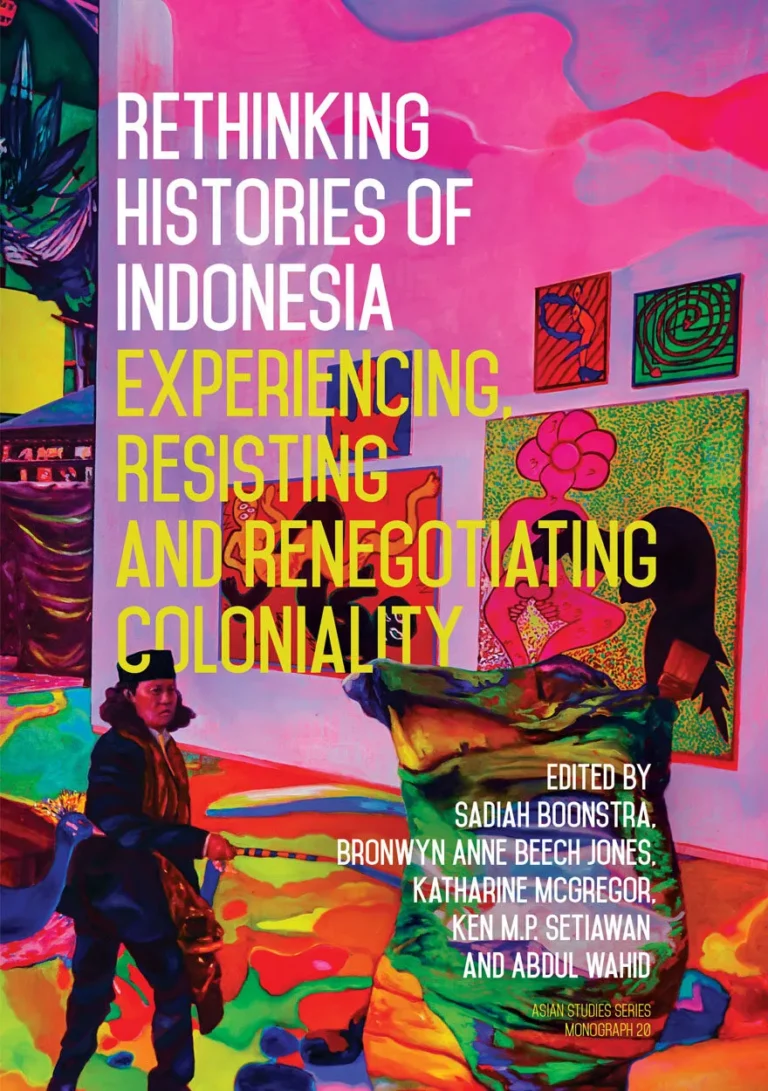
In 'Rethinking Histories of Indonesia - Experiencing, Resisting and Renegotiating Coloniality', editors Sadiah Boonstra and others provide a critical evaluation of histories of Indonesia from the formal period of colonisation to the present day. The volume approaches Indonesian history through the lens of coloniality, or the structures of power and control that underpin colonisation and which persist into the present.
Christian missionary collections have contributed much to the development of the exhibitionary complex, but have received significantly less notice than imperial states using violence to acquire collections, and subsequent demands for restitution.
Centuries of plunder, forced labour, and extraction built the wealth of Europe while impoverishing the Global South. The debt owed is not symbolic; it is measurable, moral, and political. Reparations are not charity—they are justice long overdue. Restitution of colonial collections is part of this.
[ in English and in German ] Experience to date suggests that the portal has so far been little used by actors from the contexts of origin and other countries of the so-called Global South and their diasporic communities. To shed more light on this issue, we surveyed both the DDB as the provider and German and international researchers as (potential) users in writing.
Hugh Johnson-Gilbert and Alexander Herman write: It has long been the view in the UK that national museums are restricted by law from repatriating collection objects. But will legislation passed three years ago, the Charities Act 2022, point the way ahead?
Our third In Conversation considers restitution from an ethnographic perspective. Charlotte Joy will discuss the research for her upcoming book, drawing on interviews and her work with UNESCO, with Mirjam Shatanawi and Katarzyna Puzon. We invite you to join our conversation.
Kulasumb Kalinoe (East Sepik area, Papua New Guinea; currrently James Cook University, Australia) focuses on the collection and removal of cultural material from Papua New Guinea (PNG) during the colonial era. She discusses views among the Papua New Guinean diaspora in Australia on museums and PNG collections, and argues that cultural heritage issues must be addressed before the work of decolonisation can begin.
Ahmad Mohammed writes: Sacred objects, ancestral remains, and ritual artifacts remain estranged from the communities that created and cherished them. This condition is what many scholars and practitioners now identify as cultural heritage alienation: the systematic displacement of heritage from its social, spiritual, and cultural lifeworlds into the frameworks of Western curatorial authority. But community control is crucial.
More and more colonial looted art is returned to the country of origin by European countries and museums, yet millions of precious sculptures, masks and bronzes still remain in the hands of the former colonizer. In the Netherlands alone, hundreds of thousands of artifacts are involved. Why? 'They claim that we can't take care of it ourselves.'
Tilda Gladwell likes to divert your attention from news of war and geopolitical instability for just a moment to an equally pressing issue: the decades-long debate concerning repatriation.
In 2013, the AfricaMuseum near Brussels closed its doors and embarked on a major redesign. The architectural changes must have felt less challenging than the long overdue re-evaluation of the holdings and their presentation. Jeremy Harding reports.
This workshop marks the conclusion of the interdisciplinary provenance research project "Human Remains from Colonial Contexts: Provenance Research in the Anthropological Collections of the University of Göttingen and MARKK Hamburg".
[ in English, French and Spanish ] From a continental European perspective, islands have long been considered as separated and isolated spaces, disconnected from one another and from the rest of their environment. This special issue of the ICOFOM Study Series rethinks such a perspective on islands by bringing together papers from around the world that draw on alternative views, notably from the Pacific and Caribbean regions concerning oceanic islands.
The conference “Colonial Pasts and Contemporary Search for Justice: Interdisciplinary Perspectives on the Politics of Restitution and Redress for Colonial Violence” brings together experiences from different parts of the world, and perspectives in the field of transitional justice and (post-)colonial studies.
[ in Dutch ] How are Belgium and the Netherlands dealing with the sensitive issue of returning looted art and researching its colonial origins? An exploration of some treacherous areas in the quagmire of new Dutch and Belgian restitution policy. A discussion between museum director Wayne Modest and activist Nadia Nsayi.
Social media is helping drive trade in skulls, bones and skin products as UK legal void risks new era of ‘body snatching’. Paul Boateng (Labour Party), who will meet the culture secretary, Lisa Nandy, next month to appeal for a change in the law, has raised specific concerns about the trade in remains of ancestors from Indigenous communities.
[ French translation ] La France débat actuellement de la création d’un cadre juridique pour la restitution des collections publiques historiques, principalement d’origine coloniale. La Belgique dispose déjà d’une telle loi. Ce court article propose une comparaison entre les deux dispositifs – la loi belge et le projet de loi français – en se concentrant sur trois points :
• l’approche centrée sur l’État,
• le champ d’application,
• la procédure de restitution.
Kwame Opoku writes: The French Minister of Culture presented a legislative text on 30 July to facilitate the restitution of artefacts in French museums by derogating from the principle of inalienability. It will not likely lead to a rush of restitutions from France. Excluding archaeological materials, military materials, and public records eliminates many objects. Archaeological finds from Egypt, Mali, and other African countries, such as those on the ICOM Red Lists, would be excluded.
This open access book (only after 10 - 14 days) offers a unique perspective on the return of cultural objects by considering the aftermath of the handover processes.
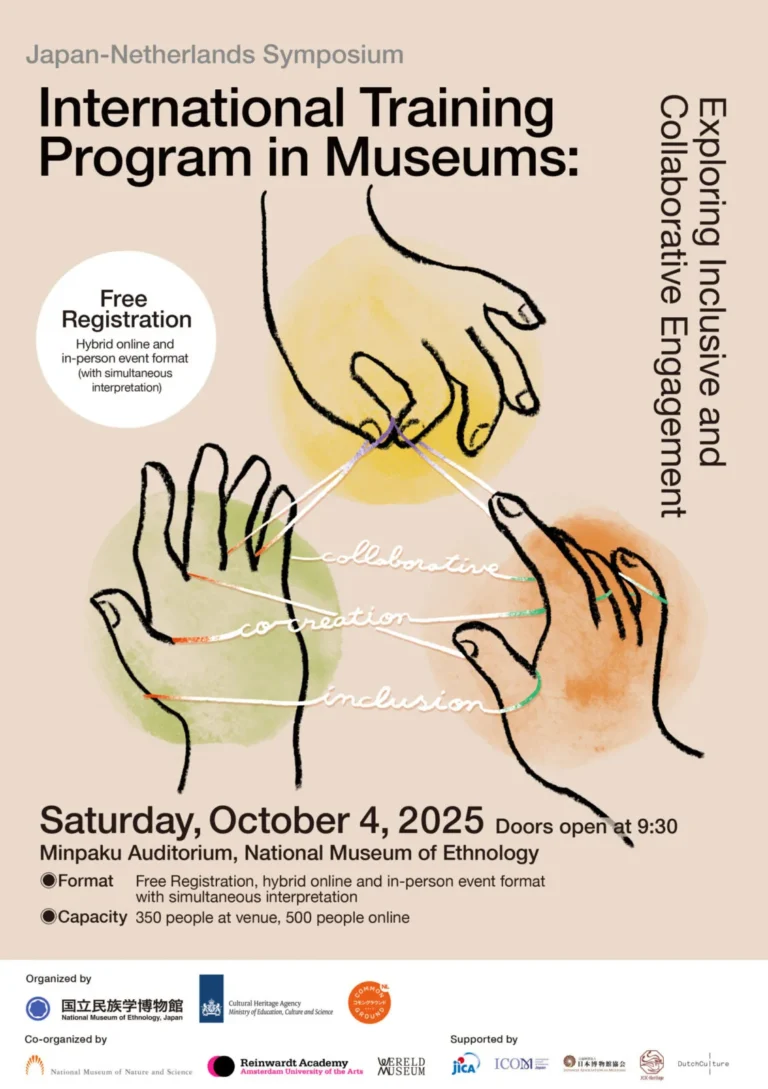
The Japan-Netherlands Symposium International Training Program in Museums: Exploring Inclusive and Collaborative Engagement focuses on international museum training programs conducted by the Netherlands and Japan, exploring new approaches to international museum collaboration that transcend the traditional hierarchy between “trainers” and “trainees.”
This paper is the outcome of joint reflections by the two authors, based in Europe and in Africa. Since the diverse practices of restitution have attracted more attention than certain concepts related to it, this paper addresses this imbalance by focusing on conceptual issues.
Thomas Fues writes: the German government emphasises its willingness to confront Germany’s colonial history and its consequences. But it remains to be seen whether and how such declarations of intent at the beginning of the legislative period will actually be implemented in the coming years.
Dan Hicks writes: Genuine transparency will require the V&A channelling its resources into creating a truly comprehensive public database of the artefacts, images and archives that it holds.
This call for contributions to Terroirs, African Journal of Social Sciences and Philosophy, aims to give greater consideration to African perspectives by analyzing citizen mobilizations, artistic initiatives, state strategies, and community practices that shape the return of heritage.
[ in English and in French ] The French government has proposed a restitution law. After Belgium, it is the second former European colonial power to do so. Such a law streamlines restitution procedures and offers former colonies more clarity and even legal certainty. This blog discusses the draft-bill and examines whether countries of origin will benefit much from it.
Paul Dailey (Guardian Australian columnist) writes: Bodies and body parts have long been part of collections of imperial plunder over the years – but museums must understand that attitudes have moved on.
It’s no easy matter resolving the current ethical debate over the retention and exhibition of human remains. But one public collection is asking visitors to cast their vote.
The Latin America and the Caribbean chapter of the Association of Critical Heritage Studies (LAC-ACHS), together with Centro de Patrimonio Cultural and Núcleo Milenio Nupats of Universidad Católica de Chile and the Department of Arts and Culture Studies of Erasmus University Rotterdam, warmly invites abstracts for its inaugural conference “Encounters. Collaborative Approaches to Heritage in Latin America and the Caribbean”.
[ in Dutch ] How do Belgium and the Netherlands deal with the sensitive issue of returning looted art and investigating its colonial origins? What do you see of this in museums and what remains underexposed?
Leading academic, Gloria Bell, argues that the Vatican is not only stalling on Pope Francis’ promises of restoring the looted artifacts — but continues to falsely 'refer to everything in their collection as a ‘gift.’
Vanessa Hava Schulmann (Freie Universität Berlin): The stories I will tell you about happened during my work in a Berlin university collection. I was tasked of meeting the deceased whose bones and tissues were stored in those dusty wooden cupboards and figure out how to handle their presence in a dignified way.
The June 2025 report by a working group of Edinburgh University DECOLONISED TRANSFORMATIONS CONFRONTING THE UNIVERSITY OF EDINBURGH’S HISTORY AND LEGACIES OF ENSLAVEMENT AND COLONIALISM focusses mainly on slavery an its current impact. At the en dit has an interesting recommendation for the university's Anatomical Museum and its 200 skulls.
Eight years after French president Emmanuel Macron pledged to return African heritage to the continent, his government has adopted a bill facilitating the deaccession of cultural items plundered from former colonies. The text will be submitted for a vote in the senate on 24 September.
The Franco-German Fund for Provenance Research on cultural belonging from Sub-Saharan Africa has announced the funding of networking and parthership initiatives aimed at fostering the creation of international research teams and strengthening existing partnerships between Germany, France, and Sub-Saharan Africa.
Ahmad Mohammed writes: While digital repatriation offers an alternative or complementary pathway to physical restitution, its success hinges not only on ethical intent or technological innovation but on the socio-technical infrastructure available to source communities.
The remains of a woman, described as a “non-European skeleton,” were given a full funeral service by Highgate School, the fee-paying secondary in Highgate Village. No relatives could be found.
Andreas Giorgallis provides an overview of how race manifests itself when it comes to cultural heritage, with reference to the restitution of colonial cultural objects, statues related to slavery and colonialism, intangible cultural heritage but also its protection during armed conflict.
[ in Dutch ] According to FARO, the Flemish support centre for cultural heritage, organisations in this part of Belgium increasingly involve communities of origin as active partners in management, description, research and showing collections of these communities that the Flemish organisations preserve.
Catharine Titi examines the history of a series of objects in the museum's possession that are currently being claimed by their countries of origin and reviews the institution's inadequate response to the repatriation debate.
'Mobile Heritage' explores how diverse digital technologies have allowed for new types of mobilities and introduced a novel set of practices, interventions, and politics for heritage collections, archives, exhibitions, entertainment, conservation, management, commerce, education, restitution, activism, and regulation. With a case-study about digitalised ancient manuscripts from Ethiopia in the British Library.
[ in Dutch ] Tervurologie sets its sights on the AfricaMuseum and radically bets on imagination - to think new Tervurens, plural. Not as escape, but as intervention. Not as recovery, but as restart. Not as an answer, but as another question. Tervurologie is an attempt at exorcism.
Proceedings from the seminar Museums, Decolonisation, and Restitution: A Global Conversation, held at Shanghai University on March 20–21, 2023. With 60 experts from 21 countries.
Quoting the recently deceased Kenyan author Ngũgĩ wa Thiong'o on decolonisation of the mind, Kwame Opoku critically analyses a recent interview in The Times with Nicholas Cullinan, the new director of the British Museum.
This article postulates that what we have seen in the past decade has been a turning point in memory politics of the colonial past, and it asks whether a new Franco-German paradigm in memory politics has emerged?
In a five pages long joint statement, eight archaeological organisations from across the UK said a “cross-sector consultative forum” should be established to enable a wide range of viewpoints to be heard on any proposed changes to human remains legislation and practice.
[ in Portuguese ] A 15-point action plan is the most tangible proposal put forward by the working group in a report on “sensitive heritage” at the University of Coimbra. Among the actions consists are “identifying and systematizing all the ‘sensitive heritage’ of UC”, the adoption of principles on dealing with them, legislation for restitution and the repatriation of a skull collection to Timor Leste.
The director of the British Museum, Nicholas Cullinan, has ruled out any move towards allowing restitution from its collections as he focuses instead on fostering global collaboration.
Why should internationally active organisations concern themselves with decolonisation? How can transnational institutions meaningfully shape this process? What challenges, responsibilities and opportunities arise from this?
Understanding the Restorative museum practices begins with a departure from static preservation models. It involves recognizing that cultural institutions operate within complex social and ecological systems, bearing responsibility for their historical impacts and future roles.
This interdisciplinary encyclopedia brings together scholars from different disciplines across the humanities and social sciences to provide the state of the art and most comprehensive overview of theoretical and methodological approaches to the study of cultural heritage and conflict.
The exhibition explores the current debate surrounding collections gathered during the colonial period and the question of restitution. Visitors not only learn about the provenance of cultural objects but also to reflect on ownership, value, and the ethical implications of a colonial history that continues to resonate in museum collections today. [ English version and Dutch version ]
With the deaccession policies of Britain’s national museums so diametrically different from Britain’s larger number of regional and university collections, learning how museums unencumbered by national legislation are dealing successfully with the same legacies of inequality and trauma is revealing.
[ in English and in Dutch ] Science museums are full of skeletons, skulls and other human and animal remains. How were these obtained? Colonial heritage researchers shed new light on that question and come to painful conclusions.
International Conference. - Decolonising Cultural Heritage: State of the Art, Methodologies, and Practices”. University for Foreigners of Siena, Italy.
“Black Paris” retraces the presence and influence of Black artists in France from the 1950s to 2000. The exhibition celebrates 150 black artists coming from Africa, the Americas and the Caribbean.
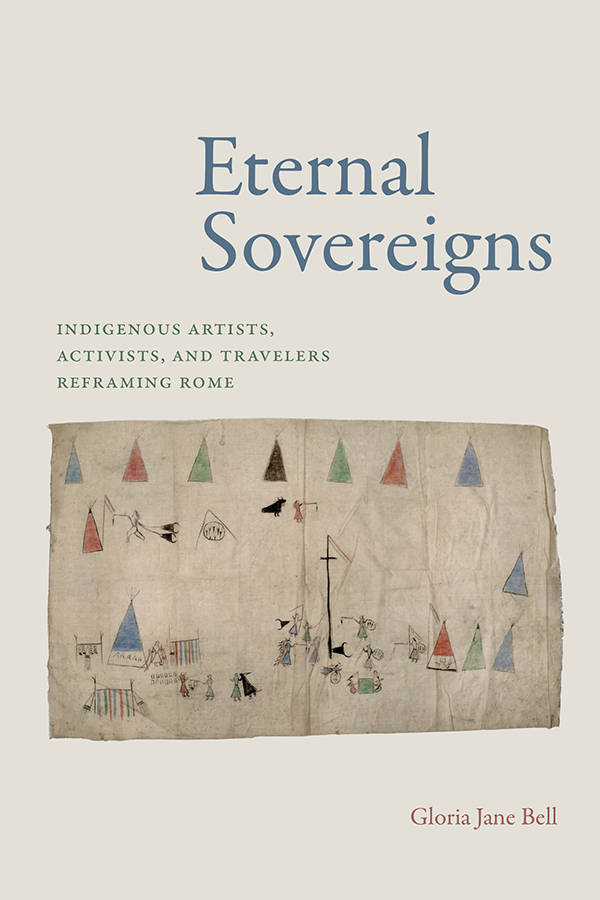
In Eternal Sovereigns: Indigenous Artists, Activists, and Travelers Reframing Rome, Gloria Jane Bell considers Indigenous cultural belongings held in Vatican Museums collections. As she turns attention to the stories they tell—and the Vatican’s efforts to silence them—she locates these possessions within a long history of Indigenous travelers with creative ties to Rome.
Pope Francis died on April 20 at 88, marking the end of an epoch for the Catholic Church and the beginning of its search for the next spiritual leader, who will also become proprietor of the Vatican’s library and vast art collection.
Dan Hicks' 'Every Monument Will Fall - A Story of Remembering and Forgetting' reappraises how we think about culture, and how to find hope, remembrance and reconciliation in the fragments of an unfinished violent past.
Ahmad Mohammed writes: Immersive technologies and digital repatriation are reshaping heritage practice—opening up new possibilities for connection, access, and repair. But are we asking the right questions?
Heritage interpretation—the process through which meaning is assigned to the material and immaterial traces of the past—is never a neutral act. It inherently involves questions of power, identity, and authority, writes Ahmad Mohammed.
The (black-red) coalition agreement of Conservatives (CDU/CSU) and Social Democrats (SPD) in Germany contains remarkably positive statements on dealing with the colonial legacy.
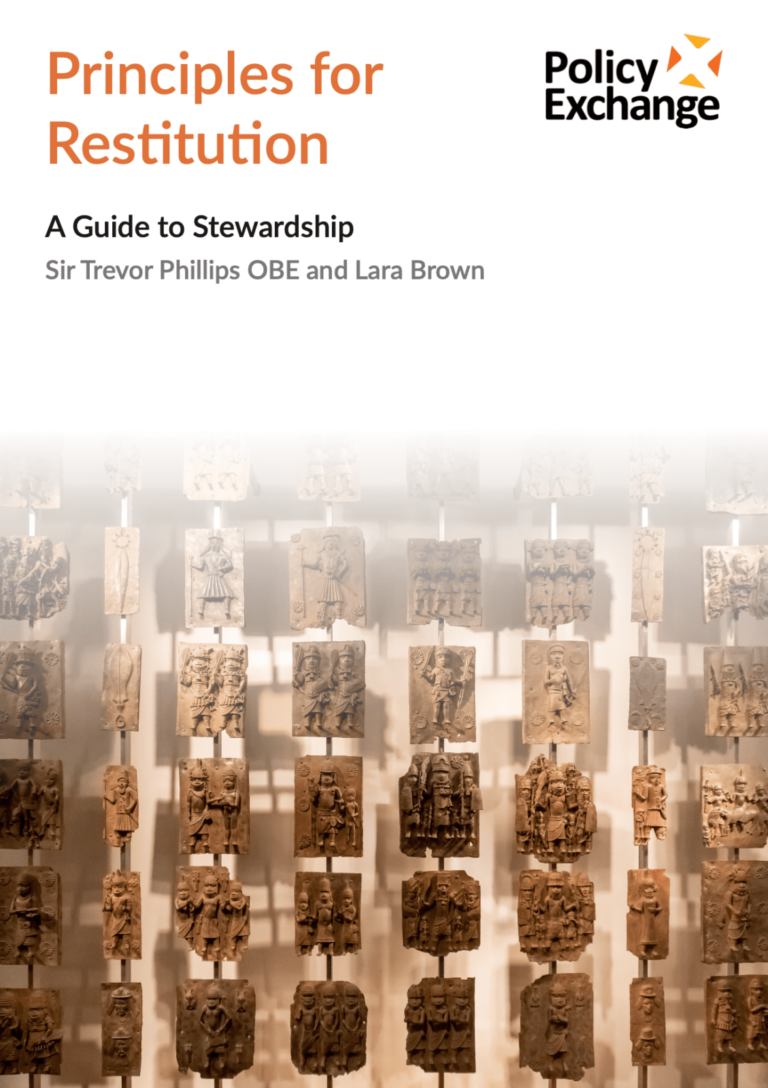
The British Museum must not succumb to pressure to return the Benin Bronzes to Africa, as the case for their restitution is 'weak', Sir Trevor Phillips says.
At Galeria Avenida da Índia in Lisbon, Uriel Orlow’s exhibition Memória Colateral unfolds like a sensory mapping of historical violence and of how memory is inscribed – or erased – within Western structures.
A central assumption in the political process of restitution of looted properties and cultural objects is that their return helps societies to redeem histories of injustice and dispossession. In this article, we ask which objects address whose histories, and how processes of restitution are influenced by the presence and absence of objects and collections.
This essay by Ahmad Mohammed critically interrogates how decolonisation discourse is being used—sometimes productively to drive real change, but other times performatively as a mere buzzword—within the heritage sector.
This conference will explore how accessing archives and museum collections can enable communities to recover their past and rekindle “alternative stories” as well as disrupt the discourses constructed by Western views.
The Leiden University Medical Centre (LUMC) has established a committee to investigate what part of the current collection has a connection to the former colonies or slavery past. Based on this investigation, the committee will issue a recommendation at a later date.
[ simultaneous translation into German, French and English ] 'Hidden paths and emerging networks - Provenance research between memory and responsibility' is the title of the event on the occasion of the 7th International Research Day on the Provenance of Cultural Objects, the Franco-German Research Fund on the Provenance of Sub-Saharan African Objects invites leading scientists and experts working at the intersection of provenance research, restitution issues and museum practices.
US President Donald Trump has signed an executive order targeting the Smithsonian Institution, which operates more than 20 museums and research centres visited by millions yearly in Washington DC and New York City. It also affects the Smithsonian's restitution policy. J.D. Vance will lead the purge.
Geraldine Kendall Adams delves into the moral and ethical arguments that surround the highly sensitive issue of human remains held in British museum collections.
The Memory & Heritage Network of Utrecht University and the ERC project Ecologies of Violence: Crimes Against Nature in the Contemporary Cultural Imagination (Eco-Violence) are organizing a workshop on the representation of colonial and ecological violence in museums.
The display of human remains in museums has long been a contentious issue. Earlier in March, the All-Party Parliamentary Group for Afrikan Reparations (APPG-AR) published the report Laying the Ancestors to Rest. Returning African human remains is time- and money-consuming. With the ongoing budget cuts, it becomes harder to return them.
At present, the law that regulates the storage and use of human remains in the UK only requires consent for acquiring and holding body tissue from people under 100 years old. Fiona Twycross, a junior minister in the Department for Culture, Media and Sport, acknowledged that the guidance was dated and “the world has changed substantially” since then.
Since the later part of the twentieth century, ethnographic museums have come under increasing scrutiny, and many have reflected on and changed their presentation as they questioned collections so often made by colonial officials and explorers.
The African Collections Futures project seeks to develop a better sense of where Africa-related objects and materials are present in diaspora and communities of origin have with these objects, and what more can be done. The scope covers the nine institutions – eight museums and the Botanic Garden – that make up the University of Cambridge Museums (UCM), the University Library, and less well-known collections such as those in various University departments and affiliated institutions.
British lawmakers, NGOs, and researchers urge the UK to address a 'legislative vacuum' permitting the display of African ancestral remains from the colonial era. T
In the last three decades, museums and museological practices that are fundamentally based on Western knowledge systems have been strongly questioned by a collective that includes Indigenous Peoples, political activists, representatives of civil society and scholars.
Tristam Hunt, director V&A Museum, discusses the contradictory state of the restitution debate in Great Britain (GB): on the one hand, a quickening rhythm of returns from university and regional museums and on the other, continued confusion around deaccessioning contested objects from national collections such as the V&A and British Museum (BM).
“Every empire, however, tells itself and the world that it is unlike all other empires that its mission is not to plunder and control but to educate and liberate” Edward W. Said.
The latest issue of the "International Journal of Heritage Studies" (Volume 31, Issue 3, 2025) is out! This issues features a series of articles on "virtual repatriation", "the symbolic violence of heritage consultancy", "the heritage value of emptiness", etc.
Despite promises from Western institutions to return the artefacts, the process has been slow and piecemeal, raising questions about the sincerity of these efforts.
On social media and in auction houses, there is a lively trade in ancestral remains from colonial areas. Skulls, skeletons and other body parts regularly change hands. While this may be an acceptable practice for those involved, it is painful for many descendants of these dead.
[ open access ] This Special Issue of UMAC Journal has a Guidance for restitution and return of items from university collections and interesting contributions about ancestral remains in these collections.
Live-report of the meanings and significance of provenance research in the current legal debate on the return and restitution of cultural objects, organised by the Cultural Heritage and the Arts Interest Group and the Interest Group on International Law of Culture of the European Society of International Law.
ETH Zurich's natural history collections house thousands of artefacts from former overseas colonies, including rocks and minerals, insects, animal and plant specimens.
Even if many museums are eager to return objects now that they are "done" with them, at a time when preservation and storage costs are skyrocketing, it does not always mean that this is the right time for the other side.
[ open access ] 'Displacing and Displaying the Objects of Others - The Materiality of Identity and Depots of Global History' brings a diverse range of contributions inspired by research from the "Hamburg’s (post-)colonial legacy" research center.
Kwame Opoku comments on the report that former director of the Louvre Museum and current Ambassador for International Cooperation, Jean-Luc Martinez, delivered on 25 April 2023 to the French Minister of Culture.
This annotated bibliography presents mostly Indigenous authors and thinkers who have identified this disconnect between Euro-centric and Indigenous ways of seeing and understanding the world for decades, if not centuries.
How can academics and museum professionals research the provenance of a colonial museum collection? And can we trace possible ‘involuntary loss of possession’ or looted objects?
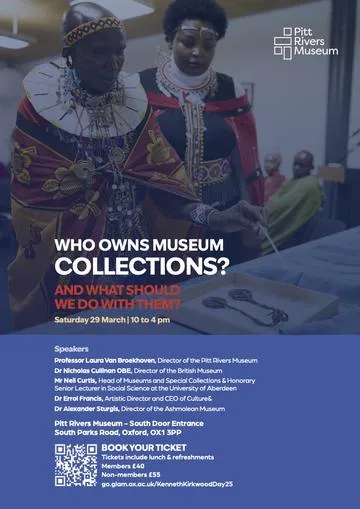
The 2025 Kenneth Kirkwood Day will explore the theme of repatriations, looking at how different museums are approaching this, the language used and if, how and why returns should be made.
[ in French, Italian subtitles ] This year it is seventy years ago that Alain Resnais, Chris Marker, and Ghislain Cloquet released their documentary Les statues meurent aussi about historical African art and the effects colonialism has had on how it is perceived.
[ in German ] The Roman-Catholic (RC) Institute for World-Church and Mission (IWM) in Frankfurt am Main is running a two-years pilot-project "Mission-History Collections", funded by two RC organisations.
In Switzerland, the decolonization of ethnological and historical museums and collections is in progress. This is true in practice, especially by federally funded provenance research projects and by single restitutions of human remains and colonial objects.
The Austrian government aims to propose legislation governing the restitution of objects in national museums acquired in a colonial context by March 2024.
Lawyer Alexander Herman: To make progress in returning countries’ heritage taken by previous generations, museums must take a pragmatic, ethical stance.
Discussions, held in March 2023 by experts, scholars, and professionals from around the world who delve into the complex questions surrounding decolonization and restitution in the museum sector.
Sometimes, descendants of Europeans no longer want to keep the objects, manuscripts or ancestral remains, which they inherited. The items have lost their significance. They take up too much space. The descendants want to make some money out of it. Or they feel these items belong more in their country of origin. Descendants use different ways to get rid of them.
Modern treaties and statutes protecting cultural property apply only prospectively to items stolen or illegally exported after their effective dates. But while the United States does not have a law concerning looted cultural objects taken from formerly colonized peoples overseas, it does have a statute governing the repatriation of Native American cultural items and human remains.
[ in English but also available in French ] With the release of the documentary film Dahomey, which follows France’s restitution of twenty-six works of art to Benin, various research teams continue to work on the return of African cultural property to their communities of origin.
RedressHub builds an innovative online platform that leverages advanced data technologies, interactive visualization tools, and participatory design to map and connect efforts addressing colonial harms and their ongoing legacies. Among these restitution.
From a historical point of view, the practice of the restitution of cultural artefacts among States emerged at the beginning of the 19th century, during the Congress of Vienna in 1815. Unfortunately, these rules were not universal. They were only applicable among contracting States, stopping at the borders of Europe, the ‘civilised world’, and did not apply to territories which were or were to be colonised.
Denunciations of the ‘evils’ of colonialism occur over and over again, as does an intermittent readiness to listen to them. But the wounds that have been inflicted cannot be healed, not least because the colonial systems in all their forms have upset the deep structures of the social, economic and political organization of the societies they have targeted.
Colonial looted art is finally being returned to its countries of origin. New problems lie ahead, as former colonies now fear the return of looted art may take the place of a comprehensive reparation for colonial crimes.
The age of many of museums, particularly those in the UK, means that they have artefacts dating back to colonial times. This article lists arguments pro and con restitution. Here the con's are presented.
The museum is an institution embedded in European modernity. It was invented when a perception of ‘the Other’, or colonised populations, was being disseminated. The International Council of Museums ICOM has had a longstanding involvement in this process.
Once, The Art Newspaper called the historical relationships of the art trade with museums a ‘foggy world’. That was in 2016. I dare say the relationship of trade with museums still is very foggy. How does this relationship look like?
During the European expansion constant fighting and violence and the taking of spoils of war went hand-in-hand. Palaces, shrines, homesteads and entire villages were plundered and destroyed. In the restitution debate, the focus is mostly on state-collections resulting from these confrontations. There is ample evidence, however, that many more parties were involved. This blogpost has soem of the evidence.
Why is research into colonial collections in the private sector - I mean art dealers, auction houses and private collectors - so tough? The main reasons is that most of them have built a wall around themselves, and there is rarely a hole in this wall through which an outside observer can look inside their closed bulwark.
The extensive article 'The ghosts are everywhere, about a museum beset by colonial controversy, difficult finances and the discovery of a thief on the inside.
Tim Maxwell: Repatriating artefacts found underwater could help former colonial powers meet moral obligations to countries they had historically exploited for their transatlantic slave trade.
Creative pursuits in Spain face the challenge of purging the country’s colonial vision, critically reviewing its relationship with the Americas and overcoming a gender bias. + Pedro Antonio Cano, a 7-foot man from South America
Material Culture in Transit: Theory and Practice constellates curators and scholars actively working with material culture within academic and museal institutions through theory and practice.
This is how the difficulties of the colonial past should be negotiated. First, begin with the object and not the politics. Museums cannot absolve the crimes of colonialism and they should not be mobilised to assist contemporary geopolitical objectives.
Egypt has announced plans to convene an international meeting for countries affected by the smuggling of antiquities during the age of imperialism. The move comes in the wake of the revelation that over 2,000 artifacts were stolen from the British Museum, which has raised concerns about the credibility of several Western museums.
Cultural assets such as the large corpus of Benin bronzes housed in museums are part of the cultural world heritage of mankind. It is time to give up the exclusive concept of private property– or a single nation’s property – for these cultural assets in favor of a concept of multiple stakeholders. “Shared heritage,” in other words. The same patterns anchored in the socioeconomic structure of European societies unfold their power again and again: It is not the victims, the slaves, who receive compensation, but the dispossessed slave owners, then as now.
Museums from Glasgow to Cambridge are proactively repatriating objects. Glasgow has become the first UK museum to repatriate objects to India (“a very emotional event”, as Glaswegians of Indian heritage said).
The Mauritshuis gallery in the Netherlands and the Humboldt Forum in Berlin have joined forces in an exhibition that addresses the looting of art that has sustained European collections for centuries
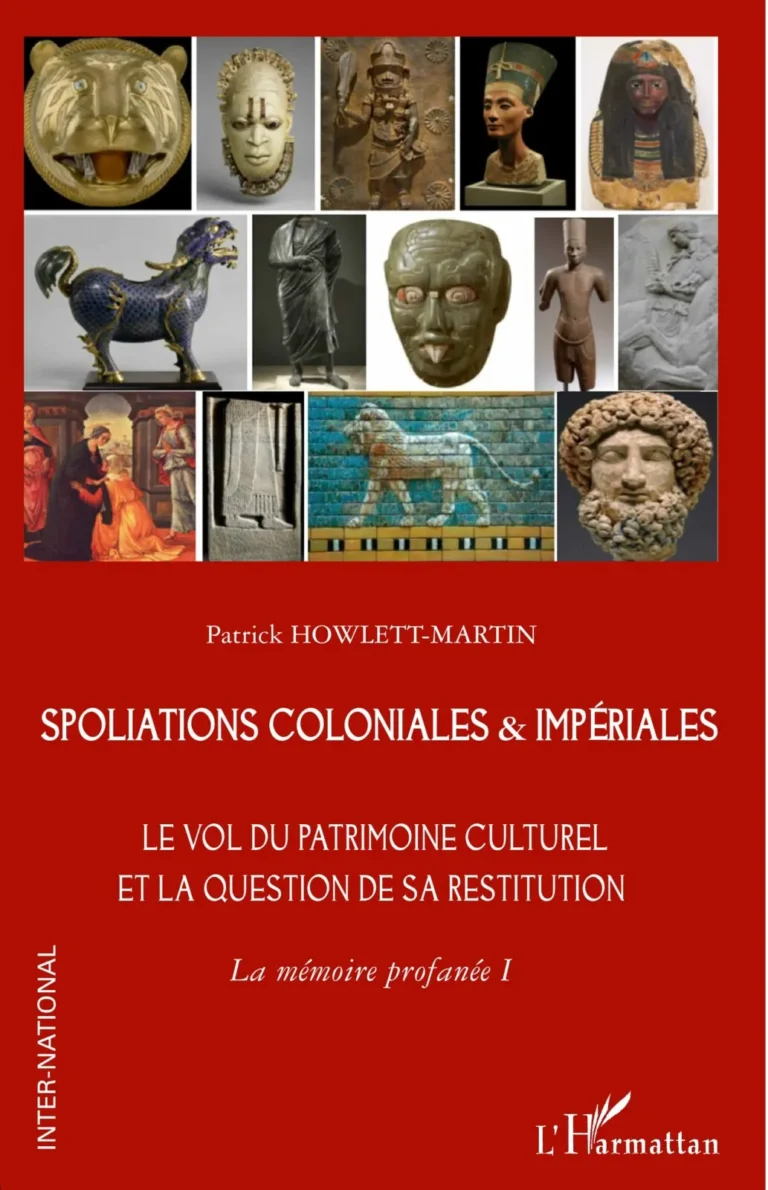
[ in French ] French historian Patrick Howlett Martin focuses on colonial spoliations and those committed during conflicts and military interventions with their procession of enslavement, repression and pillage exercised on the peoples and cultures that suffered the rule of the conquering powers.
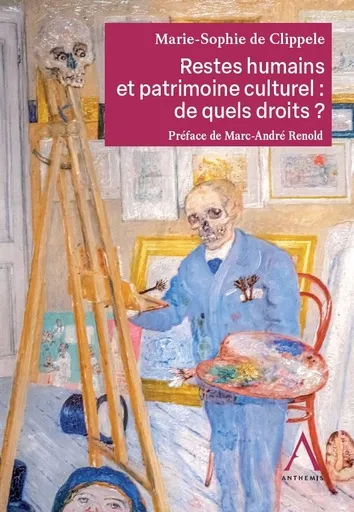
[ in French ] Marie-Sophie de Clippele’s book maps the numerous recent regulations relating to legal limitations on the marketing of objects and to assess their impact on the art market.
[ in French ] Relations between ethnographic museums and African and Oceanic art markets in France, Switzerland and Belgium : building value(s) and appropriating otherness
Aurora Hamm argues that restituted objects are instruments of soft power through public and cultural diplomacy. The (former) coloniser states utilise them, with geopolitical considerations in mind, as a means of ‘restarting’ their bilateral relationships and thus obtaining a certain form the restitution
Many believe new applications—from AI and NFTs to 3D scanning—are game changing in returning objects to source communities. Lawyers say they can make the process harder.
Switzerland’s Federal Council will set up a new independent committee to advise on disputes over art that was looted during the Nazi era. The committee will also be consulted over repatriation claims made about cultural objects that came to Switzerland due to colonialism.
European powers often dismissed or devalued the cultural expressions of colonised peoples, labelling them as ‘crafts,’ ‘artifacts,’ or ‘ethnographic objects’ rather than art and reinforcing the idea that European art holds a superior place in global culture.
Anaïs Mattez (University of Hongkong) argues that provenance research has been key in the downfall of the internationalist ideology about cultural property.
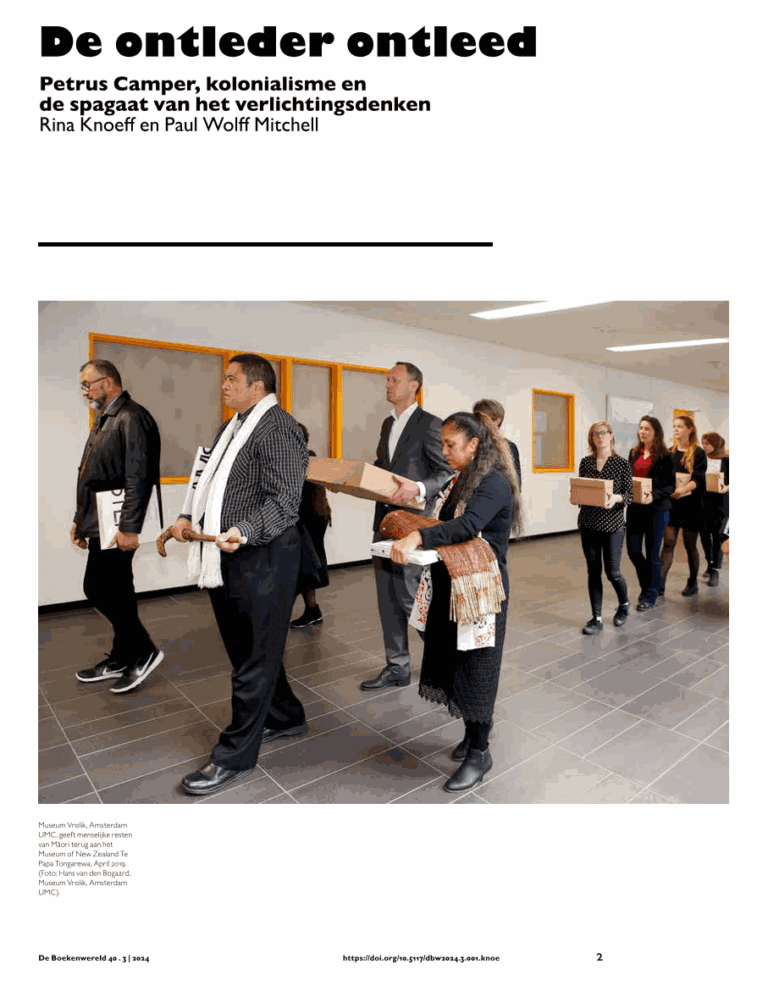
[ in Dutch ] The University Museum Groningen has a collection of human remains from Petrus Camper (1722-1789). Where do they come from and how can their presence there be understood? This issue of Magazine De Boekenwereld is about Camper, his ideas and his collection.
What practical steps can we take to resolve cross-border claims to looted art and prevent illicit trafficking in cultural goods? That's what the European Parliament asked Leiden legal scholar Evelien Campfens.
British High Commissioner in Nigeria: UK museums operate independently of the government, as decisions relating to the care and management of UK collections are addressed by museum trustees, with claims for restitution addressable to relevant museums.
Nick Merriman, the chief executive of the Horniman Museum in south London, says inclusion of difficult stories of slavery and empire is not wokery, but ‘simply good history’.
Human remains held in French public collections and less than 500 years old, can now be returned to their countries of origin by a decision of the prime minister.
[ in French and in Dutch ] Although it is accepted that human remains are out of trade and therefore should not be sold, practice shows that this happens anyway.
In January 2021, the Dutch government became the first in Europe to approve a central mechanism for repatriating colonial loot. One aspect of the new policy raises concerns given that artefacts that were looted from non-Dutch colonies will not automatically be repatriated.
[ in Spanish ] The Spanish Minister of Culture, Ernest Urtasun, has reported to the parliamentarian Commission on Culture about the review of the “colonial framework” carried out in Spanish museums, institutions “anchored in gender or ethnocentric inertia that have often hindered the vision of heritage, the history and artistic legacy”. Conservatives are against.
Mirjam Shatanawi's 'Legacies of Colonialism in Museum Collections - The (Un)Making of Indonesian Islam in the Netherlands' tells the untold story of Indonesian Islam in museums: Often overshadowed by Hindu-Buddhist art, Indonesian Islamic heritage rarely receives the attention.
[ in Dutch ] What to do with the human skulls from Africa or Asia in their collection? The days when this kind of heritage could be easily in museums seem to be over. The call for return to the place of origin is louder and louder. But are they waiting for it there?
[ in German ] ‘African human skull, early 20th century, €2000’ - this is how dealers openly advertise human skulls on social media such as Instagram. Panorama reporters uncover just how dubious this trade is, especially when you realise the origin of these skulls.
Once, The Art Newspaper called the historical relationships of the art trade with museums a ‘foggy world’. That was in 2016. I dare say the relationship of trade with museums still is very foggy. How does this relationship look like?
Fifty-four years ago, Ghanaian Nii Kwate Owoo was granted access to the storage facilities of the British Museum. The result was You Hide Me – a 40-minute film depicting Owoo and his colleague discovering an enormous volume of colonial objects hidden away in the institution’s basement.
The 2024 report covers the previous year and concludes that the tribal art market has plummeted in 2023, with a global auction turnover of €37.55 million, marking a 37.5% decline, compared with the year 2022.
In a lengthy and worthwhile essay in ARTnews about the progress in the restitution discourse, both steps forward and steps back in the former colonizers’ countries and the former colonies are discussed.
If you came here for a vicious takedown or a strident defence of Tristram Hunt’s position on “colonialism and collecting”, you might be slightly disappointed.
Some 17,000 human remains are said to be in the collections of German museums and universities. It's often no longer clear how they ended up in Germany. Colonialists committed horrific crimes.
As a result of the Netherlands’ colonial past, parts of the history of countries, communities and individuals across the world are being held in archives currently located in the Netherlands. These archives might not be in the right place.
Robert Jenrick, MP Conservative Party since 2014 and Minister of State from 2022 to 2023, writes: Our museums have fallen into the hands of a careless generation. Foreign governments seeking restitution of art calculate that our institutions – the UK itself – lacks the self-confidence to fight back.
Taco Dibbits: “Like many people I used to think of restitution as a solution — politically, certainly. If you just give something back, then that’s done with, finished. But now I think it’s only the beginning.".
This paper offers an overview of successful cases and unsettled claims submitted to West and East German museums, collections and private people between 1970 and 2021.
Returns of Cultural Artefacts and Human Remains in a (Post)colonial Context. Mapping Claims between the Mid-19th Century and the 1970s, renders visible protests against the dispossession of cultural property and demands for its return in both colonial and post-colonial times: a starting point.
Resist, Reclaim, Retrieve - The Long History of the Struggle for the Restitution of Cultural Heritage and Ancestral Remains Taken under Colonial Conditions, brings together authors from countries in the Global South and North. They shed light on the long history of restitution claims from colonised countries, with a focus on the pre-1970 period.
How did Geneva live through the colonial period? In what ways was the Ethnography Museum a major cultural actor in the colonial context? What is the future of the collections held there? Can we understand today the real identity of an object, sometimes centuries after it entered the Genevan museum collections?
On Wednesday (Nov. 20, 2024), Labour's Bell Ribeiro-Addy told the Commons that human remains are sold at auction and on social media and asked the government to end what she described as a "depraved practice."
Christa Roodt, specialist in international private law and and provenance and restitution issues at the University of Glasgow, adopts a novel approach to the social question of restitution and repatriation of sacred cultural property and heritage acquired unethically during the colonial era. Her approach premises on better integration of law, ethics, history, anthropology, and provenance research.
How did Geneva live through the colonial period? In what ways was the Ethnography Museum a major cultural actor in the colonial context? What is the future of the collections held there? Can we understand today the real identity of an object, sometimes centuries after it entered the Genevan museum collections?
[ in Dutch ] Museum Huis Doorn in the Netherlands, the exiling place where Wilhelm II lived until his death in 1941, owns 36,000 objects from the ex- emperor. How many of these have a colonial origin, and whether there is colonial predatory art, for example, the museum did not know until recently.
David Guido Pietroni, Italian publisher, film, and music producer, offers an overview of the BM’s history, not only of its large collections of artworks, antiquities, and collectibles, but also of its large collections of controversies: colonial loot, Nazi-looted art works, stolen and lost objects, and links with big business.
When Prime Minister Justin Trudeau met with Pope Francis last month, he raised the issue of reconciliation with First Nations, and urged the pope to return Indigenous cultural artifacts from the Vatican collections to communities in Canada. This request came at a tense time.
(In English, French and Spanish) This issue of ICOFOM Study Series is the result of an international seminar at the University of Marburg in Germany in June 2024, where a wide range of speakers from the global south and north met.
Over the centuries, a multitude of items – including a cannon of the King of Kandy, power-objects from DR Congo, Benin bronzes, Javanese temple statues, Maori heads and strategic documents – has ended up in museums and private collections in Belgium and the Netherlands by improper means.
In 'The Empty Showcase Syndrome - Tough Questions about Cultural Heritage from Colonial Regions', author Jos van Beurden explores three questions that slow down the restitution process.
Historian Justin M. Jacobs challenges the widely accepted belief that many of Western museums’ treasures were acquired by imperialist plunder and theft. His account re-examines the allegedly immoral provenance of Western collections, advocating for a nuanced understanding of how artefacts reached Western shores.
(In English, Italian and French) The central issue examined in this impressive collection of essays is how to respond to the desire of African-origin communities to reclaim what was taken from them.
This special issue of Museum & Society (open access), Mobilizing Museum Minerals: Critical Approaches to Mineralogical Collections, showcases burgeoning critical approaches to the collection, interpretation, and display of mineralogical specimens in museums while expanding understandings of their transformative potential in an era of rising ecological injustice.
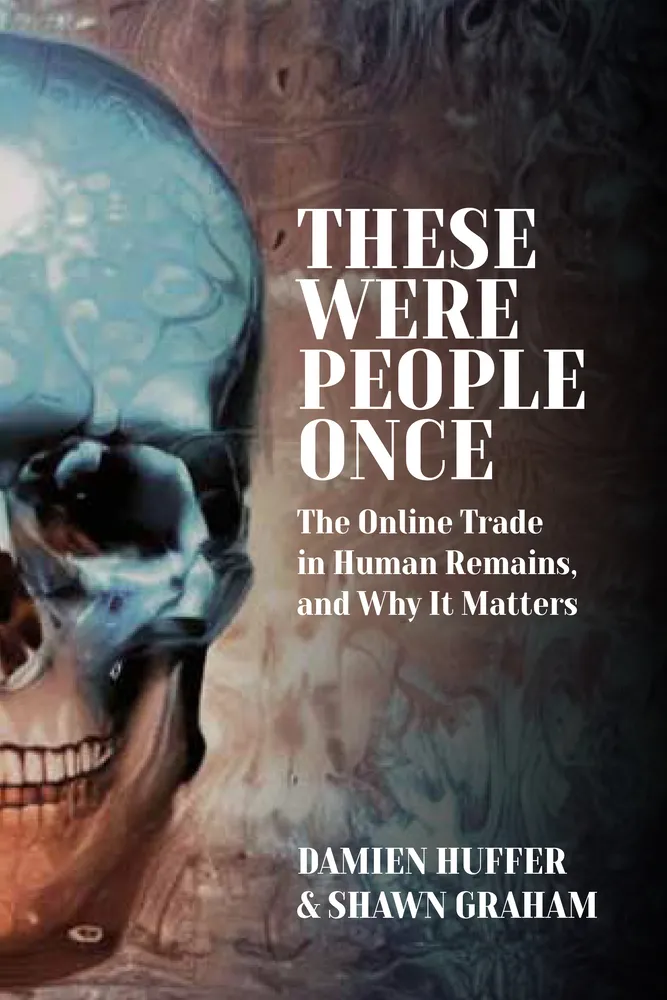
People buy and sell human remains online. Most of this trade these days is over social media. In a study of this 'bone trade', how it works, and why it matters, the authors review and use a variety of methods drawn from the digital humanities to analyze the sheer volume of social media posts in search of answers to questions regarding this online bone trade.
An estimated 350,000 African artefacts and manuscripts, as well as human remains, photographs and natural history specimens, have been found in the stores and archives of the eight museums and the Botanic Garden which together make up the University of Cambridge Museums, as well as the University Library and less-well known collections in university departments and institutions.
The project, running until March 2025, highlights objects associated with the ship Saida. His Majesty's Ship Saida was built in 1878 and sailed from the main naval harbour of the Austro-Hungarian monarchy in Pula, Croatia. From 1884 to 1897, ship's doctors and other crew members collected objects, partly on behalf of the museum, during four so-called training voyages.
[ in German ] The draft law on the return of cultural property from colonial contexts has been shelved for the time being. It did not meet with the approval of the ruling Österreichische Volkspartei ÖVP (Austrian People’s Party).
Justin M. Jacobs examined the allegedly immoral provenance of Western museum collections and challenges the widely accepted belief that many of Western museums’ treasures were acquired by imperialist plunder and theft.
Although there is no lack of information on individual repatriated works, the larger picture of where they came from and how, who is returning them and why can be lost in the anecdotes. This is where the Museum of Looted Antiquities (Mola) comes in—a new digital platform that traces not only the histories of specific repatriated objects but also compiles metadata in order to better understand smuggling networks and the museum industry’s intensifying repatriation efforts.