In 1590, the aristocratic Matsumae clan gained exclusive trade rights with the Ainu. It was the start of the colonisation of the Ainu homeland. Japan developed Hokkaido Island into a “frontier land” akin to that of America. Following the USA, Great Britain, and other European countries to “develop” the region. American businessman and agriculturalist Horace Capron was the first. Their expertise was predominantly as a defence mechanism against Russia’s threat of the time.Meiji Restoration in 1868, Japan sought expertise from scholars in the USA, Great Britain and other European countries.

Hokkaido – Courtesy Wikimedia
However, Ainu bodies have historically been used both to reflect and to reinforce ideas of primitivism, emphasising that they are inherently inferior to those of Japanese or Western descent. The Ainu have a long history of organising themselves to resist their colonisation. But it was not until 2019 that the Japanese Parliament enacted the Ainu Policy Promotion Act. It officially recognises the Ainu as the country’s Indigenous people. One year later, the Ainu got their own museum: the Upopoy National Ainu Museum and Park on Hokkaido’s south coast.
The Role of the British Empire
Both Western and Japanese scholars collected Ainu remains to study racial differences. Regarding the five sets from London’s Natural History Museum, the Japan Times reported, however, that the museum must have more: “[i]n Britain, three more sets of Ainu remains and an additional ten sets that may be Ainu have been confirmed at the Natural History Museum in London,” implying that there are thirteen sets. If the repatriation is now limited to only five sets of ancestral remains, it begs the question: why have the other eight sets been rejected?
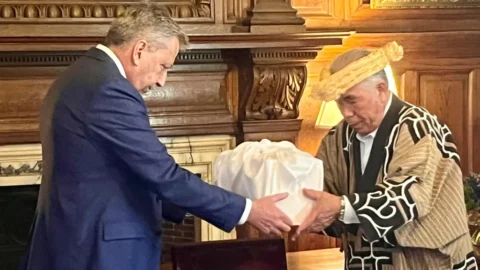
Okawa Masaru (Ainu Association of Hokkaido) receives Ainu remains from Peter Mathieson (University of Edinburgh) – Courtesy BBC
The involvement of the Japanese government, Western institutions, and the Ainu community is often underplayed in the media and academic articles. This highlights the need for a comprehensive understanding of the reparations and repatriation movement. The good news is that the Natural History Museum’s repatriation indicates British acknowledgement that these remains were acquired through colonial looting.
Nowadays we know that members of the British consulate secretly excavated the ancestral remains, including children, from Ainu territories and brought them to the consulate in the treaty port of Hakodate. They initially denied involvement but later admitted guilt, implicating Captain Francis Howard Vyse (1753-1853). Some remains were returned at the time, but events like anatomist George Busk’s 1868 lecture at the Ethnological Society of London on an Ainu skull made these objects highly sought after. Busk got his skull from the renowned biologist Thomas Huxley, who probably obtained it himself from these looted specimens.
The Indigenous Viewpoint
In 1945, the Ainu Association of Hokkaido was established with government collaboration as a coordinating body for various Ainu groups. Initially under state control, it aimed to assist in the assimilation of the Ainu community. Over time, it gradually gained more independence to promote public understanding of Ainu issues, including archaeological matters. Elders and leaders are recognised as authorities on cultural concerns, such as the repatriation of ancestral remains, since open dialogue about collection practices is crucial for authentic reconciliation.
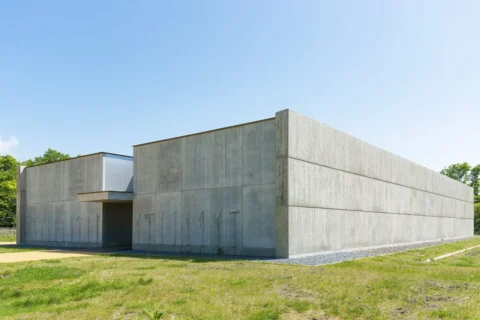
Ainu Memorial – Courtesy Upopoy Museum
Indigenous histories often differ greatly from the narratives created by nation-states and archaeologists. In Japan, the main issue is less the story itself and more how it is presented. While the Japan Times mentions the excavation sites, it lacks additional details, prompting questions about the underlying motivations. Often, human remains in these sorts of collections have very limited labels, with erased or undocumented provenance.
The Natural History Museum’s collection is impressive, holding the world’s largest collection of natural history literature, but it also avoids questions; the repatriation of the five remains might suggest reluctance to reveal how they were acquired.
The British Museum Act (1963) limits the management of “disposal” of cultural objects and human remains in national museums, mainly banning disposal but allowing the return of remains under the Human Tissue Act (2004). This legal framework can hide the British Empire’s destructive actions. Meanwhile, Indigenous Ainu ancestors are again devalued and treated as ‘objects’, repeating history and spreading misinformation about Indigenous nations.
In Japan, museological development is usually cautiously approached. The status quo often leads to resistance to change and a slower pace than in other nations. This demonstrates that traditional (de)colonial models are not equally effective everywhere.
Responsibilities of the Japanese Government
With the opening of the Upopoy museum, the Japanese Government had to establish guidelines for repatriating Ainu ancestral remains. This was a step in the right direction. The government chose to store all repatriated Ainu ancestral remains in a memorial facility located near the museum. A policy that continues today.
While ancestral remains have become a central concern shaping Ainu identity, focusing solely on their repatriation risks undermining wider reparative efforts. Although their repatriation can comfort the spirits of ancestors and their descendants, it may also impose a heavy burden on the communities responsible for ensuring a respectful reinterment.
The View from Japan
Does this recent surge in Ainu repatriations indicate a significant shift in Japan’s approach to its Indigenous populations? Mr Hitoshi Kikawada, the Minister of State for Okinawa and Northern Territories Affairs and Ainu-Related Policies, would answer this question in the affirmative. He stated in the Japan Times, “It will finally be possible to commemorate them [Ainu ancestors] in their homeland once they are returned.” He also added, “[w]e would like to firmly proceed with the return process, while making sure that the pride of the Ainu people is respected.”
At first glance, this statement seems respectful and progressive. But it remains unclear how much emphasis is placed on Ainu-related issues. This scepticism arises because the same Mr Kikawada serves as the Minister responsible for a wide range of other policy areas and for addressing many of Japan’s internationally negative perceptions.
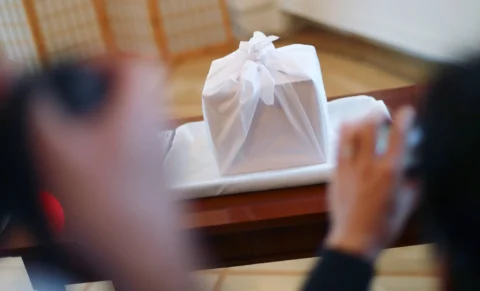
Handover Ainu skull – Courtesy Japan Times
Clearly, the Ainu merit dedicated representation, perhaps even their own minister. The era of perceiving the Indigenous Ainu as a negative symbol of Japan has come to an end. For now, the question remains: whether the politics of recognising the Ainu will stay tied to this archaeological background or move beyond it. As long as these ancestral remains are understood in this way, their repatriation will boost Indigenous self-awareness by developing a recognition system that promotes the global expression of their identity.
However, it also offers the potential to confine the Ainu within a resistance-based framework of acceptance that is widespread across much of Japan. Will views on repatriation continue to mainly focus on safeguarding the reputation of the British and Japanese Empires, often at the cost of indigenous peoples’ dignity? This perspective is fundamentally unjust, yet it also provides valuable insights.
Although many consider the imperial histories of Britain and Japan to be quite distinct, they share similarities that can teach us valuable lessons moving forward. The extensive exchange of ideas among imperial and colonial nations, particularly through anthropological and archaeological networks, has significantly influenced academic discourse.