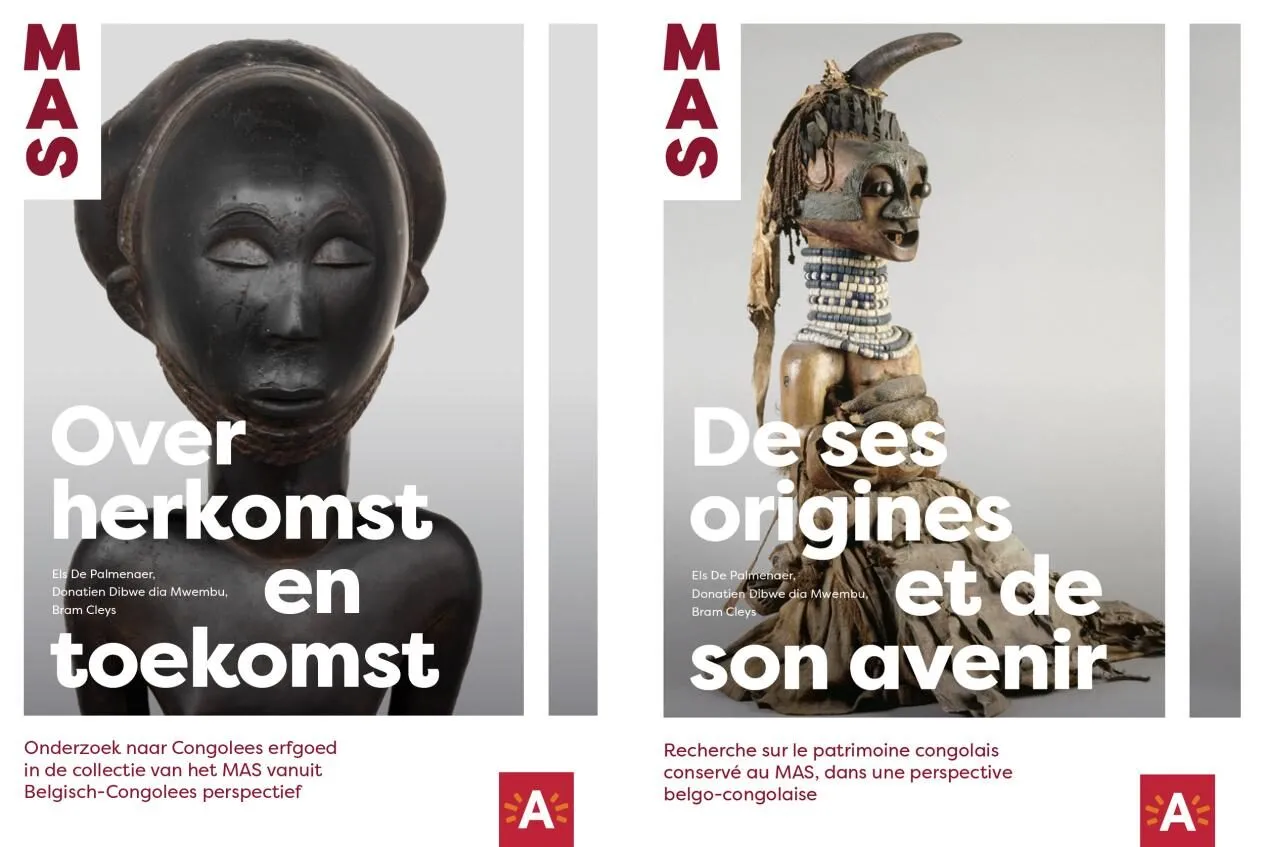
From 2022 to 2025, the MAS investigated the provenance of several important cultural objects from its Congolese collection.
The publication focuses on three cultural objects and combines archival research with oral testimonies from Congo. It also includes contributions from external authors on oral history, restitution, legal frameworks, and provenance research. The entire collection offers new insights that are important for dialogue, restoration, and the future of the collection.
Three Key Pieces The three pieces each demonstrate in their own way how Congolese heritage disappeared from its communities in a colonial context. Not all details can be determined, but the research did lead to new insights and collaborations with Congolese communities and researchers.
- The power statue (nkishi) of Chief Nkolomonyi belonged to a Songo Meno chief who resisted colonial occupation. After his arrest in 1923, his possessions, including this statue, were confiscated. Thanks to archival research and new testimonies, the violent seizure by the Belgian colonial ruler can now be reconstructed.
- The two pre-colonial wrought-iron Kuba statuettes belonged to the royal court art in Mushenge. The king gave them to a colonial official in the early 20th century, presumably under pressure from the military conquest of the Kuba empire. They were acquired by the Museum Vleeshuis in 1920 through the Antwerp merchant Henri Pareyn.
- The Hemba memorial statue of a chief (singiti) was an heirloom of a Hemba clan leader. How it disappeared from the community is no longer known, but Congolese informants point to the pressure of missionary work. Research in Congo has yielded new insights: a “singiti” means “pillar of support” and was always displayed wearing a loincloth.
The provenance research conducted by Els De Palmenaer (Curator of Africa at the MAS), Prof. Donatien Dibwe dia Mwembu (Congolese project leader and researcher, UNILU Lubumbashi), and Bram Cleys (Belgian project leader and researcher), with fieldwork by three Congolese researchers: Philippe Mikobi Pongo, Dieudonné Kabuetele, and Constantin Kasongo Kitenge.