Lia Iannarilli and Malaika Bunzigiye conclude: The story of looted art from the Democratic Republic of the Congo is inseparable from broader struggles of political sovereignty. By holding on to these items, European powers are holding on to the narrative of their colonial rule. In a world shaped by imperial legacies, the decolonial project must be both material and symbolic. To repatriate art is to repatriate power.
An important moment! Congolese and Belgian experts presented their recommendations for the future of institutional provenance research at an open forum: ‘The current framework is insufficient.’
[in French] The PROCHE project, implemented by the Royal Museum for Central Africa, is part of the 2022 Belgian law on the restitution of colonial collections. It aims to retrace the conditions of acquisition of the museum's so-called "ethnographic" and musicological objects, in close collaboration with Congolese institutions and cultural actors.
[in French] This issue of Relations Internationales, edited by Anne Sophie Gijs, Matthieu Gillabert and Serge Jaumain offers a range of interesting articles about restiution issues, museums, diaspora groups and communitie sof origin, mostly in Switzerland and Belgium and in African countries as Cameroon and DR Congo.
[in French] Yasmina Zian, Aline Bosuma, Alexandre Chevalier and Laurent Licata make critical remarks about Belgium's decolonisation of museums effort. Belgium keeps control over decisions and there is a lack of a balanced dialogue with the DRC.
Thomas Laely writes: The debate on the repatriation of (in)tangible cultural heritage and belongings has developed a broad dynamic in recent years. This sudden activism raises questions. What is its background, what are the goals behind it, and how are they to be achieved? Is it primarily about African or rather European interests?
During negotiations in the 1960s about a new relationship, DR Congo claimed the archives with information about its rich natural resources. Belgium was not prepared to do so. The documents, housed at the AfricaMuseum are now being sought by DR Congo and KoBold Metals, a Bill Gates-backed mining and artificial intelligence company that struck a deal last year with Kinshasa to digitise them.
[in French] On 7 February 2026, an open forum at the AfricaMuseum in Tervuren follows on two public events that took place in December 2025 in Kinshasa where researchers, heritage institutions and partners from both countries engaged in discussions on various themes in connection with provenance research and restitution of cultural heritage.
[mostly in French] Based on research in the DR Congo, Vicky Van Bockhaven explores a tension within contemporary museum and cultural policies, focusing on the decolonisation of colonial collections and associated knowledge production. These initiatives often remain under the control of Western institutions, leaving the concerned countries and communities unequally involved.
[ in French ] The exhibition draws on more than eighty photographs from colonial archives, mainly held at the Royal Museum for Central Africa in Tervuren. But far from a simple presentation of heritage, Boma La Première offers a critical reading of these images.
[ in French ] The AfricaMuseum in Tervuren, Belgium, changed from a ‘museum for colonial propaganda’ and a ‘museum of avoidance’ into one that ‘multiplies voices on colonial history and its persistence’, says historian Yasmina Zian.
[ in French ] What does decolonization mean when power relations remain unchanged? Anne Wetsi Mpoma invites us to rethink decolonization as a political, epistemic and restorative process — where art becomes a space of resistance, reappropriation and symbolic justice.
[ in Dutch, in French ] The MAS in Antwerp investigated the provenance of three important cultural objects from its Congolese collection. How did they end up in Antwerp, and what do they mean to Congolese communities today? The results are published in the new publication "On Origin and Future" and incorporated into the permanent exhibition.
[ in Dutch ] Time is running out to return the hundreds of human remains collected by soldiers, missionaries and others in Congo, says historian and anthropologist Lies Busselen. The combination of archival and fieldwork in Belgium and Congo continuously encourages us to reflect on the colonial past.
American firm KoBold Metals' desire to scan the Congolese geological archives is causing embarrassment in Belgium, which holds a large collection inherited from the colonial era. A project for the digitisation of said archives for research purposes backed by EU funding is already underway.
[ in Dutch ] Tervurologie sets its sights on the AfricaMuseum and radically bets on imagination - to think new Tervurens, plural. Not as escape, but as intervention. Not as recovery, but as restart. Not as an answer, but as another question. Tervurologie is an attempt at exorcism.
[ in French ] Study day organised as part of the PRD-ARES project (ULB-UNILU-UCLouvain) ‘Towards the psychosocial reappropriation and resocialisation by the source-communities of Katanga of the remains of former soldiers to be repatriated and the cultural objects to be recovered’.
The article 'Hidden Colonial Legacies and Pathways of Repair'investigates how the question of ancestral remains out of colonial contexts in Belgian museum collections is understood in the DR Congo.
[ in French ] The article 'Between Belgian archives and Congolese oral sources in provenance research. The case of the statue of Chief Nkolomonyi at MAS (Belgium)' examines the value of sources in the country of the former coloniser and that of the ex-colonised. It broadens the scope of provenance research.
The Bill of 3 July 2022 to recognize the alienability of goods linked to the Belgian State’s colonial past and to determine a legal framework for their restitution and return (“the Restitution Bill”) puts Belgium at the forefront of international restitutions of colonial collections.
Why is research into colonial collections in the private sector - I mean art dealers, auction houses and private collectors - so tough? The main reasons is that most of them have built a wall around themselves, and there is rarely a hole in this wall through which an outside observer can look inside their closed bulwark.
During the European expansion constant fighting and violence and the taking of spoils of war went hand-in-hand. Palaces, shrines, homesteads and entire villages were plundered and destroyed. In the restitution debate, the focus is mostly on state-collections resulting from these confrontations. There is ample evidence, however, that many more parties were involved. This blogpost has some of the evidence.
[ in French or in English ] Provenance research into non-Western heritage in Europe has become a must in the field of museology and cultural policy. Yet no scientific work has yet examined the collections of the Royal Museum for Central Africa in Tervuren (Belgium) in their entirety.
[ in French ] President Tshisekedi of DR Congo, currently chair of the African Union, has made restitution priority. It is interesting to read what the Director General of the Kinshasa Academy of Fine Arts, Henri Kalama Akulez, has to say about it.
How do we trace the origin of collections? What new insights can be gleaned from these provenances? And what should become of such collections, within and beyond museum walls?
After almost 70 years in the Africa Museum, the rare Kakungu mask is back in Congo. Despite the festive ceremony at the National Museum, the mask remains the property of Belgium, causing unrest among the Congolese people and the Suku community, where the mask originally came from.
In the colonialist moves to collect human remains, and the desire to demonstrate grandeur and strength, many soldiers relied on racist and blood-thirsty narratives to rationalize their cruel actions.
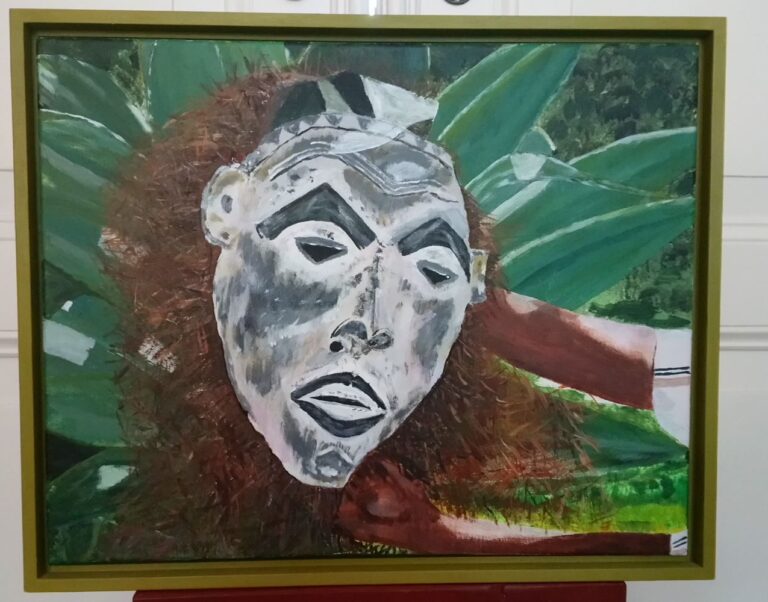
Long ago, I held this Congolese mask in my hands. The dealer claimed it to be very old; he was keen to sell it. But unlike other wooden pieces, which he offered for little money, he asked a big sum for this one. Perhaps, it was indeed old and valuable. Back then, the mask struck a chord with me. Nowadays, it still does.
Exactly 130 years ago, the World Exhibition took place in Antwerp. For that occasion, 144 Congolese were exhibited at the KMSKA. Seven Congolese died. The AfricaMuseum, which has a similar colonial history in Tervuren, organizes an online MuseumTalk about the memory and commemoration of this tragedy. The speakers are a researcher, an activist and an artist.