RM* is trying to get more grip on cultural and historical treasures that disappeared from Middle Eastern countries during the European imperial period. In this contribution, Shabnam Balouch, an Iranian working in cultural heritage, discusses the label ‘Islamic Art’.
Every year on 18 November, UNESCO marks the International Day of Islamic Art, established in 2019 to celebrate artistic achievements and encourage intercultural dialogue. While I appreciate the intention behind this day, as an Iranian working in cultural heritage, I have always felt uncomfortable with how an enormous range of artistic traditions from different countries, cultures and historical periods is grouped under one religious classification: Islamic art.
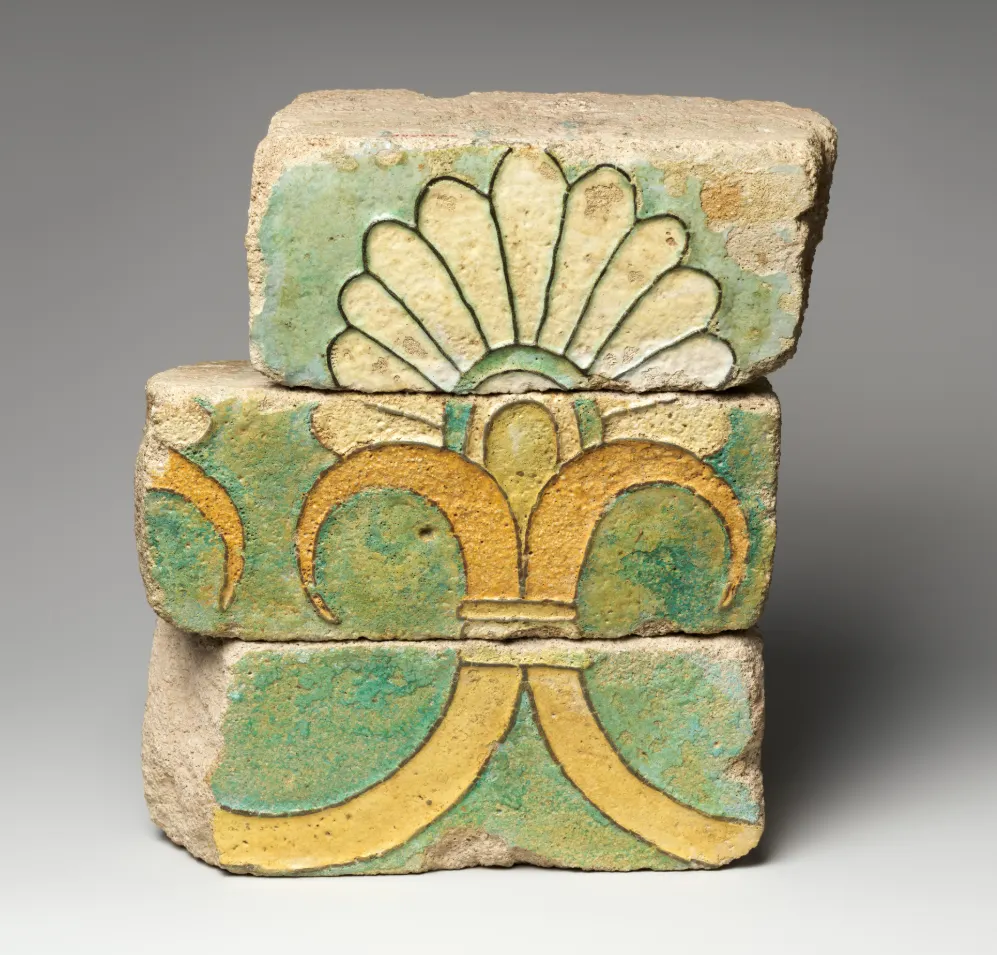
Glazed bricks with a palmette motif , Achaemenid, 6th–4th century BCE · Susa, Iran – These colourful glazed ceramic fragments feature stylised plant ornament, centuries before Islam. – Courtesy Metropolitan Museum of Art
Iran had already developed extraordinary artistic traditions long before the seventh century. From the monumental architecture of the Achaemenid Empire to Parthian architectural innovations and the elaborate metalwork, textiles and decorative arts of the Sasanian period, Persian artistic heritage was already rich and sophisticated.
These traditions did not simply disappear with the arrival of Islam. They continued, evolved and influenced artistic production under later dynasties. Sasanian metalwork, with its royal hunting scenes and animal motifs, influenced later decorative arts. The iwan, an architectural form with important pre-Islamic Iranian roots, became a defining feature of many later mosques and palaces. Decorative patterns, craftsmanship and artistic knowledge continued across political and religious changes.
I am not arguing that museums should abandon the term Islamic art altogether. It remains a useful field of study, particularly when exploring artistic exchanges across different regions. But I believe we need greater geographical and cultural specificity, alongside clearer explanations of artistic continuity.
An object can be Persian, produced under an Islamic dynasty, influenced by pre-Islamic traditions and connected to wider artistic exchanges, all at the same time. These histories do not contradict one another, and our interpretation should reflect that complexity.
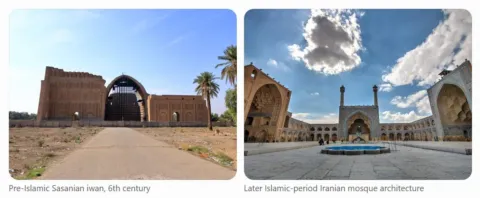
Taq Kasra alongside a photograph of the Jameh Mosque of Isfahan. This comparison shows how the iwan was incorporated into later religious architecture, rather than suggesting that the buildings are identical.