A late coloniser
Like Belgium and Germany, Italy was a late coloniser. After participating in the Berlin Conference of 1884-1885, Italy colonised three territories in Northeast Africa: Eritrea (1890), Italian Somaliland (Somalia) (1905), and Libya (1911).
So far, I have not found information about official war booty shipped from these areas to Italy. Italian history does not include any episodes in these colonial areas comparable to the looting of Benin, Asante, Abomey or Lombok.
However, Italian soldiers and administrators did privately appropriate numerous cultural and historical objects. This circumstance makes it very difficult for former colonies – especially Eritrea and Somalia – to file claims.
- Eritrea In 2006, Eritrea demanded the return of archaeological objects taken by Italian amateur-diggers from the ancient site of Matara. It is not known, whether this led to any returns. In general, descendants of private collectors who wish to dispose of their collections donate these to museums in Italy, usually without much documentation.
- Somalia Somalia has repeatedly claimed objects and ancestral remains that disappeared during the Italian colonial era. In 2021, Somalia and Italy resumed talks. Some items have been returned but most remain in Italy.
- Libya Libya has been more successful. One reason is that Italy needs – as the third European investor in Libya – this country not only for oil but, in recent years, also for migration management.

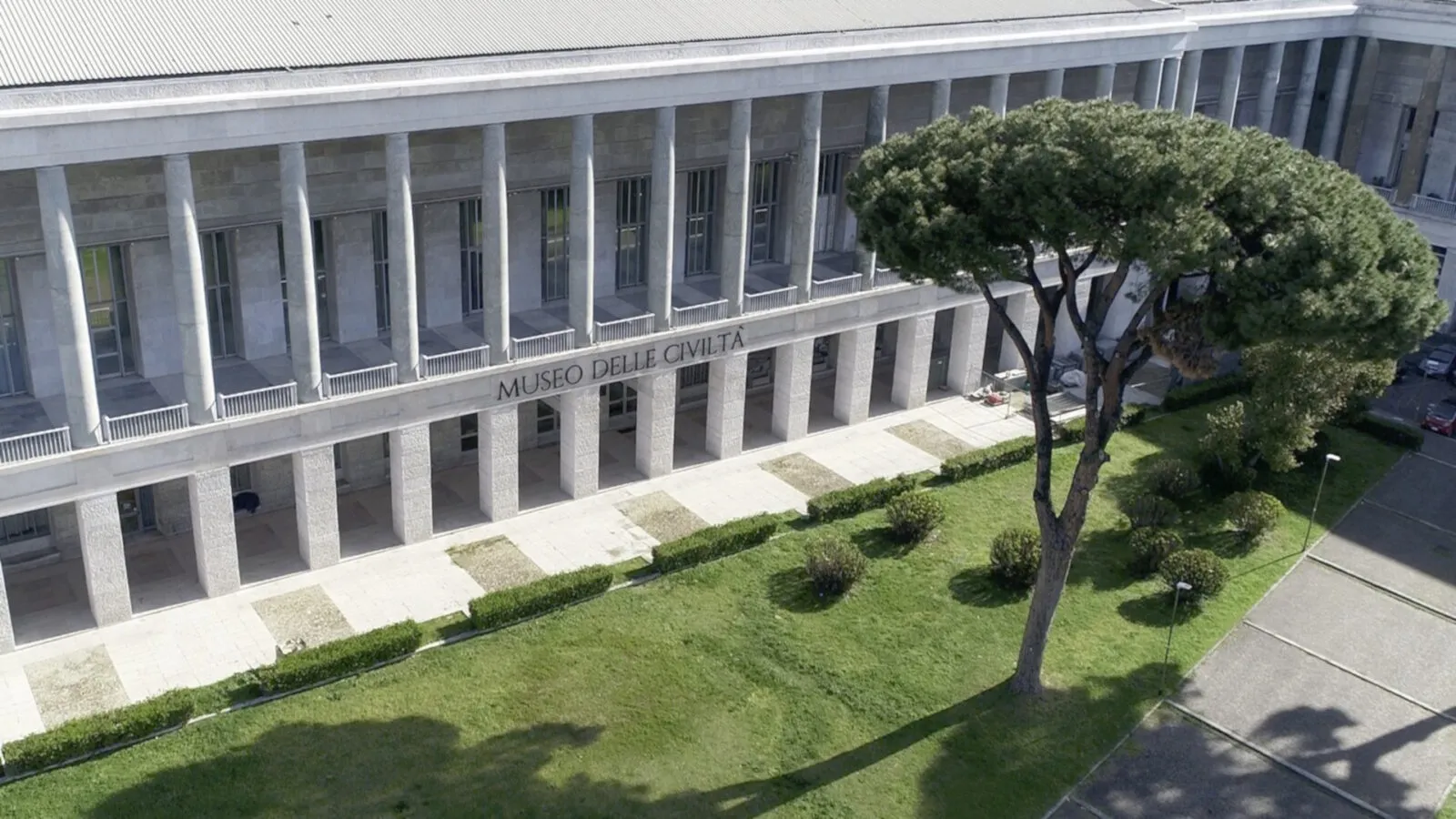
Today, most colonial collections can be found in the MuCiv in Rome, the Musea delle Civiltà
Courtesy MuCiv – Musea delle Civiltà, Rome
Two notable returns to Libya
After the Second World War, Italy – as a country that had lost this war – was supposed to return treasures taken from colonial possessions within eighteen months. But, as Beatrice Falucci has shown, the Italian government avoided to take action, often arguing that these treasures were ‘safer’ in Italy than in an African country like Libya.
Nevertheless, Libya did receive two looted objects: the Venus of Cyrene and Venus of Lepcis Magna.
Return of Venus of Lepcis Magna in 1999
Fiona Rose Greenland describes how archaeologists at Lepcis Magna discovered the marble statue in 1924 and how the Italian Governor-General of Libya donated it to Nazi leader Hermann Goering in 1940. After the Second World War, it was taken to the Soviet Union but in 1958 it returned to Germany. When, in 1999, the Pergamon Museum in Berlin discovered it in storage, the then East-German government sent it to Italy. At that point, the Libyan government had already demanded its repatriation. In December 1999, the Italian administration brought the statue back.
Return of the headless Venus of Cyrene statue in 2008
In 1913, Italian troops took this ancient statue from the ruins of a Greek and Roman site. Libya had requested its restitution for the first time in 1989. At the same occasion in 2008, when the Rome administration handed over 5 billion dollars in compensation for damage inflicted in the period 1911-1943, the statue was returned. This was almost two decades after the two governments had reached agreement on its return – as Alessandro Chechi shows – but an Italian NGO had filed a lawsuit against the Italian Ministry of Culture for the annulment of the agreement with Libya. It was not until 2007 that a judge rejected this claim.

Earlier, in 1982, Italy had returned the Goddess of Butrint to Albania. This important sculpture had been discovered in the ancient city of Butrint in 1928, when Albania was occupied by Mussolini’s soldiers. The sculpture is known under different names: Head of Dea (dea = goddess), Dea of Butrint, Goddess of Butrint, Head of Apollo. Currently it is presented as ‘Head of Appollo’ in the Pavilion of Antiquity of the National Historical Museum in Tirana.
Courtesy National Historical Museum, Tirana
Italy’s invasion of Ethiopia
The relationship between Italy and Ethiopia is a chapter unto itself. It begins with the nature of Italy’s invasion into the then Abyssinia in 1935. For Prime Minister Mussolini’s Italy, the invasion was part of a colonial adventure and a belated revenge for the defeat at Adwa in 1896. There, Abyssinian Emperor Menelik had defeated the Italian forces. Ethiopia claims to have never been colonised. For Emperor Haile Selassie’s regime, the invasion was a temporary occupation. Regardless of the word used, it is certain that Ethiopia suffered the impact of Europe’s colonial expansionism.
In Africa e Mediterraneo, Alula Pankhurst and I have mapped out how Mussolini’s troops looted many hundreds of imperial archives, thrones, crowns and other ceremonial objects and pillaged Ethiopian Orthodox Churches and monasteries.
The precise size of the loot is hard to assess but what we know for certain is that principal Fascist leaders were involved. Italy’s viceroy in Ethiopia, Pietro Badoglio, needed three hundred cases to ship his share in the booty home. General Rodolfo Graziani seized hundreds of ancient religious manuscripts. He donated almost three-hundreds of these to the Vatican, where they are still kept in the library. A diaspora-group has been asking for their return for decades.
Ethiopia: a 1956 list
The Italians were expelled from Ethiopia in 1941. A few items, found by allied forces in Rome after the Second World War, were returned to the emperor almost immediately. But Italy itself was very slow in returning more.
This slow pace was despite a 1956 agreement between the two states on ‘the settlement of economic and financial matters issuing from the Treaty of Peace and Economic collaboration’. The settlement has two annexes with detailed lists of objects and collections to be restituted.
Among these are the Imperial Government’s archives, imperial statues, thrones, numerous objects made from gold, silver or precious materials, paintings from three emperors, and gifts from German Kaiser Wilhelm II, Kaiser Franz Joseph of the Habsburg Monarchy, and Czar Nicholas II of Russia to Emperor Menelik II (1844-1913).
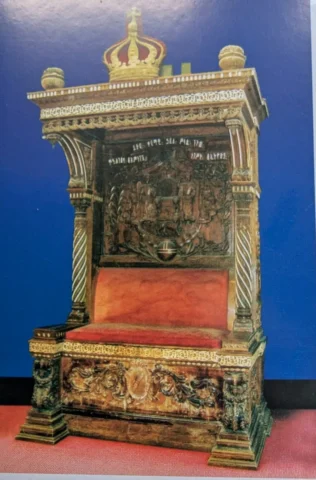

Throne Emperor of Haile Selassie and chair of Empress Menen, returned by Italy in 1972 and now in National Museum, Addis Ababa
To date, only few of these items have been returned.
- Around 1970, a statue of the Lion of Judah, some imperial statuettes, a throne of Emperor Haile Selassie and a chair of Empress Menen were transferred. They are currently in the National Museum in Addis Ababa.

Obelisk, ready to be erected again in Axum
- In 2008, the most significant restitution undertaken by Italy took place: an obelisk – length 24 metres, weight 160 tonnes and possibly the heaviest restitution ever. In the 1937, Mussolini ordered it to be shipped from the holy city of Axum in the north to Rome. There it was unveiled opposite the Ministry of Colonies (later FAO Headquarters). It is back in Axum.
- In 2024, Italy returned the imperial military aircraft “Tsehay,” the first aircraft built in the African country, which had been confiscated during the fascist occupation. The aircraft had also been requested since the immediate post-war period. It can be seen in the new Adwa Museum in Ethiopia’s capital.
Incidentally, objects circulating among private collectors and in the art trade, are claimed by the Ethiopian Heritage Authority. An example are a sword and cloak of a national hero which surfaced on the website of an Italian auction house in March 2025.
General: a 2022 list
In 2022, a team of museum directors, university researchers and scholars has been conducting a ‘census’ of the collections in the 498 Italy’s state museums to gain insight into their weapons, artifacts, and ritual objects. According to Nicole Winfield, this should help the government respond to restitution requests.
The audit, which began under the previous government, is continuing under Prime Minister Giorgia Meloni. But after four years since its establishment, no results that are tangible for former colonial areas have been achieved.
-.-
When it comes to its own vanished heritage, Italy is quick to respond. It has a well-organised art squad Comando Carabinieri per la Tutela del Patrimonio Culturale at its disposal with regional offices. Through the years, it has been successful in recovering stolen objects from museums and private collections in the US and Europe. In June 2025, it reopened the Museo dell’ Arte Salvata (Museum of Rescued Art) for showing recovered objects from Italian archaeological sites.
The country has admittedly begun to reckon with Fascist-era colonial collections and the knowledge about these exists within the government, museums and academia is increasing. There are sufficient claims from Africa to realise restitutions. However, the restitution of collections captured by Italy and Italians from its colonial possessions is happening at a snail’s pace.
Considering the current political atmosphere, if returns are done, they are likely to be used for oiling relations with African countries. Like France, Italy is fighting for their loyalty and has set up a multi-billion-dollar fund in 2024 (so-called Mattei Plan for Africa), aimed at Algeria, DR Congo, Egypt, Ethiopia, Ivory Coast, Kenya, Morocco, Mozambique and Tunisia.
The author thanks Maria Pia Guermandi for her comments.