Restitution beyond legal ownership
The Nandi claim cannot be reduced to a technical dispute over property ownership, accession registers, or museum de-accessioning rules. Ancestral human remains differ fundamentally from ethnographic artefacts or commercial commodities. Within Nandi cosmology and customary responsibility, ancestors maintain an enduring spiritual and moral bond with the living, the land, and collective memory. Proper burial rites and ancestral placement anchor communal harmony. The unresolved absence of Koitalel’s skull therefore inflicts a continuing injury that disrupts cultural continuity, spiritual obligations, and the community’s ability to honour its foremost historical leader.
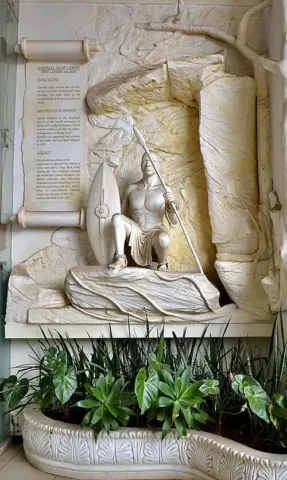
Sculpture of Koitalel Arap Samoei in the Kenyan National Library Service building
Broken promise
This wound cuts deeper because of the treachery surrounding his death. For over ten years, Nandi-leader Koitalel directed sustained resistance against British conquest and the Uganda Railway across Nandi territory to Mombassa. On 19 October 1905, Captain Richard Meinertzhagen of the King’s African Rifles arranged an ostensible truce parley at Ketbarak near present-day Nandi Hills, inviting Koitalel and his entourage to negotiate peace. Instead of honouring the truce, Meinertzhagen shot Koitalel at point-blank range as they stepped forward to shake hands, signalling a pre-planned ambush that slaughtered his companions.
For the Nandi, the betrayal of a sacred peace parley and decapitation of their spiritual leader compounded military conquest with profound spiritual desecration. This pain is symbolized today by the empty symbolic grave beside his three returned ceremonial staffs at the Koitalel arap Samoei Museum in Nandi Hills.
Viewing restitution as repair requires confronting how colonial systems of power still govern archives, museums, and evidentiary rules. As Sabelo J. Ndlovu-Gatsheni demonstrates in Epistemic Freedom in Africa: Deprovincialization and Decolonization, dominant institutions have long subordinated African historical knowledge while treating Eurocentric records as universally authoritative. Genuine repair demands recognising Nandi authority to define harm, interpret collective experience, and govern remedies rather than treating the community as passive petitioners.
Lessons from Mkwawa and Yagan
The Nandi claim has instructive historical parallels. In 1954, the skull of Chief Mkwawa of the Hehe people—removed by German colonial forces in 1898 was returned to Tanganyika. His return demonstrates that time neither extinguishes historical accountability nor prevents states from arranging return when political will aligns with sustained advocacy.
A second parallel is the repatriation of the head of Yagan, a Noongar resistance leader killed in Western Australia in 1833 whose head was taken to Britain and buried in an unmarked Liverpool grave. Following decades of advocacy by Noongar elders, Yagan’s remains were repatriated from Britain in 1997 and laid to rest in a community-led ceremonial burial in 2010. Yagan’s experience underscores a vital distinction between institutional handover and genuine repair: transferring remains across borders is only the first step, whereas substantive justice depends on descendant communities controlling post-return ritual, burial, and remembrance.
The problem of archival silence and oral memory
A central hurdle confronting the Nandi claim is ongoing uncertainty over the skull’s whereabouts. While media reports have frequently linked Koitalel’s remains to British collections including the Pitt Rivers Museum (PRM) in Oxford, UK, institutions have denied holding the skull. Recent engagement under the PRM’s Rethinking Relationships initiative alongside discussions at the First International Koitalel Conference in March 2026 have focused on access, interpretation, and Nandi cultural belongings rather than confirming custody of his remains.
This uncertainty exposes a deeper structural problem in how historical proof is constructed. Colonial archives were compiled by imperial administrators and military officers who selected what to record and omit. As Achille Mbembe observes, silence within state repositories is itself an exercise of power rather than neutral proof that an event never occurred. Where Meinertzhagen’s diaries and official dispatches remain silent or contested, Nandi oral history and descendant testimonies preserved across generations recounting the disappearance of the Orkoiyot’s head after Ketbarak and the spiritual duty to reunite his remains with ancestral soil cannot be dismissed as secondary folklore. Rigorous inquiry must weigh colonial records alongside documented Nandi oral memory without uncritically assuming foreign possession or erasing community testimony.
Restitution as transitional justice and legal reform
Situating the Nandi claim within transitional justice and cultural heritage law transforms how remedies are designed. Rather than treating physical repatriation as an all-or-nothing outcome, a community-accountable framework links truth-seeking, formal acknowledgement, archival disclosure, memorial governance, and legislative reform. Internationally and regionally, this approach resonates with Article 12 of the United Nations Declaration on the Rights of Indigenous Peoples – which affirms repatriation through fair, transparent, and effective mechanisms developed jointly with the peoples concerned – alongside the 2023 Accra Proclamation on Reparations, the African Union’s Decade of Action on Reparations and African Heritage (2026–2036), and United Nations General Assembly Resolutions 79/133 and 80/250.
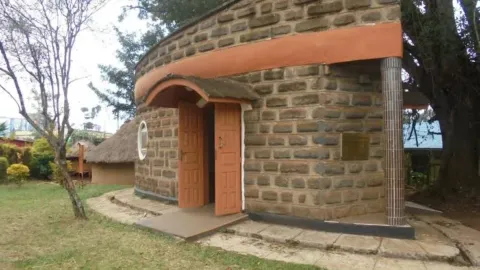
Koilatel Mausoleum
Domestically, recent developments in Kenya reveal urgent statutory gaps that reform must close. While the National Land Commission (Investigation of Historical Land Injustices) Regulations 2026 addresses colonial land dispossession between 1895 and 2010, ancestral human remains require distinct cultural and spiritual governance. Notably, although the Kenyan Senate passed the Heritage and Museums Bill 2023 on 21 July 2026 repealing the National Museums and Heritage Act 2006 and establishing a Heritage Tribunal under section 82 the Bill omits human remains from its Clause 2 definition of antiquities and lacks a community-led repatriation procedure.
Closing this gap requires four concrete reforms:
- First, inserting a dedicated Part on Ancestral Human Remains and Community Repatriation into the Heritage and Museums Bill 2023 would mandate joint governance among the National Museums of Kenya, county heritage committees, and descendant families, with disputes reviewable by the Heritage Tribunal.
- Second, establishing a bilateral provenance and archival disclosure protocol anchored in Article 35 of the Constitution of Kenya 2010 and United Kingdom museum guidance across Kenyan and British repositories would ensure evidential gaps are investigated openly.
- Third, instituting an interagency referral rule would distinguish remains restitution from land redress claims before the National Land Commission while coordinating communication.
- Fourth, adopting a community-governed post-return and memorial care charter for the Koitalel arap Samoei Museum and Nandi County Government would ensure descendant authority over ritual, burial, and interpretation whether the skull is recovered or remains unlocated.
Challenges and limitations
Significant legal and evidentiary obstacles persist. Apart from the 1970 UNESCO Convention’s and 1995 UNIDROIT Convention’s non-retroactivity provisions, under United Kingdom law, statutory de-accessioning powers under section 47 of the Human Tissue Act 2004 apply only to nine designated national museums, leaving university collections, charitable trusts, and regimental museums governed by institutional statutes and ethical frameworks such as the UK Department for Culture, Media and Sport Guidance and ICOM Code of Ethics.
Equally serious is the risk that restitution becomes purely symbolic if states and institutions treat return as a public-relations gesture devoid of truth-telling, institutional accountability, or descendant authority.
Conclusion
Return alone cannot heal the legacies of colonial violence, dispossession, and exile endured by the Nandi and Talai communities unless accompanied by transparent archival investigation and structural reform.
The unresolved absence of Koitalel arap Samoei’s skull is neither a minor curatorial puzzle nor a closed chapter of imperial history. It is a living reminder of colonial violence and an ongoing test of institutional accountability toward the Nandi people.
Whether his skull is ultimately located and returned or remains unrecovered, an accountable process grounded in epistemic freedom ensures that restitution marks not a symbolic formality, but the beginning of genuine repair.
Elsie Chelang’at is a law student at Kabarak University and a member of the Nandi community.