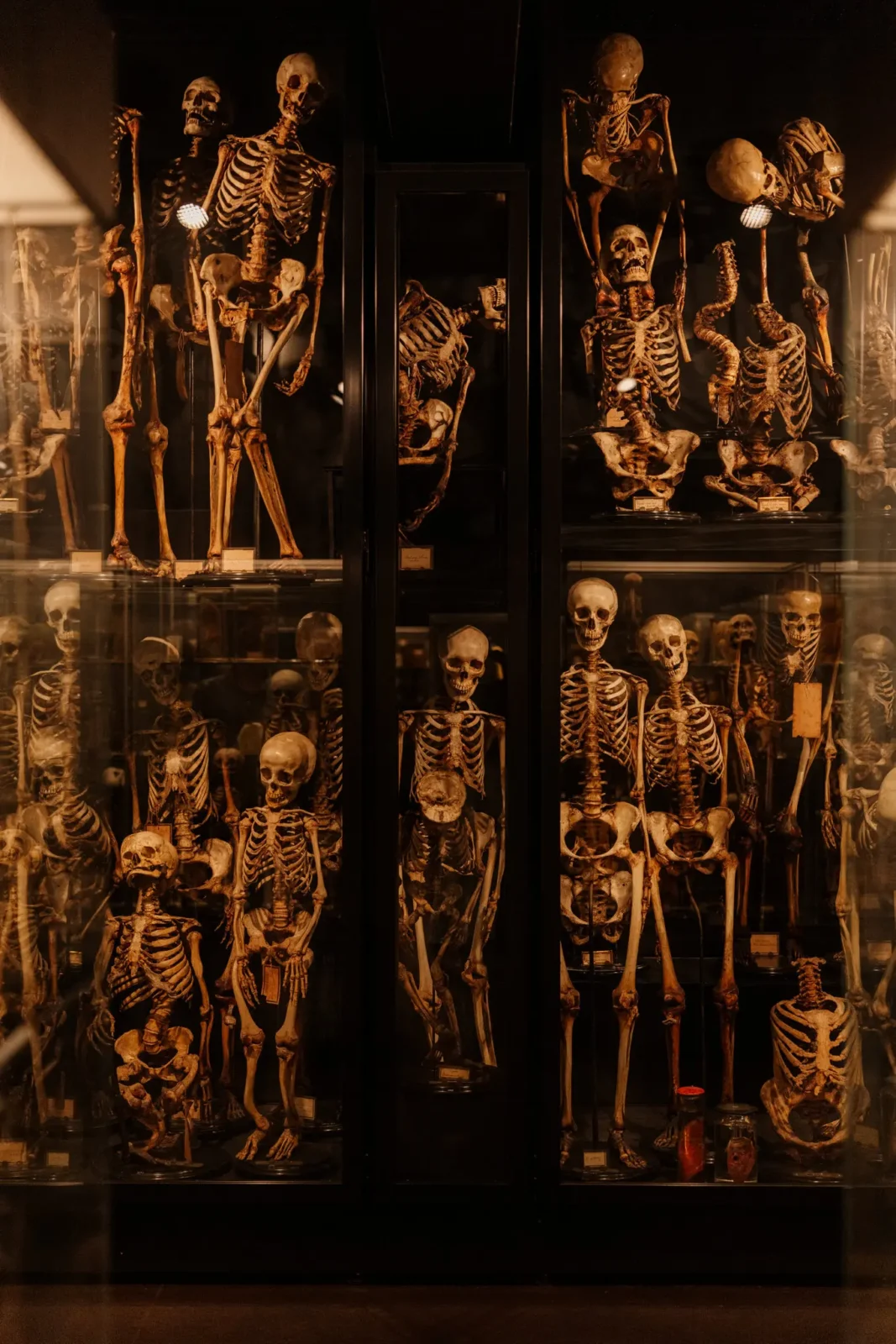
The skulls are absent, but are also present , their presence being marked only by the metal stands that once held them. They sit in otherwise empty display cases at the entrance to the museum.
The idea, said Laurens de Rooy, the museum’s director, is to call attention to these problematic troves. “What it should emphasize is the idea that, in an ideal situation, collections like these — racialized collections — should reach their final resting place, with their communities,” he said. “The empty stands show this important absence so we don’t forget these things happened in the past.”
The show explores a problem that faces the Museum Vrolik and many other European museums today: What to do with the colonial-era skeletons in their closets?
There are thousands of colonial-era human remains, including skulls, skeletons, mummies, hair and teeth, in European collections. Many are from anatomical troves that medical institutions used for scientific research, and others belong to natural history museums. Most were acquired from local hospitals, dug up from paupers’ graves or purchased through the commercial trade in skeletons. A small portion were gathered through archaeological looting or taken as trophies from colonized lands in Africa, Asia and Oceania.
While the United States has a 1990 law, the Native American Graves Protection and Repatriation Act, that requires cultural institutions to recognize and return Indigenous human remains when possible, the European Union doesn’t have any similar legislation to cover its member states’ colonial ventures. Instead, European institutions rely on a patchwork of local laws and regulations, and ethical guidelines set by individual countries or museum councils.
“What the museums have in common is that they all see it as a problem — and that’s already progress,” said Jos van Beurden, a repatriation expert and senior researcher at the Free University of Amsterdam. “They all deal with it in different ways, although there are many similarities,” he said. “Some are more proactive than others.”
The Karolinska Institute in Stockholm, founded in 1810, collected and measured skulls to study racial characteristics, among other things. It once held thousands of human remains, but in the 1940s it changed locations and many of the specimens were cremated or discarded. Only about 5 percent of the original trove remains.
Today, said Eva Ahren, the head of medical history and heritage at the Karolinska, said that about half of the extant 700 skulls came from non-European countries.
In the case of the Vrolik, the repatriation of the Moluccan remains was largely down to the efforts of Moluccan-Dutch Menucha Latumaerissa, who worked with de Rooy, the director, to find out that the skulls described in the 1917 book had been taken five years earlier, in 1912, from a village called Amtufu. A Dutch medical officer with the colonial army had removed them from their burial site and taken them to Amsterdam.
“It makes me sad,” Latumaerissa said in an interview. “The Dutch destroyed everything of ours, our language, our culture. First they forbid it, and we all had to become Christians and learn the Dutch language, and then they displayed and traded our ancestors’ skulls.”