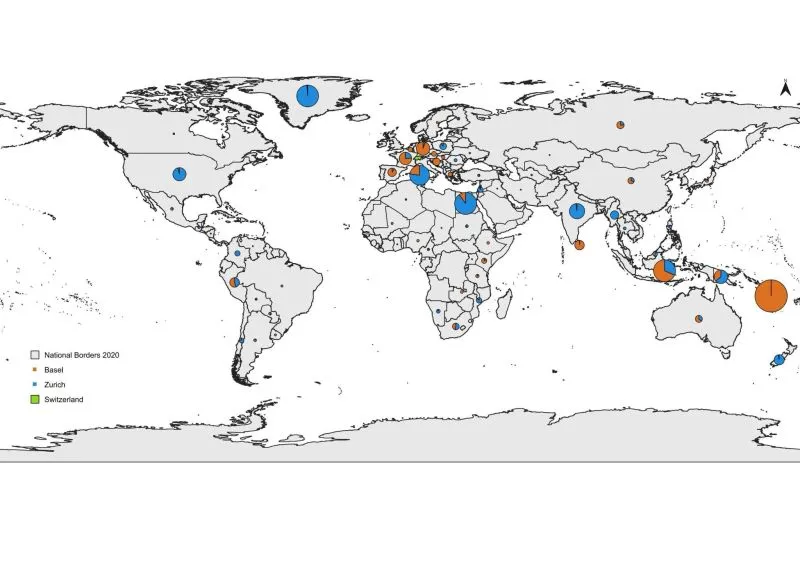

This map shows the provenance of c. 3,500 human remains in two of the largest colonial collections in Switzerland. In total, we estimate that Swiss collections hold c. 4,100 human remains from former colonies, alongside c. 20,000 remains of Swiss and European provenance. These were often collected alongside colonial remains, held in the same repositories, and examined from a comparative perspective.
These human remains constituted a core material infrastructure for the formation and evolution of the modern human sciences in Switzerland from c. 1850 to the present. The disciplines involved include ‘racial anthropology’, ethnology, archaeology, palaeontology, anatomy, pathology, and dentistry.
The project has three major interventions:
- To study not only the colonial period, but also how skulls and bones collected during that era continued—and continue—to shape scientific institutions, practices, and discourses up to the present.
- To study ‘ancestral remains’ of colonial provenance within the same analytical framework as those of Swiss and neighbouring European provenance.
- To ask how a country without a colonial empire could become a major centre of colonial and ‘racial’ sciences—and how this requires us to rethink European and imperial histories more broadly.
Participants include major museums as well as collections with limited experience in provenance research. The aim is to help a variety of institutions gain insights into the origins of their collections, providing a basis for further actions.
For example, $120,000 will fund a collaboration between the Natural History Museum in Basel and the Gadjah Mada University in Indonesia. The project will trace the provenance of 189 Indonesian human remains in the Natural History Museum’s collection, the circumstances of their acquisition, and their potential descendent communities, with the aim of establishing a basis for restitution dialogues.