The founder-director of the Royal History Museum of Oyo State Nigeria (RHMO) writes:
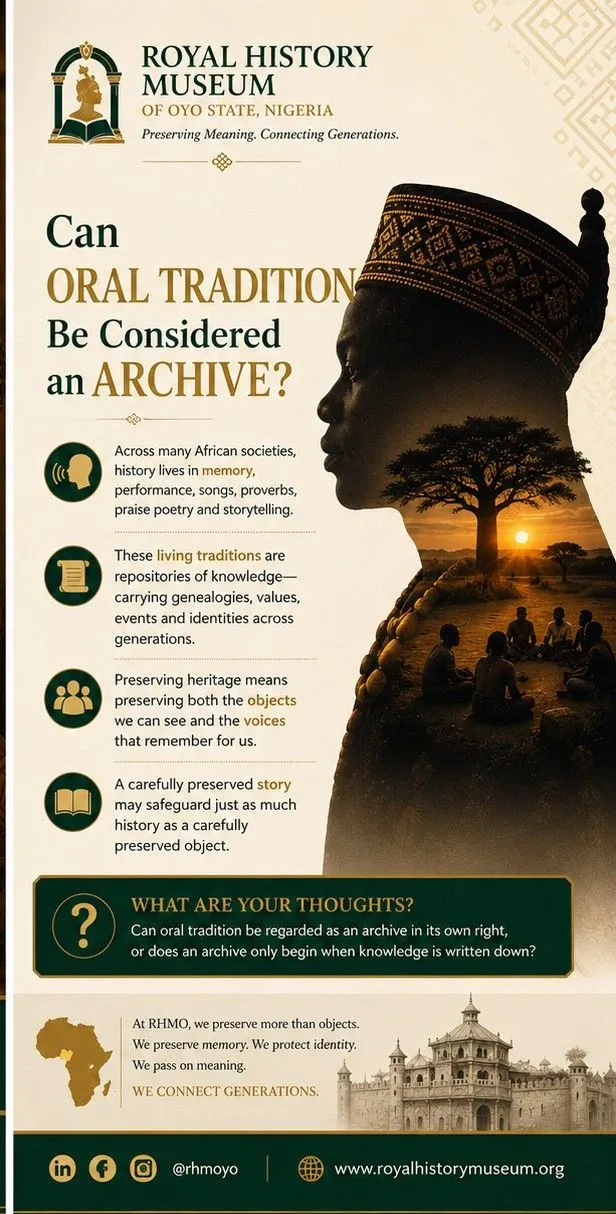
Across many African societies, history has long been preserved through memory, performance, ceremony, praise poetry, songs, proverbs, and storytelling.
These traditions have carried genealogies, systems of governance, moral values, and community identities across generations, often with remarkable continuity.
In the context of Yoruba royal heritage, oral tradition is far more than folklore. It is a living repository of historical knowledge. Royal lineages, palace customs, coronation rites, oríkì, and narratives passed from one generation to another form an archive that cannot be fully understood by examining artefacts alone.
This is one of the convictions that guides our work at the Royal History Museum of Oyo State Nigeria (RHMO).
Preserving heritage is not only about caring for the physical objects that survive. It is also about documenting the voices, memories, and knowledge systems that give those objects meaning.
As museums increasingly embrace digital technologies, perhaps our understanding of what constitutes an archive should also expand.