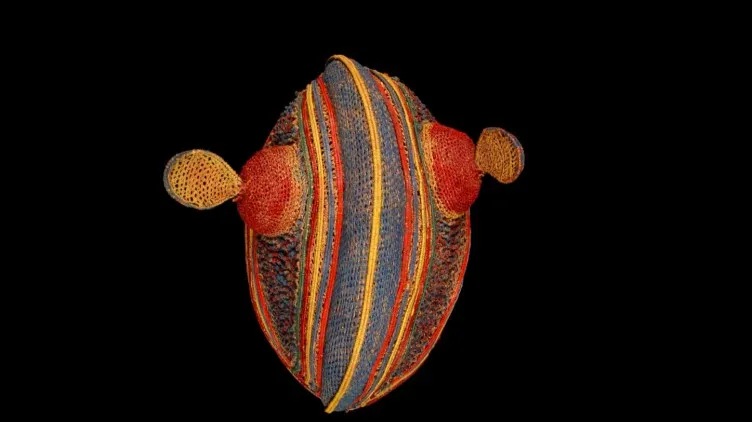
We often know the famous “Kasai velvet” kuba. But behind it hides a whole geography of know-how: the ferruginous mud and vegetable tannins that give black, the padauk powder (ngula) for the red-pink, the painted clay of the Mangbetu, the acidic saps that fix the color of the Mbuti of Ituri… So many precise technical gestures, passed down from generation to generation, and carried out largely by women.
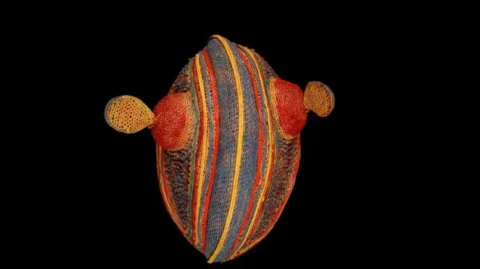
Courtesy Musée du quai Branly – Jacques Chirac
This work is based solely on the museum’s notices, with a clear distinction between what the sources document and my own hypotheses as a researcher, always pointed out as such.
Several entries underline the gendered distribution of this knowledge: among the Kuba, the dyeing of fibres and velvety embroidery is the responsibility of women, basic weaving is the responsibility of men; among the Mbuti, the preparation of pigments and the painting of fabrics are also described as an essentially female activity.
The mastery of colour thus appears, in a large part of this corpus, as a technical and aesthetic knowledge transmitted mainly between women.