In 1925, the Nationalist government led by Chiang Kai-shek turned the Forbidden City into the National Palace Museum. Soon afterward, China was plunged into war, first against Japan and then in a civil war between the Nationalists and the Communists.
To protect the imperial treasures from being captured or destroyed, officials repeatedly moved them across China over a period of about fifteen years. [RM*: read about this Adam Brookes (2022) Fragile Cargo – China’s wartime rtace to save the treasures of the Forbidden City.]
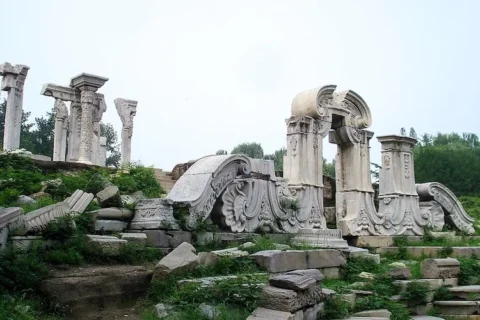
Remains of the Old Summer Palace
The collection was taken to Nanjing, the Nationalist capital, and then moved farther inland as Japanese forces advanced. After World War II, many treasures were returned to Beijing and Nanjing.
But by 1948-49, Communist forces under Mao Zedong were close to defeating the Nationalists. Fearing the collection would fall into Communist hands, the Nationalist government decided to send many of the most valuable objects to Taiwan.
The selective retelling of the story today has lost none of the emotional impact for many people in China. For years Chinese state media and sympathetic commentators have claimed that millions of “stolen” Chinese artifacts from the Summer Palace remain in foreign museums and private collections in Taiwan, Europe and North America, often implying that entire institutional holdings were looted outright by imperial armies.
At the same time, a number of events have taken place thar remain more hidden in the country’s propaganda. Apart from the destruction during the country’s Cultural Revolution and the continuing culural destruction in Tibet and Esatern Turkestan, Fitz Gibbon mentions:
- the Nanjing Museum, which has been accused of internally laundering, mislabeling, and selling national treasures through domestic channels
- a gang of fourteen that stole jade, lapis, and rhinoceros-horn objects from British museums, many specifically associated with the Summer Palace. Authorities believed some of the unrecovered objects were trafficked into China, where wealthy collectors viewed the acquisitions as patriotic recoveries rather than criminal contraband.

