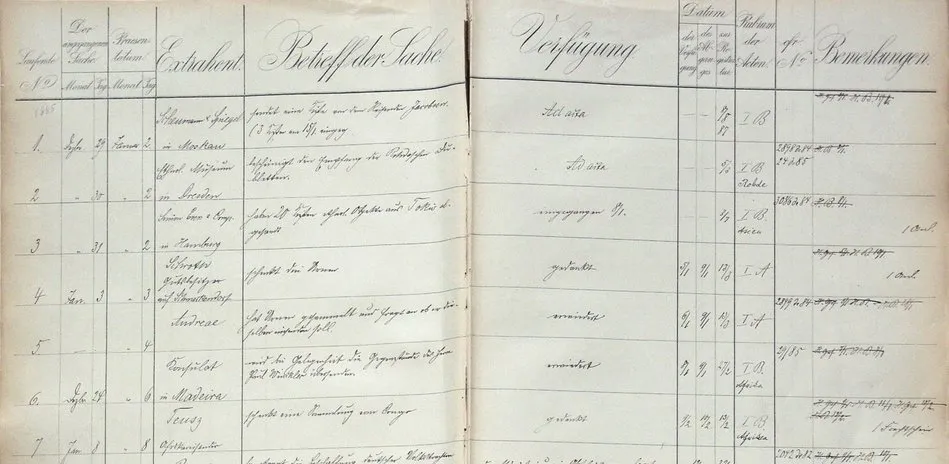
To this day, the Ethnologisches Museum in Berlin is still home to a considerable number of objects that made their way to Berlin in the context of colonial military campaigns. The key aim of provenance research is to investigate and expose the violent history of these kinds of acquisitions.
As part of this project, innovative digital methods are being trialled for assisting and facilitating provenance research. Researchers now aim to determine how these documents can be transcribed and subsequently translated into several languages.
In addition to this, the visualisation of the recorded data will be tested in order to provide content-related support to provenance research in this area, as well as to gain insight for future projects.
The documents that have been selected for the project pertain to naval activities conducted in the colony of German New Guinea and provide contextual information about colonial military campaigns and the museum artefacts that were acquired within this context.
The project is a preliminary test run:
- What kinds of technologies can actually be employed for provenance research?
- Just how much human labour is required in order to obtain correct and usable results when using the AI-based technologies that are currently available to us? What are the limits and limitations of automated processes?
The insights gleaned here will hopefully contribute to the ongoing evolution of digital tools for researching colonial collections.