
During the session of the Namibian Parliament of the 8th of April 2026, the Leader of the Popular Democratic Movement (PDM), Honourable McHenry Venaani, tabled a motion requesting the President to clarify whether the Namibian government is prepared to strategically reposition its negotiations in order to secure a fair and just reparations agreement with the German government.
Holocaust and genocide victims
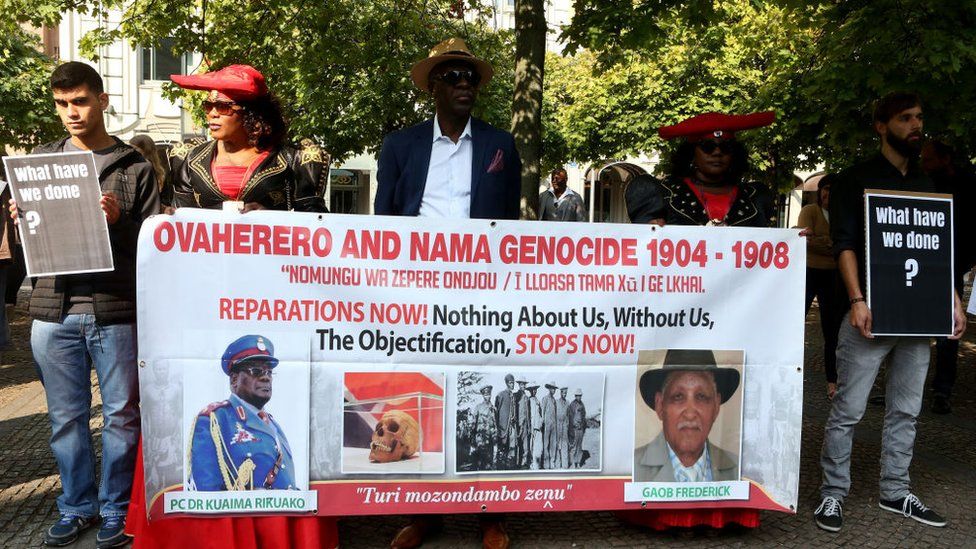
Mr. Venaani expressed concern that Namibia is being treated unfairly compared to the reparations extended by Germany to the Jewish victims of the Holocaust. He underscored that Germany paid substantial financial reparations to these victims, amounting to billions. In contrast, he argued that the proposed arrangement for Namibia appears comparatively minimal and is structured over an extended period. He further highlighted the devastating impact of the genocide, noting that approximately 60% of the Nama population and 80% of the ovaHerero population were exterminated.
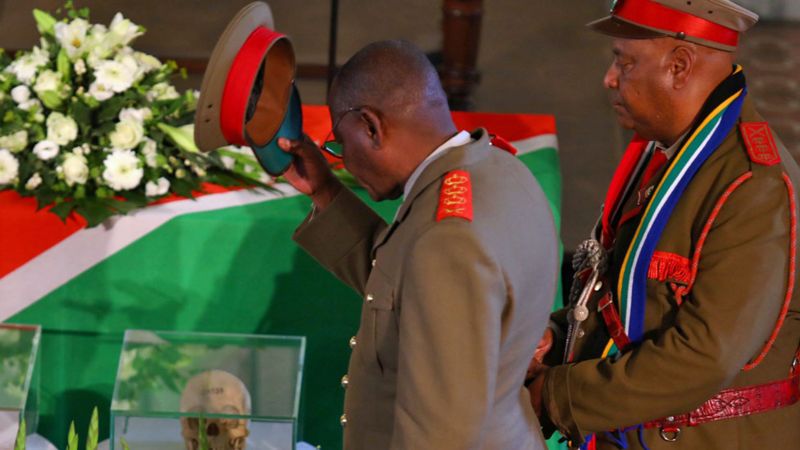
Historical records indicate that a significant number of ancestral remains were taken to Germany during the colonial period, alongside personal and cultural belongings belonging to Namibian communities. While efforts have been made in recent years to address this legacy, progress has been limited. Notable examples of repatriation include some of the ancestral remains, as well as personal belongings of national hero Hendrik Witbooi and portions of his documentary record.
In German museums and private collections
However, much work remains to be done. Archival evidence suggests that a considerable body of material is still held in German institutions, including museums and private collections. These holdings comprise, among others, Hendrik Witbooi’s correspondence, fragmented letters, and historical photographs taken in Namibia during the colonial era. In some instances, private individuals in Germany have come forward, expressing willingness to return ancestral remains, including skulls, that remain in their possession.
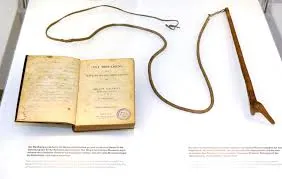
Witbooi’s Bible and whip – Courtesy Linden Museum Stuttgart
From an archival and heritage perspective, these scattered records and belongings are not merely historical items, they embody memory, identity, and the lived experiences of communities. Their continued dispersal underscores the importance of sustained, systematic efforts towards repatriation and restitution guided by ethical responsibility, international cooperation, and respect for the dignity of the affected communities.
Reparative justice and Namibia’s traditions
The five elements of restitution, compensation, rehabilitation, guarantees of non-repetition, and satisfaction are not solely a government initiative, but reflect internationally recognised principles of reparative justice that have been strongly articulated and advanced by the affected communities and Namibia at large. These demands resonate with longstanding Namibian traditions of conflict resolution, which emphasise restoration, acknowledgement of harm, and the rebuilding of social harmony. In this sense, the framework aligns both with global norms and with indigenous approaches that prioritise dignity, healing, and the re-establishment of balanced relationships within and between communities.
Courtesy BBC
Review Joint Declaration
President Netumbo Nandi-Ndaitwah, while acknowledging the comparisons being drawn between Germany’s reparations to Jewish victims and the current agreement under negotiation with Namibia, cautioned that these historical processes should not be viewed as identical. They have distinct contexts. But the matter remains under active consideration within the framework of the Joint Declaration on the Nama-Herero genocide between Namibia and Germany.
According to the President, the ongoing review of the Joint Declaration seeks to advance principles of fairness and equity, with Namibia advocating for treatment that reflects the same level of seriousness and respect accorded in other historical reparation cases. The government is committed to ensuring that Namibia’s position is firmly and constructively represented in the negotiations.
The President also provided clarification on the status of the discussions, noting that an earlier point of contention in the negotiations concerned a clause within the Joint Declaration proposing the closure of the chapter on the genocide. She stated that the Namibian government firmly rejected this provision, maintaining that such a clause would undermine the potential for future engagement and the pursuit of ongoing redress.
Courtesy BBC
Complex process
There has been measurable progress in the negotiations, with both governments demonstrating clear willingness to engage constructively on this historically matter. This reflects a shared commitment to addressing the past in a forward-looking manner. While Germany has shown openness in acknowledging historical responsibility and supporting reparative efforts, the process remains complex, with legitimate expectations from affected communities around adequacy, inclusivity, and restorative justice. There are encouraging signs of mutual respect and cooperation, however, achieving full parity is an ongoing process. Overall, the trajectory is positive, and sustained goodwill, transparency, and responsiveness will be key to a just and equitable outcome.