The exhibition shows once again how colonial history is not distant and abstract, but took place here in a very concrete way and is still located. That is why it is so important that we deal honestly with this legacy: the intertwining of trade and violence, the consequences for humans, animals and the environment and the questions of responsibility, recognition and dignity that arise from this.
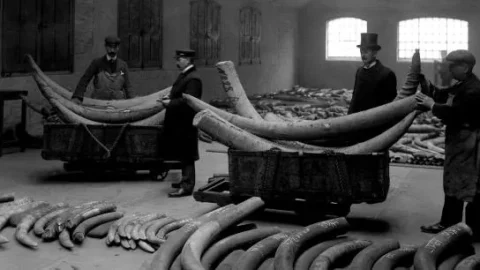
“Ivory Floor” in the port of London(Quelle: Picture Alliance Archive Images)
Francke’s grandfather had already traded in exotic woods and imported tusks from killed elephants. Theodor Francke imitated him as an adult and quickly established himself as one of Berlin’s leading ivory traders.
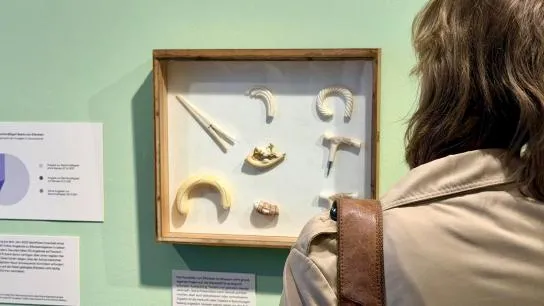
In his Kreuzberg steam cutting mill, combs, fans or handles for knives, umbrellas and display cases are made from it. Above all, however, ivory is used to carve piano keyboards and billiard balls. Four elephant tusks were needed for a set of 16 balls, according to the text for a new exhibition currently on view at the Museum Tempelhof.

Photo rbb/Olivier Noffke
“In the 1890s, there was a real boom in piano making,” says Mirja Memmen, one of the three curators of the exhibition. “The bourgeoisie brought pianos into their living rooms.” At that time, ivory was given its nickname as “white gold”. “This contrast of pure white with dark precious woods on the keyboards was in great demand.”