
The draft legislation was unanimously approved by the upper house and will next be sent to the National Assembly lower house before it can become law.
France still has in its possession tens of thousands of artworks and other prized artefacts that it looted from its colonial empire.
The return of every item in the national collection must be voted on individually.
Designed to streamline the process, the bill under consideration specifically targets property acquired between 1815 and 1972.
“The idea is not to empty French museums, but to achieve authenticity in France’s response, without denial or repentance, but in recognition of our history,” said centrist Senator Catherine Morin-Desailly.
In 2025, France’s parliament approved the return to Ivory Coast of a “talking drum” that colonial troops took from the Ebrie tribe in 1916.
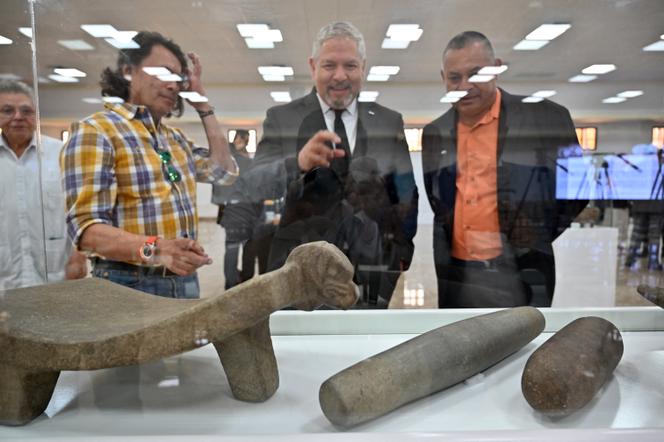
Courtesy Orlando Sierra / AFP
Former Honduran foreign minister Eduardo Enrique Reina, center, looks at pre-Columbian artifacts returned by France to his country from the possession of the Musée du quai Branly in Tegucigalpa, March 19, 2025.
One obstacle remains to be overcome in its progress: the Constitutional Council. Uncertainty persists since an opinion from the Council of State determined that the restitution of assets acquired through bequests and donations must be governed by a “higher public interest.”
However, both the Senate and the government consider this risk of unconstitutionality limited. This law completes a three-part legislative package, following two framework laws adopted in 2023: the first concerning property looted by the Nazis, and the second concerning human remains.
The National Foundation for Museums in Morocco welcomes this development. Chairman Mehdi Qotbi calls it a historic step, but also advocates for a balanced approach: “It’s normal that we reclaim illegally taken heritage, but culture is also meant to be shared.”