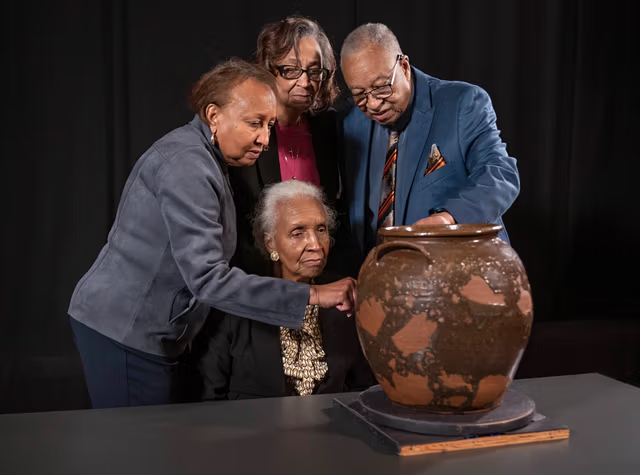
The MFA has now handed ownership of two 1857 Drake pieces over to the descendants of the man who made them. It marks the first time that a respected museum has put the principles of returning looted art during the Nazi era into practice regarding items produced during American slavery without pay.
The details of the deal, worked out by the descendants’ lawyer, George Fatheree, are just as exacting as the cuts Drake made himself in the clay.
- One of the jars, with signature and date, will be loaned back to the Boston museum for at least two years.
- The other, the magnificent “Poem Jar,” purchased by the museum in 1997, has been bought back by the museum for an undisclosed price.

Pictures MFA, Boston
The “Poem Jar” is an outstanding example of strength and determination and has a text on it, stating that: “I made this Jar = for cash / Though its called Lucre trash.” It provides a sharp comment on the economy and labour of a person who had no right to earn money by selling it or any other items.
As the chair of the art of the Americas at the museum, Ethan Lasser, mentioned correctly, Drake was the first owner of his creations, but at the same time, he had no choice concerning its fate and his pay.
This long-overdue act of justice affects other institutions, including the Metropolitan Museum of Art, as well as the Crystal Bridges Museum of American Art, which have artifacts created by Drake in their possession.
Modern artists are interested in the heritage of this craftsman; for instance, Theaster Gates recently donated one of Drake’s pots from his collection to the descendants.