Catarina Simão writes on the first seminar in Maputo in 2019, organised by civil society actors. At the time, the question of restitution began to enter into the public sphere in Maputo, making headlines in the press: “Mozambique has not yet taken a position”, “Cultural assets looted during colonial times—Return Africa to Africa”, “Restitution is an irreversible process. Portugal must prepare itself” or “It is imperative to restore our humanity”.
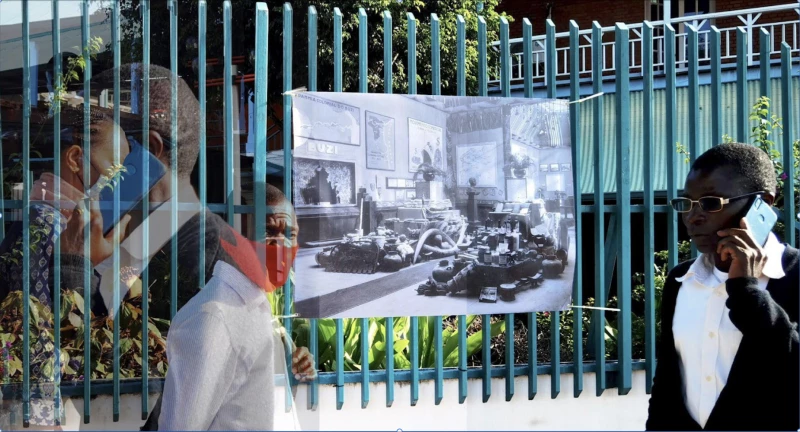
The piece By Eduardo Quive, “Civil society debates on restitution”, offers a first‑hand perspective on how public discussion around restitution has further taken shape in Mozambique. Non‑state actors play a central role in pushing the debate beyond official and museum channels and framing restitution as a question to be opened up rather than settled in advance.
In “Restitute or Institute”, the Mozambican artist Titos Pelembe starts from a single setting: the colonial monument to Mouzinho de Albuquerque inside the Fortress of Maputo. The coexistence between the celebrated coloniser and the defeated emperor–between victory plaques for Portuguese troops and the belated honouring of Ngungunhane–becomes his starting point for thinking about how public symbols might be reconfigured rather than simply preserved.
Jessemusse Cacinda’s essay “Historical Reparations and Multiple Identities: The Amakhuwa of South Africa and their relationship with Mozambique” examines how the Amakhuwa‑Zanzibari community in South Africa turns a history marked by enslavement, displacement and misclassification into a collective movement for recognition, historical repair and the right to sustain multiple, overlapping identities.
In “Signs of the future”, Eduardo Quive situates his reflection in the fiftieth anniversaries of independence and the April Revolution, showing how recent youth mobilisations and the first official acknowledgements of colonial crimes expose tensions between symbolic reparations, economic compensation and still‑pending structural reforms.

