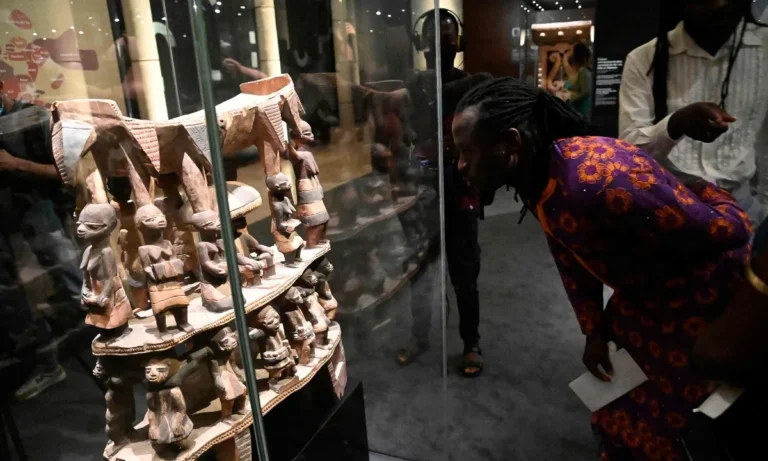
The Restitution Law, approved by the French parliament, evokes all sorts of reactions. RM* summarises them in a few posts. In this post, the Chinese Global Times writes that while countries around the world have been progressively engaging in the repatriation of cultural relics, Japan stands out as a negative example.
Reporters from the Chinese newspaper Global Times visited Japan and found that looted Chinese cultural relics are being displayed and even promoted as militarist "trophies," including at a notorious shrine. History must not be distorted, and heritage must not be plundered. But to this day, Japan has not returned these looted relics. Instead, it has attempted to conceal and deny this history.
The Shanghai University’s Research Centre for Chinese Relics Overseas has completed evidence-based research proving that a precious cultural relic currently in Japan belongs to China, and has urged - with support of Japanese cultural groups - Japan to promptly return it.
The British Museum has hosted a lavish fundraiser at 2,000 pounds ($2,668) per ticket, dubbed the "Pink Ball," in the room housing the Parthenon Marbles, igniting fierce criticism and reviving long-standing debates over cultural ethics and colonial restitution. Greek Culture Minister Lina Mendoni condemned as 'provocative indifference'. Here follows a comment by Global Times reporter Chen Xi.
The Japanese civic group, Movement for the Repatriation of Chinese Cultural Properties, urges the Japanese government to return looted Chinese cultural relics, the Chinese Global Times reports. Japan conducted archaeological surveys in China during wartime and later transported their "findings" to Japan under the guise of "academic research."
According to the National Cultural Heritage Administration, more than 1,800 sets of cultural relics have been returned to China over the past decade.
RM* found two links; sometimes it is hard to open them.
The semi-documentary sheds light on the Qing Dynasty (1644-1911). Taoist abbot Wang Yuanlu, who was the caretaker of the Mogao Caves (UNESCO World Heritage site) in Dunhuang in Northwest China's Gansu Province, discovered the Library Cave at the site, a repository of over 50,000 items dating back to the 4th to the 11th century.
The Alliance for Cultural Heritage in Asia (ACHA) is a framework in which China will work with all Asian countries to strengthen experience sharing on cultural heritage preservation and establish a network for dialogue and cooperation among civilizations. Many members are also participating in China's Silk Road initiative. Reclaiming colonial loot is a minor aim.
China has launched a recommendation for the protection and return of cultural objects removed from colonial contexts or acquired by other unjustifiable or unethical means: the Qingdao Recommendations for the Protection and Return of Cultural Objects Removed from Colonial Contexts or Acquired by Other Unjustifiable or Unethical Means (Qingdao Recommendations)