The consequences of colonisation in the Australian-Pacific region include the appropriation of human remains from Aboriginal, Torres Strait and Pacific Islanders. The confronting history of Ancestors kept within museums for over one hundred years is leading to more work with descendant communities to seek culturally safe ways for return.
In her (open access) thesis, Polly A Bence examines the Bristol Museum & Art Gallery’s Pacific collection as a local–global interface—a palimpsest of empire, anthropology, and emotion. With a focus on the Museum’s ethnographic collection from Australia and the Pacific Islands, stored in a city where the subjugation of other cultures was once central.
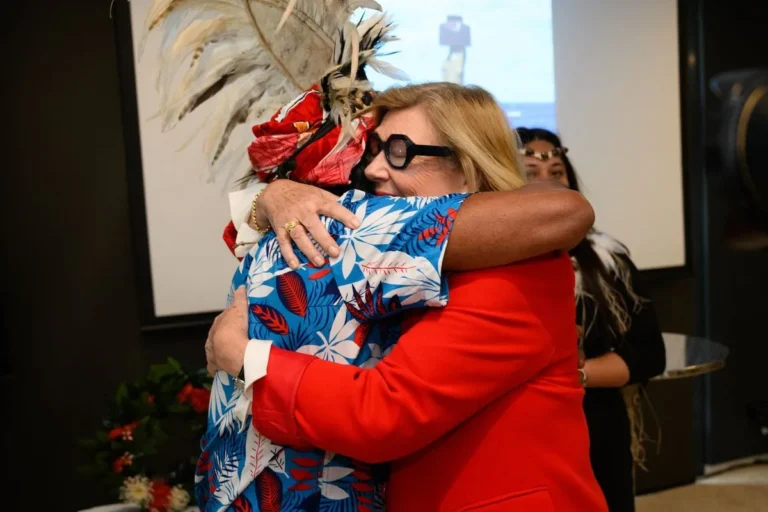
A ceremony was held at the Wollondilly Heritage Centre and Museum in New South Wales to acknowledge the return of the ‘Murrooin-Carradgie’ breastplate. The community had chosen the Museum as a place of safe keeping for the breastplate.
Language and culture advocate Gulwanyang Moran writes: Be honest with each other about history. Archives on this continent were working tools of colonial administration: mission records, protection board files, the paperwork of surveillance and control over Aboriginal lives. Many of our languages survive in the records of the very systems that punished our old people for speaking them.
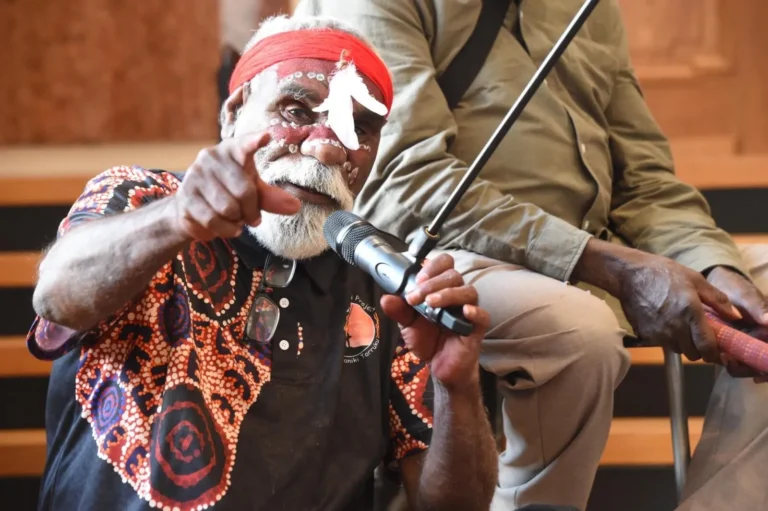
After sitting for decades in a collection in Melbourne University , the remains of nine Yolŋu ancestors have been sung back onto their country in the remote Northern Territory. Elders had been pushing for the remains to be returned for years. For them the ceremony is a milestone.
[in French] The metaphor of “objects as ambassadors” - used to refer to Kanak objects originating in New Caledonia and currently kept outside the territory, and sometimes returned there temporarily for exhibitions, arises in a context of institutional decolonisation and the aspiration for full Kanak sovereignty, with New Caledonia remaining a sui generis French overseas collectivity.
The Australian Museum has returned remains of 17 Rapa Nui people to their rightful home of Easter Island. They were removed from sacred burial sites in 1882 by a German naval expedition, and sold to the Sydney-based museum, where they have remained for more than 140 years.
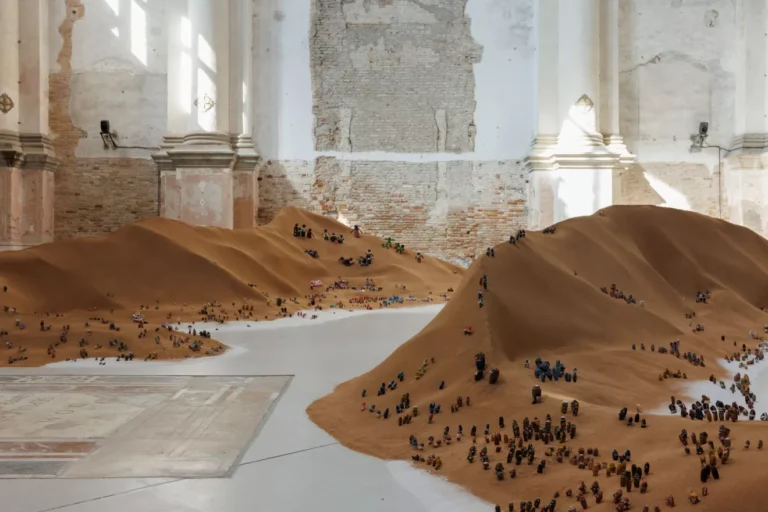
Running from 28 March through 11 October 2026 at Ocean Space, the Venice Art Biennale exhibition “Tide of Returns” by Khadija von Zinnenburg Carroll raises questions about such issues as ownership and ways of acquisition.
The 'Oceania and Indonesia' holdings in Altenburg (approx. 350 objects) and the entire ethnographic collection (approx. 250 objects) in Meerane will be examined. The initial check follows a research project on the Africa collection in Altenburg and the recommendation by ethnologist Ms Dolz from the State Ethnographic Collections of Saxony for Meerane.
Since 2019, a number of sacred objects and ancestral remains have been repatriated to the Warlpiri people of Yuendumu community north-west of Alice Springs in the middle of Australia. For them repatriation is about healing the community, but in particular healing the young men and women of their community, writes Jamie Hampton*. In this Blog, he shares his story about the Yuendumu community and how repatriation has helped them heal from past injustices, providing pathways for the next generations of Warlpiri to ensure they live a life grounded in culture in a changing world.
Anthropologist Nancy Munn studied the Warlpiri people from 1956 to 1958. Now, with the repatriation of her collection to Australia, a younger generation is reunited with its ancestral heritage.
Thomas Fues (Dekolonial Erinnern) is monitoring all restitutions from German museums and universities to former colonial regions. Wherever possible, with a source. In 2026, Māori taonga („Pou of Hinematioro“) was returned to New Zealand by the University of Tübingen.
Coloniality is ever-present. Even decades after the period of formal colonisation has ended it has persisted through structural forms of privilege and bias. Beyond their more obvious manifestations such as the racial stratification of labour and the proliferation of inequality and racism, there is the coloniality of knowledge, which is hard to discern and much more insidious to overcome.
The remains of an unknown Aboriginal man taken to London in 1900, have been returned to Country in Sydney. A reburial was held for ‘Uncle’, conducted by Indigenous elders at Berowra Creek.
Restitution debates – the question of whether a cultural object should be returned from a museum or other collection to a person or community – often begin with a deceptively simple question: who owns an object?
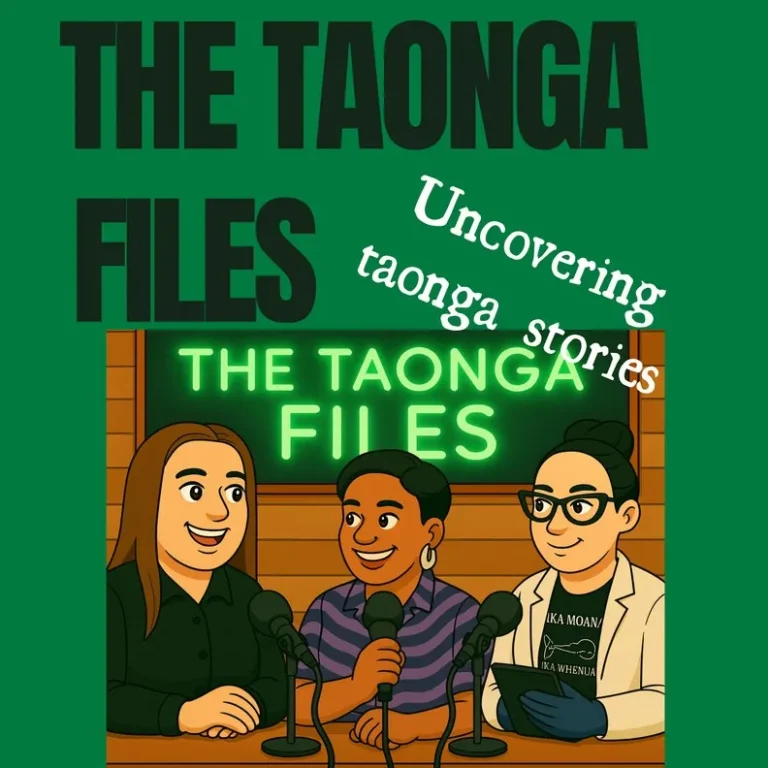
The Taonga Files, a new investigative podcast exploring the journeys of Aotearoa’s taonga now held in museums around the world — and the complex systems, histories, and relationships that shape their return.
[in German] Parts of the collection of the closed, missionary Werl museum "Forum der Völker" in Germany are under suspicion. Three collections may have originated from colonial looting. The German Lost Art Foundation sees a need for further research.
According to Ruby Satele, a PhD candidate from Sāmoa at the University of Vienna, rematriation involves not only the return of ancestors, but also practices of care while they remain in storage. Her research combines strong theoretical thinking with practical action to challenge power imbalances and promote greater justice in museums and universities.
[in English and German] One of the mortal remains of three people of Indigenous Australian descent in the University of Cologne’s Anatomy Center, which were planned to be returned on 4 December 2025. was discovered during the preparations for the return to have been replaced.
More than 1,790 Aboriginal and Torres Strait Islander ancestral remains have been repatriated from 11 countries over the past 35 years. An unknown number remain abroad. Eight major museums can apply for up to $100,000 a year in federal funding to support the return of ancestors and cultural objects.
To exhibit taonga is not simply to interpret the past. It is to enter a living relationship with an ancestral presence. Museums do not own taonga. At best, they are temporary caregivers, and increasingly, digital co-stewards.
Bella d'Abrera writes: The decolonisation movement is making headway in Australia’s museums and libraries which are adopting dangerous politics which will ultimately call into question their very existence. In trying to erase the past, we erase ourselves. (It is an older article but worth offers an anti-restitution perspective)
This paper explores the challenges of repatriating poorly documented Aboriginal secret-sacred objects—known as tywerrenge—to central Australia. 'No story, but we still want to see them come back. Then people can know them.'
[ in German ] The Stiftung Preußischer Kulturbesitz will return spiritual objects from Kpando containing human remains to Akpini People in Ghana, and spiritual objects to Australia. Currently, they are in the Ethnological Museum in Berlin.
Andrew Matthijssen of the Vendue House informs the authorities in Vanuatu that it withdraws the skulls from auction and will suggest to the owner(s) of the skulls to return them to Vanuatu.
In an email, in the hands of RM*, to the Vendue Huis in The Hague, the Netherlands, the Vanuatu Cultural Centre (VKS) and the National Museum of Vanuatu, the national authorities responsible for the safeguarding of Vanuatu’s cultural heritage, demand the immediate withdrawal of ancestral remains from sale.
The auctioneers of the Venduehuis in The Hague, the Netherlands, offer four ancestral skulls from Vanuatu. Evidence that the trade in ancestral remains continues. On line auction, until 24 November 2025
It is well known that Australia's police perpetrated violence against First Nations throughout the colonial period, but their role in supplying Indigenous ancestral bodily remains and cultural heritage objects to domestic and overseas museums is little understood, nor too is whether they exceeded or abused their powers in doing so.
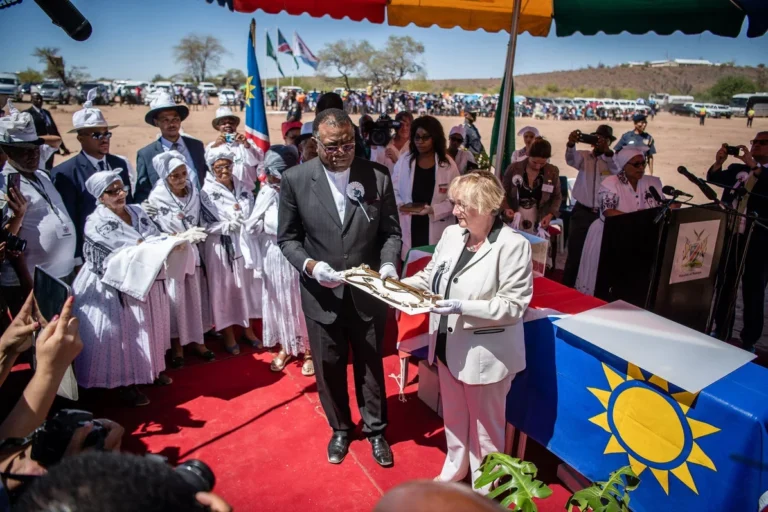
The German state Baden-Württemberg acknowledges its historical responsibility and is committed to provenance research in order to identify and return colonial cultural goods that were acquired unlawfully. The start was in 2019, when Hendrik Witbooi's Bible and whip were returned to Namibia.
Kulasumb Kalinoe (East Sepik area, Papua New Guinea; currrently James Cook University, Australia) focuses on the collection and removal of cultural material from Papua New Guinea (PNG) during the colonial era. She discusses views among the Papua New Guinean diaspora in Australia on museums and PNG collections, and argues that cultural heritage issues must be addressed before the work of decolonisation can begin.
The Ethnographic Museum Zagreb presents the exhibition “Travellers” – Collection of Non-European Cultures, tracing the journeys of people and objects from colonial times to the present day.
Two pou - ornate carvings - that have been in the South Australian Museum's collection for more than 130 years are now destined for New Zealand after a ceremony in Adelaide on Tuesday.
The objects, comprising spears, spear throwers and a club, were collected in the late 19th and early 20th centuries and have been held in the museum’s collection for decades.
This workshop marks the conclusion of the interdisciplinary provenance research project "Human Remains from Colonial Contexts: Provenance Research in the Anthropological Collections of the University of Göttingen and MARKK Hamburg".
For several years, Bristol Museum and Art Gallery and the Australian Institute of Aboriginal and Torres Strait Islander Studies (AIATSIS) have been discussing returns of cultural heritage to Australia. This event will reflect on those discussions with community members and AIATSIS staff.
Museums hold thousands of ‘things’ from all around the world. In larger institutions like Te Papa, the histories of these ‘things’ are not always known. This blog is looking at ways to start recovering these lost stories and histories.
Paul Dailey (Guardian Australian columnist) writes: Bodies and body parts have long been part of collections of imperial plunder over the years – but museums must understand that attitudes have moved on.
On March 14, the remains of eight Mirning ancestors were returned to their country and buried. The ancestors lived between the late 1800s and 1979, and their remains had most recently been stored at the West Australian Museum.
Indigenous artefacts will be returned to their ancestral home on Mornington Island in Queensland's Gulf of Carpentaria. More than 3,000 kilometres away in Victoria, Baw Baw Shire staff uncovered the 37 articles in storage.
This working paper offers an inventory of missionary orders and societies active in German colonial regions in Africa and Asia, the information available about them and the options for further research.
The Albanese Labor Government has welcomed the return of 10 First Nations ancestors from three Japanese collecting institutions. A joint ceremony was held in Tokyo. This is the first ever return of ancestors from Japan.
Experts in Basel have found four plant collections belonging to the two naturalists Fritz and Paul Sarasin that were thought to be lost. Until now, scientists had assumed that these pocket herbaria were destroyed in Berlin during the Second World War.
Half of the 11 returned objects to the Larrakia community in Northern Australia first arrived at the Fowler Museum in 1965 through a large donation from the Wellcome Trust.
In a historic handover event at the Fowler Museum in California, USA, a collection of 11 objects of deep cultural significance were unconditionally returned to the Larrakia Community of the Northern Territory in Australia.
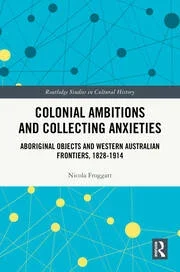
In her book 'Colonial Ambitions and Collecting Anxieties: Aboriginal Objects and Western Australian Frontiers, 1828–1914' Nicola Froggatt assesses how non-Aboriginal collectors understood Aboriginal objects, and what this reveals about colonial relationships, anxieties and ambitions.
The Natural History Museum in London hosted a formal ceremony on 10 April 2025 with Traditional Custodians from Queensland communities to mark the return of 36 First Nations ancestors.
Te Papa collection manager and kaitiaki taonga Moana Parata brings home a precious taonga, a raranga vest collected by Carl Freeze, an American Mormon missionary in the early 1900s.
After more than 170 years at the Scottish University of Aberdeen, the remains of a young Aboriginal man who was killed on his Country have returned home.
The Tasmanian Aboriginal Centre and The Hunterian at the University of Glasgow have announced the repatriation of a rare shell necklace from The Hunterian collection in Glasgow to its home in Tasmania.
This dissertation investigates the histories and itineraries of Abelam collections from the East Sepik Province of Papua New Guinea held in museums in Europe (the Netherlands, Germany, Switzerland and the UK), Australia and Papua New Guinea.
Argentina has one of the most important and sensitive bioanthropological collections in Latin America. Most of the remains in museums come from Tehuelche and Mapuche victims of the so-called "Conquest of the Desert". However...
In the late 1800s, Andreas Reischek, an Austrian scientist, robbed Māori graves and plundered Māori artefacts for his private collection. More than 140 years later, officials of the Austrian government have been repatriating what Reischek looted.
During a solemn ceremony at the GRASSI Museum für Völkerkunde zu Leipzig, ancestral remains, which had been in the possession of the Staatliche Ethnographische Sammlungen Sachsen (SES), were returned to representatives of their Māori (New Zealand) und Moriori (Chatham Islands) communities of origin.
Museums in Leipzig, Göttingen, Stuttgart and three other German cities have transferred the remains of Māori and Moriori people to a New Zealand delegation, headed Te Herekiekie Herewini of the Museum of New Zealand Te Papa Tongarewa.
[ in Dutch ] They are the most controversial items in the collection of the Dutch Mission Museum in Steyl, Limburg: five human skulls from Papua New Guinea. How did they get there? And why don't the locals want them back?
Known only as A01392 in the records of the Grassi Museum in Saxony, now the life mask of a Ngāti Toa tupuna has returned to his whenua and people as a taonga.
[ in Englis, in French ] The piece brought back by British Captain James Cook in 1771 is said to be the first Oceanian sculpture collected by a European.
Dresden’s museum of world cultures returned four everyday objects to the Kaurna Aboriginal community of Australia at a ceremony in Sydney: the spear, digging stick, cudgel and net were brought to Germany by two protestant missionaries between 1838 and 1839.
Manchester Museum, UK, has handed over 174 items to the Australian Aboriginal Anindilyakwa Community, marking one of the largest restitution projects ever undertaken in the UK.
A museum in Limburg has decided not to return five ornamental human skulls taken by missionaries from Papua New Guinea after the local population turned down the offer.
The Missiemuseum in Steyl investigated the origin of the artefacts in the wake of the controversy surrounding a skull from Benin that was sold by an auction house in Amsterdam.
'Measina' or cultural artefacts kept in the Uebersee Museum in Bremen will be back in Samoa in June 2024. A team from the National University of Samoa, led by Ta’iao Matiu Dr Matavai Tautunu, will be making this trip.
The wars of 1845–72 were described by James Belich as ‘bitter and bloody struggles, as important to New Zealand as were the Civil Wars to England and the United States’. The conflict’s themes of land and sovereignty continue to resonate today.
Europeans collected a huge number of Aboriginal artefacts during the colonisation of Australia. Gemmia Burden's research is on the Queensland Museum’s collecting networks.
Trinity College and the Museum of Archaeology and Anthropology (MAA) agreed in March 2023 to return the spears to descendants of the Gweagal people who crafted the spears more than 250 years ago. One year later, they were handed over.
Police played an important role in the collecting of Aboriginal objects for colonial and imperial museums. Although most scholars have noted the unequal power relationship that occurred when police ‘collected’ Aboriginal objects on the frontier, scholarship has not previously explored the ‘authority’ of the police to collect objects.
Conversations between communities and institutions around the world are ramping up, with museums and universities agreeing to return culturally significant items. But in the case of the British Museum, there is one big roadblock.
The Alliance for Cultural Heritage in Asia (ACHA) is a framework in which China will work with all Asian countries to strengthen experience sharing on cultural heritage preservation and establish a network for dialogue and cooperation among civilizations. Many members are also participating in China's Silk Road initiative. Reclaiming colonial loot is a minor aim.
The contents were two skulls molded with mud and three large effigies, called rambaramp, each containing the skull of a man, uniquely painted to depict the final stages of his life.
Six years ago, AIATSIS set up the Return of Cultural Heritage (RoCH) programme, and began looking at collections worldwide that might have holdings to return. Among the 200 institutions it first contacted, 74 responded positively, among these the Fowler museum in Los Angeles
An ancient, carved tree will be returned to Australia around a century after it was cut down and shipped to Europe. It was one of several “dhulu” stolen from a Gamilaraay ceremonial site beside a creek in northeast NSW in 1917.
The contents were two skulls molded with mud and three large effigies, called rambaramp, each containing the skull of a man, uniquely painted to depict the final stages of his life.
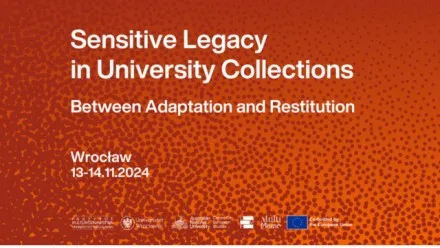
Conference Sensitive Legacy in University Collections: Adaptation and Restitution, organized by the ANU Centre for European Studies in collaboration with The Urban Memory Foundation and the University of Wroclaw, Poland.
Until the late 1980s Indigenous art was being ripped off left right and centre. It was open slather. First at the cheap end of the market on T-shirts and then on fancy carpets made in Vietnam. The rip-off merchants maintained black artists were just painting old patterns, so their work was for the taking.
In July 2020, the Australian Government announced the introduction of the RoCH program with funding until June 2024. The research and community work continued and at the end of this period RoCH identified 383 overseas collecting institutions holding 126,000+ Aboriginal and / or Torres Strait Islander cultural heritage items.