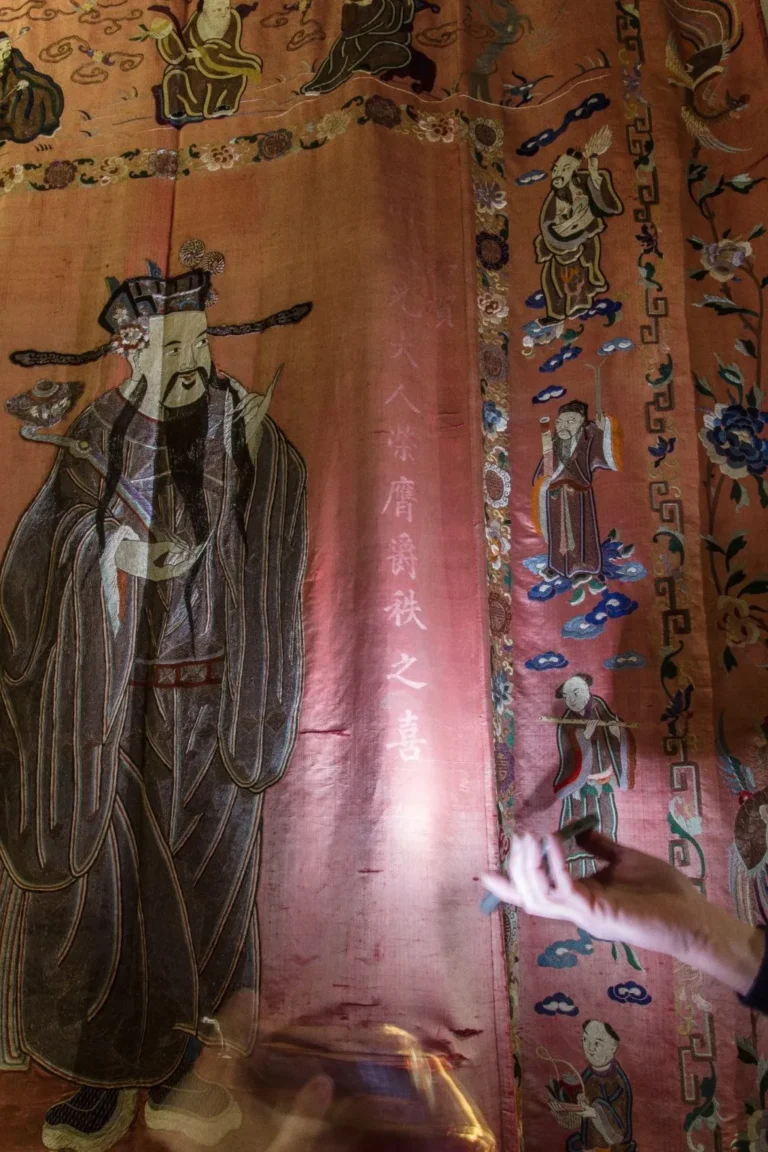
The provenance of a Chinese honorary tapestry – which disappeared from China in 1901 and became part of the collection of Mission Museum Steyl under circumstances that are not entirely clear – has been investigated. The SVD missionaries played a role in fuelling the Boxer Rebellion.
The conversation around restitution just got a major jolt of momentum. Musée Guimet of Asian Arts in Paris, where Chinese artifacts make up roughly a third of the collection, has set a groundbreaking precedent: if any of its Chinese relics are definitively proven to be looted, they will be sent back to their country of origin within 24 hours.
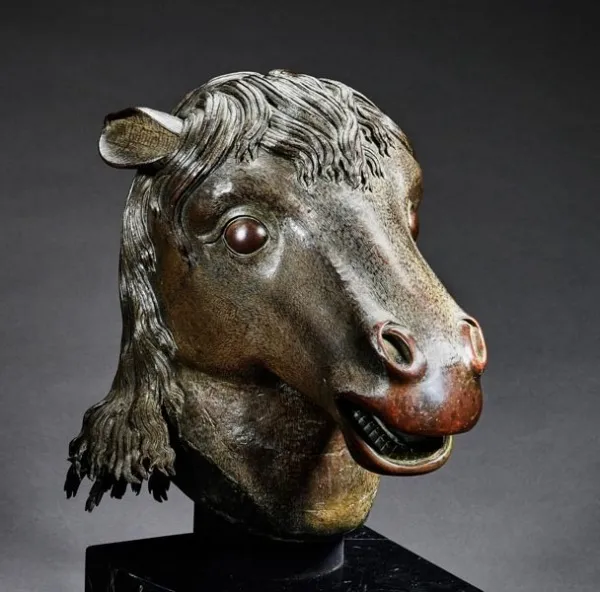
These two bronze zodiac heads once formed part of the clepsydra (water clock) that adorned the entrance to the Western style Yuanmingyuan or Old Summer Palace gardens in Beijing. After the sacking of the Summer Palace by Anglo-French forces in 1860, the zodiac heads were stolen and dispersed among private collections.
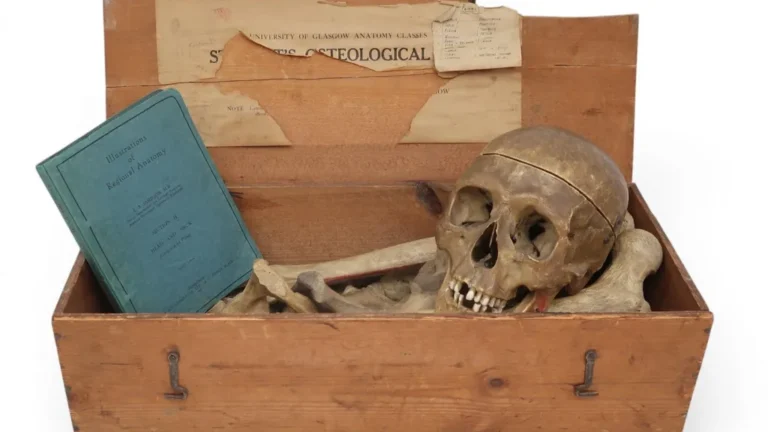
A Glasgow auction house founded by TV presenter Anita Manning has been criticised for offering human remains for sale. Human bones, including a skull, were due to go under the hammer on Friday, but Great Western Auctions withdrew the item for sale after being contacted by BBC Scotland News.
The Restitution Law, approved by the French parliament, evokes all sorts of reactions. RM* summarises them in a few posts. In this post, the Chinese Global Times writes that while countries around the world have been progressively engaging in the repatriation of cultural relics, Japan stands out as a negative example.
The fact that cultural possessions, which were brought from China at the beginning of the twentieth century, are spread throughout Europe and the US is proven by the Skušek Collection in the Ethnographic Museum of Ljublijana. Ivan Skušek had served in the Austro-Hungarian navy and was in a Chinese prison from 1917-1920, had several dozens of boxes filled Chinese art objects. The circumstances under which he had acquired such a mass of Chinese art are not yet completely clear.
As one of the biggest targets of wartime looting in centuries past, China is now positioning itself as a global pioneer in repatriating lost cultural artefacts. In two articles, Xinlu Liang looks a Chinese demand that Japan returns an ancient tablet, which could mark a ‘historical reckoning’, and how China is wielding law, diplomacy and a Global South coalition to rewrite the rules of restitution, filling a void left by a retreating US.
Reporters from the Chinese newspaper Global Times visited Japan and found that looted Chinese cultural relics are being displayed and even promoted as militarist "trophies," including at a notorious shrine. History must not be distorted, and heritage must not be plundered. But to this day, Japan has not returned these looted relics. Instead, it has attempted to conceal and deny this history.
Ganga Rajinee Dissanayaka discovered at a conference in Europe that Benin Bronzes, Egyptian antiquities and African collections were discussed. But Asia was unmentioned. And then when a colleague from Indonesia brought up the topic of Southeast Asian collections, the moderator nodded graciously and then moved on to another topic. Decolonisation, it appears, is an African story.
The Shanghai University’s Research Centre for Chinese Relics Overseas has completed evidence-based research proving that a precious cultural relic currently in Japan belongs to China, and has urged - with support of Japanese cultural groups - Japan to promptly return it.
The protection of cultural heritage is increasingly shifting towards favouring the return of cultural property to its people of origin. Evidence of this shift can be found in a more intentional distinction between cultural property rights on the one hand, and traditional rights in rem on the other; the strengthening of international cooperation; as well as the reconstruction of traditional doctrines.
[in German] Parts of the collection of the closed, missionary Werl museum "Forum der Völker" in Germany are under suspicion. Three collections may have originated from colonial looting. The German Lost Art Foundation sees a need for further research.
[ in French ] In the 19th century, the concept of "Asian art" gradually gained prominence in the European market, driven not initially by collectors, but by dealers, the true intermediaries between Asia and Europe. This phenomenon took root in a context of forced opening of Asian territories: the Treaty of Yedo (1858) with Japan, the Treaty of Tianjin (1858-1860) with China, and the Treaty of Saigon (1862) with Vietnam.
Seven years ago, two men found a bronze Ming Dynasty Buddha statue on a roadside in WA's Shark Bay region, Australia. Tests confirmed the Buddha had been buried for 150 years and is probably linked to the beginnings of WA's pearling industry, which was pioneered in part by Chinese people. The two men want it to be handed over to the Chinese government as a symbol of peace and diplomacy.
Restitutions of colonial loot by Japan to former colonial possessions? Yes, that has happened and is still happening: manuscripts and objects to South Korea and China, ancestral remains to groups within Japan’s own borders. News about it is quite rare. What is actually known about the colonial collections and restitution practice of this former colonial power in the Far East?
The Japanese civic group, Movement for the Repatriation of Chinese Cultural Properties, urges the Japanese government to return looted Chinese cultural relics, the Chinese Global Times reports. Japan conducted archaeological surveys in China during wartime and later transported their "findings" to Japan under the guise of "academic research."
This working paper offers an inventory of missionary orders and societies active in German colonial regions in Africa and Asia, the information available about them and the options for further research.
A 1000-year-old statue of the Boddhisattva Guan Yin lives in The British Museum. When it emerges that the statue was stolen from its original home, the museum attempts to deflect both the public response and controversial repatriation claims from the Chinese government.
Since the later stage of the Qing Dynasty, many imperial objects have been moved to Europe due to a series of Sino-European wars. Perceived as having less material value, Qing imperial books, manuscripts, and scrolls are studied less by contemporary scholars.
According to the National Cultural Heritage Administration, more than 1,800 sets of cultural relics have been returned to China over the past decade.
RM* found two links; sometimes it is hard to open them.
During the European expansion constant fighting and violence and the taking of spoils of war went hand-in-hand. Palaces, shrines, homesteads and entire villages were plundered and destroyed. In the restitution debate, the focus is mostly on state-collections resulting from these confrontations. There is ample evidence, however, that many more parties were involved. This blogpost has some of the evidence.
The semi-documentary sheds light on the Qing Dynasty (1644-1911). Taoist abbot Wang Yuanlu, who was the caretaker of the Mogao Caves (UNESCO World Heritage site) in Dunhuang in Northwest China's Gansu Province, discovered the Library Cave at the site, a repository of over 50,000 items dating back to the 4th to the 11th century.
Tea sets, paravents, spears and shields – even if today’s heirs were not involved in their acquisition or theft, these artefacts are inextricably linked to German colonial history.
Seven German museums under the management of the Zentralarchiv of the Staatliche Museen zu Berlin (Central Archive of the Staatliche Museen zu Berlin) systematically examine their holdings for looted goods from the Boxer War in cooperation with the Palace Museum Beijing.
China has launched a recommendation for the protection and return of cultural objects removed from colonial contexts or acquired by other unjustifiable or unethical means: the Qingdao Recommendations for the Protection and Return of Cultural Objects Removed from Colonial Contexts or Acquired by Other Unjustifiable or Unethical Means (Qingdao Recommendations)
The British Museum (BM) has an extensive collection of Chinese antiquities. Historically, many assumed that these treasures were obtained through imperialist plunder. However, recent findings by US historian Justin Jacobs present a different narrative, suggesting that a significant number of the artifacts in question were willingly given to the British Museum by Chinese officials.
The Parthenon Marbles, Rosetta Stone and Benin Bronzes are just some of the ‘contested objects’ in the British Museum (BM). The Marbles are ‘not going to be on the prime minister’s agenda. His focus will be on support for Ukraine and the urgent need for a ceasefire in Gaza.’ They remain ‘a matter for the BM, and the government has no plans to change the law to permit a permanent move of the Parthenon Sculptures.’ But the BM has more contested collections.