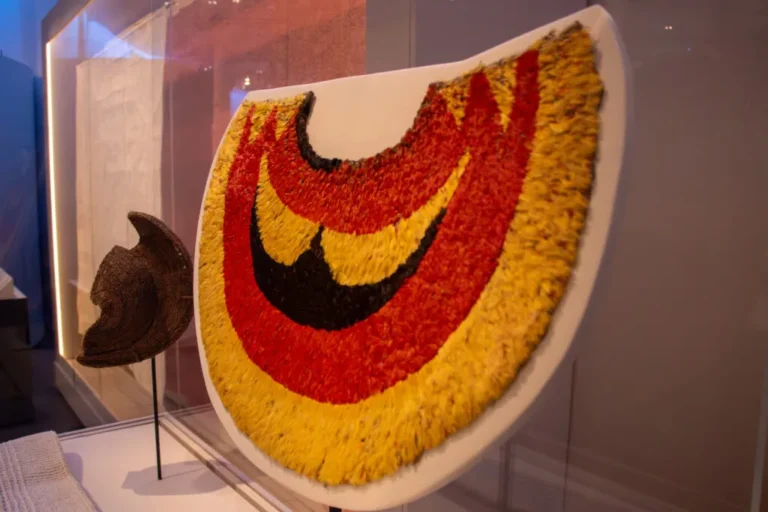
Makana Eyre thinks that the exhibit at The British Museum, “Hawaiʻi: a kingdom crossing oceans,” poses questions that have historically been uncomfortable for museums. Many items, though certainly not all, are sacred, intrinsically linked to ceremony, community, even Hawaiian sovereignty.
One of the most preserved among the eleven remaining mantles of the Tupinambá native people will definitely return to Brazil. By the end of 2023, the treasure made with red feathers of the scarlet ibis will leave the ethnographic collection of the Nationalmuseet, the National Museum of Denmark, and will join the collection of the National Museum in Rio de Janeiro.
A sacred cloak that had been in the holdings of the National Museum of Denmark for more than 300 years was returned to Indigenous leaders in Brazil. The nearly six-foot-long cloak was constructed using 4,000 scarlet ibis feathers. It was taken from the Tupinambá people during Portuguese colonial rule.