The Museologies of Africa explores decolonial museum practice in Sub-Saharan Africa, asking how to decolonize knowledge production in Africa and to meaningfully collaborate with indigenous communities to reimagine museology.
'Mobile Heritage' explores how diverse digital technologies have allowed for new types of mobilities and introduced a novel set of practices, interventions, and politics for heritage collections, archives, exhibitions, entertainment, conservation, management, commerce, education, restitution, activism, and regulation. With a case-study about digitalised ancient manuscripts from Ethiopia in the British Library.
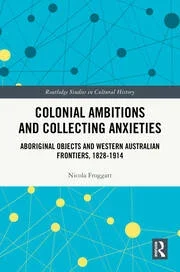
In her book 'Colonial Ambitions and Collecting Anxieties: Aboriginal Objects and Western Australian Frontiers, 1828–1914' Nicola Froggatt assesses how non-Aboriginal collectors understood Aboriginal objects, and what this reveals about colonial relationships, anxieties and ambitions.
This essay proceeds from the observation that the “Egypt” portrayed in museums and school education misrepresents the lived realities of modern Egyptians, their experiences, and their expectations concerning Egypt’s past and present.
A foundational handbook for critical heritage research about Africa and its diaspora. Part III African Objects and the Global Museum-Scape is relevant for RM*.
The Return of Cultural Heritage to Latin America takes a new approach to the question of returns and restitutions. It is the first publication to look at the domestic politics of claiming countries in order to understand who supports the claims and why.
Material Culture in Transit: Theory and Practice constellates curators and scholars actively working with material culture within academic and museal institutions through theory and practice.
Many European countries deal with their colonial history and their collections of ethnographic material. As much as human remains seem like the essence of the need to do reparations to indigenous cultures, they are but a small part of the responsibility to understand our entangled histories
Cynthia Scott analyzes the history of the negotiations that led to the atypical return of colonial-era cultural property from the Netherlands to Indonesia in the 1970s. By doing so, the book shows that competing visions of post-colonial redress were contested throughout the era of post-World War II decolonization.
Christa Roodt, specialist in international private law and and provenance and restitution issues at the University of Glasgow, adopts a novel approach to the social question of restitution and repatriation of sacred cultural property and heritage acquired unethically during the colonial era. Her approach premises on better integration of law, ethics, history, anthropology, and provenance research.