Some readers wonder why articles by authors, who oppose or are highly critical of restitution, or who publish in anti-restitution channels should be distributed. Some do so in a personal capacity. Others do so on behalf of a conservative institution established specifically for this purpose. RM* offers a three-fold answer.
The colonial collections in public museums and the private sector in Italy are not less substantial than elsewhere in Europe. Italy has made some significant returns. Nevertheless, this blog argues that the country is much better at reclaiming its own stolen relics than at accepting the consequences of the investigations into its colonial collections.
Restitutions of colonial loot by Japan to former colonial possessions? Yes, that has happened and is still happening: manuscripts and objects to South Korea and China, ancestral remains to groups within Japan’s own borders. News about it is quite rare. What is actually known about the colonial collections and restitution practice of this former colonial power in the Far East?
[ in English and in French ] The French government has proposed a restitution law. After Belgium, it is the second former European colonial power to do so. Such a law streamlines restitution procedures and offers former colonies more clarity and even legal certainty. This blog discusses the draft-bill and examines whether countries of origin will benefit much from it.
For a long time, the debate on decolonisation in Portugal, including the restitution of colonial collections, was limited to art, activist and academic circles. Only recently is it gaining more public attention. Portugal's lack of a national policy should not obscure initiatives at other levels. These are very important for pushing the topic into the public debate and may act as forerunners for a national policy in the future.
An exhibition in the Musée du quai Branly – Jacques Chirac in Paris dives into the French Dakar–Djibouti Expedition (1931-1933), one of the most iconic ethnographic missions in the colonial period. The museum’s head curator was helped by other French scientists and experts from Senegal, Mali, the Republic of Benin and Ethiopia. The outcome is recommended. But why did I leave the exposition feeling empty, anyhow?
A diaspora group discovers an object in the Wereldmuseum Amsterdam’s collection that the village of origin in Indonesia dearly misses. As it belongs to the Dutch national collection, its return requires the signature of the minister of Education, Culture and Science. But he only signs if the Indonesian minister of Culture supports the claim. After return, the latter must decide whether to deviate from the policy that returned objects are kept at the Museum Nasional Indonesia in Jakarta. Only then can the object go back to its village of origin. An interim report about a journey whose outcome no one yet knows.
European governments negotiate restitutions only with the governments of countries of origin. The collections they negotiate usually are state-owned and contain valuable, not rarely iconic objects. The path followed by governments of former colonies is quite similar. It is the path of what Laurajane Smith called the authorized heritage discourse (AHD), where only a limited part of a country’s heritage dominates in national narratives and public policies. This approach has serious limitations.
On social media and in auction houses, there is a lively trade in ancestral remains from colonial areas. Skulls, skeletons and other body parts regularly change hands. While this may be an acceptable practice for those involved, it is painful for many descendants of these dead.
In both the Netherlands and Nigeria, there were political bumps in the road that could have hindered the return of the Benin collection. In Nigeria, those bumps were the most difficult to overcome. Despite the joy on both sides, some uncomfortable questions remain.
Art dealers represent a wide range. Not only from large to small but also from purely commercial to commercial with ethics and open to restitution. For most, colonial collections is just one category among others. For only few is it a primary concern.
Sometimes, descendants of Europeans no longer want to keep the objects, manuscripts or ancestral remains, which they inherited. The items have lost their significance. They take up too much space. The descendants want to make some money out of it. Or they feel these items belong more in their country of origin. Descendants use different ways to get rid of them.
Why is research into colonial collections in the private sector - I mean art dealers, auction houses and private collectors - so tough? The main reasons is that most of them have built a wall around themselves, and there is rarely a hole in this wall through which an outside observer can look inside their closed bulwark.
During the European expansion constant fighting and violence and the taking of spoils of war went hand-in-hand. Palaces, shrines, homesteads and entire villages were plundered and destroyed. In the restitution debate, the focus is mostly on state-collections resulting from these confrontations. There is ample evidence, however, that many more parties were involved. This blogpost has some of the evidence.
Once, The Art Newspaper called the historical relationships of the art trade with museums a ‘foggy world’. That was in 2016. I dare say the relationship of trade with museums still is very foggy. How does this relationship look like?
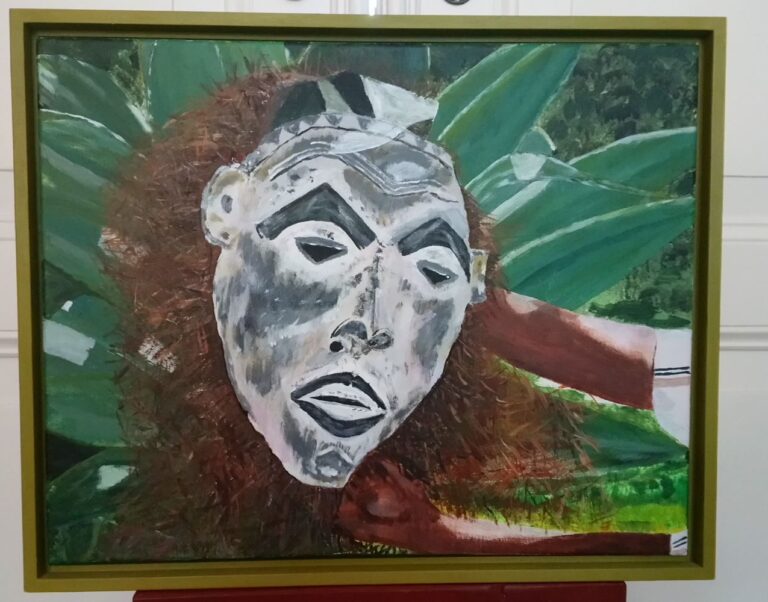
Long ago, I held this Congolese mask in my hands. The dealer claimed it to be very old; he was keen to sell it. But unlike other wooden pieces, which he offered for little money, he asked a big sum for this one. Perhaps, it was indeed old and valuable. Back then, the mask struck a chord with me. Nowadays, it still does.