In 'Loot and the Making of British India', James L. Hevia unveils the intricate and often contentious role of military looting and prize practices in shaping British imperial expansion on the Indian subcontinent. The British army developed a unique system that transformed plundered property into 'booty' and redefined it as prize money, distributed under royal prerogative.
Thirty-nine Naga ancestors will soon begin their journey home from Oxford to Nagaland. This is the culmination of a Naga-led process of dialogue, research and reconciliation that began in 2020, supported by the Forum for Naga Reconciliation, in collaboration with the Pitt Rivers Museum, a process the Naga partners describe as not an ending but as a step on the longer path towards healing.
The exhibition 'What Empire Took, What Empire Left: Museums, Borders and the Politics of Return in South Asia’ portrays the structures that enabled displacement, including colonial systems of knowledge and museum practices.
Adrian Plau of the Wellington Trust that recently returned Jain manuscripts to the Jain community in GB, argues: Restitution is not a remedy for the past alone – it’s about the future we can create together.
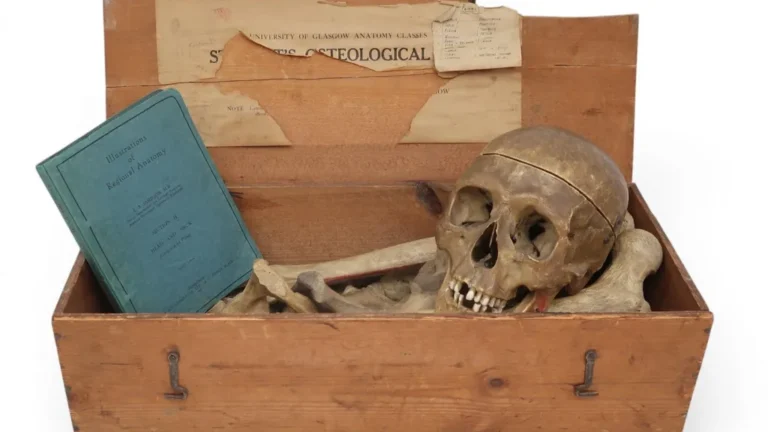
A Glasgow auction house founded by TV presenter Anita Manning has been criticised for offering human remains for sale. Human bones, including a skull, were due to go under the hammer on Friday, but Great Western Auctions withdrew the item for sale after being contacted by BBC Scotland News.
Eberhard As Seen By Amit is a composite film documenting a life of work. It draws on footage from Eberhard Fischer’s many ethnographic films, alongside images shot by Dutta in India and more recent sequences filmed by Fischer himself at his residence in Switzerland. “Through his eyes, I began to see my own heritage with a clarity and depth I never knew.”
The Chola Plates , historical objects originating from India held by University Libraries Leiden (UBL) have been handed over to India at the occasion of India's PM Modi's visit to the Netherlands. The restitution of this heritage follows the advice of the Dutch (national) Colonial Collections Committee.
The Wellcome Collection in London has committed to returning around 2,000 sacred manuscripts to the Jain religious community as part of a “landmark” restitution framework agreement. As a result of the agrrement, the manucripts will stay in the UK.
New York City Mayor Zohran Mamdani has called for the return of the priceless Koh-i-Noor diamond from the UK. The 105-carat diamond is part of the Crown Jewels but its ownership has been disputed by India, who claims that it was stolen during British rule. Mamdani was born in Uganda but has Indian roots.
Kedleston (north-west of Derby) houses an impressive collection of paintings, sculptures and furnishings, some collected by the then Viceroy of India, George Nathaniel Curzon during his travels. The exhibition sheds light on previously untold stories. Encounters, a new film by British-Tibetan artist, Nyima Murry, brings to life the artefacts.
Ganga Rajinee Dissanayaka discovered at a conference in Europe that Benin Bronzes, Egyptian antiquities and African collections were discussed. But Asia was unmentioned. And then when a colleague from Indonesia brought up the topic of Southeast Asian collections, the moderator nodded graciously and then moved on to another topic. Decolonisation, it appears, is an African story.
Jennifer Howes writes: Amaravati Stupa was the first Buddhist site in India to be systematically excavated by the British. Its first colonial excavation in 1816–17 led to 51 sculptures being removed from the site by amateur antiquarians. Some of these were sent to museums, but most of them were transported to the market town of Machilipatnam, where they were used to construct an eccentric marketplace monument.
Vishakha N. Desai writes: The return of looted artworks shows India is no longer treating restitution as a zero-sum recovery, but as a negotiating tool that asserts ownership while deploying art as soft power.
The British Museum’s attempt to frame its decision to ‘share’ a few colonial-era artefacts with the Chhatrapati Shivaji Maharaj Vastu Sangrahalaya (CSMVS) in Mumbai as a move to ‘decolonise’ its collection has been ridiculed by art historians as a ‘con’. There’s only one way to show contrition: return the stolen goods.
The theft of the Louvre’s crown jewels has increased calls for the museum to be more transparent about the colonial origins of the treasures it displays. Their routes to Paris run through the shadows of empire, an uncomfortable history that France has only begun to confront.
Windsor Castle’s splendour hides a legacy of colonial loot, from Tipu Sultan’s swords to the Koh-i-Noor, raising debates on restitution and justice, Jan Muhammad Shaikh writes.
Rohan Fernando emphasises the colonial roots of India’s great contemporary museums and the role of the British in rediscovering India’s past. Muhammad Nishan Hussain [University of Lahore] takes an opposite view and sees them as a tool of colonial control.
The Ethnographic Museum Zagreb presents the exhibition “Travellers” – Collection of Non-European Cultures, tracing the journeys of people and objects from colonial times to the present day.
The Indian government has secured the repatriation of ancient gem relics linked to the Buddha’s remains, two months after it halted their auction in Hong Kong. Indian prime minister, Narendra Modi, said the return of the Piprahwa gems after 127 years was “a joyous day for our cultural heritage”.
[ in Portuguese ] A delegation from Nagaland in north-east India travels to the Pitt Rivers Museum in Oxford to negotiate the return of remains and artefacts taken during the colonial period.
A delegation of Naga elders and leaders, along with representatives from the Forum for Naga Reconciliation (FNR) and Recover, Restore, and Decolonise (RRaD), gathered at the Pitt Rivers Museum (PRM), University of Oxford, to initiate the repatriation of Naga ancestral human remains.
In The Art Newspaper, Ben Luke wonders whether museums are ‘guilt tripping’ their visitors and concludes they aren’t doing enough.
Engaging with the difficult histories behind objects has deepened my experiences at cultural institutions — and the fact it is different for everyone is a good thing.
British Culture Secretary Lisa Nandy: “In the arts and creative industries, Britain and India lead the world and I look forward to this agreement opening up fresh opportunities for collaboration, innovation and economic growth for our artists, cultural institutions and creative businesses." (Not a single word about restitution)
On May 6, just days before Buddhists around the world celebrate the holiday of Vesak, Sotheby’s Hong Kong will put relics of the Buddha — what Sotheby’s calls the “Piprahwa Gems of the Historical Buddha”— on the auction block.
The focus of the campaign is on the process of retrieval of antiquities through bilateral cooperation and partnership, in a manner consistent with existing international arrangements. Great Britain has the most extensive collections.
Collections in private hands and the trade can contain important objects, while no one has a grip on them. An example is the 18th-century sword stolen by British troops from Seringapatam in India that was featured at the Bonhams auction on May 23rd, 2023.
The Koh-i-Noor diamond, a 106-carat gem that is part of Britain's crown jewels, has been back on public display after initially being absent at Charles III's coronation. The diamond was gifted to Queen Victoria after Britain's East India Company formally annexed the Kingdom of Punjab in 1849.
Why is research into colonial collections in the private sector - I mean art dealers, auction houses and private collectors - so tough? The main reasons is that most of them have built a wall around themselves, and there is rarely a hole in this wall through which an outside observer can look inside their closed bulwark.
This is the “age of apology” for past wrongs. Reams of articles in Western media are devoted to former colonizer countries and yet, this is rarely the result of requests from former colonies. Example India.
Kate Fitz Gibbon offers an extensive overview of India’s current cultural policies and the policies and practices during British colonial domination. It covers both the pro-Hindu policies of the Modi administration and the earliest laws to cultural heritage in Bengal (1810,1817).
In October 2024, a 19th-Century skull from the north-eastern Indian state of Nagaland was up for auction in the UK. The horned skull of a Naga tribesman was among thousands of items that European colonial administrators had collected from the state.
Early in October 2024, RM* distributed news about an auction by Swan Fine Art at Tetsworth (UK) of Naga human remains estimated at 3,500 – 4,000 UK pounds. This had infuriated the Forum for Naga Reconciliation and many others.