Leah Niederhausen and Nicole L. Immler joined forces with Markus Kooper (Hoachanas Community Library & Archives) and Talita Uinuses (Captain Hendrik Witbooi Auta !Nanseb Foundation) and listened to, archive, and amplify Nama knowledge (Namibia) on and experiences with restitution, reparation, and historical (in)justice.
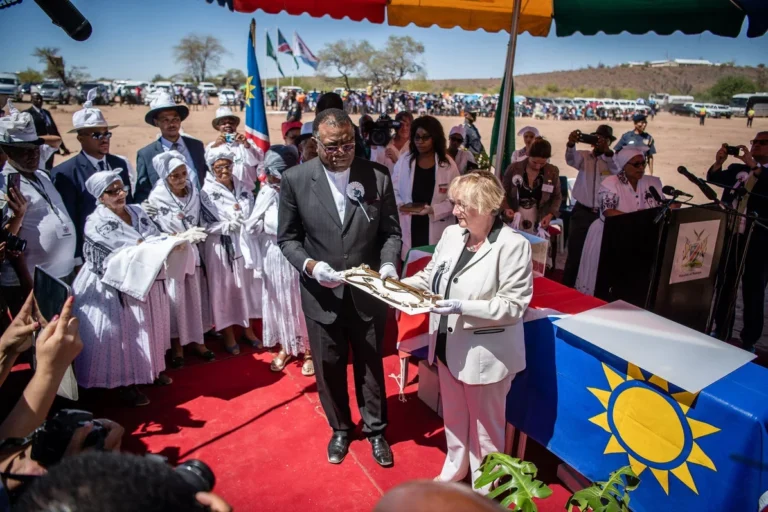
The German state Baden-Württemberg acknowledges its historical responsibility and is committed to provenance research in order to identify and return colonial cultural goods that were acquired unlawfully. The start was in 2019, when Hendrik Witbooi's Bible and whip were returned to Namibia.
This workshop marks the conclusion of the interdisciplinary provenance research project "Human Remains from Colonial Contexts: Provenance Research in the Anthropological Collections of the University of Göttingen and MARKK Hamburg".
Vanessa Hava Schulmann (Freie Universität Berlin): The stories I will tell you about happened during my work in a Berlin university collection. I was tasked of meeting the deceased whose bones and tissues were stored in those dusty wooden cupboards and figure out how to handle their presence in a dignified way.
This working paper offers an inventory of missionary orders and societies active in German colonial regions in Africa and Asia, the information available about them and the options for further research.
[ open access ] 'Displacing and Displaying the Objects of Others - The Materiality of Identity and Depots of Global History' brings a diverse range of contributions inspired by research from the "Hamburg’s (post-)colonial legacy" research center.
A foundational handbook for critical heritage research about Africa and its diaspora. Part III African Objects and the Global Museum-Scape is relevant for RM*.
Germany asks forgiveness for 'dark' colonial legacy in Tanzania and discusses repatriation of human remains. German President Frank-Walter Steinmeier said his country would "open negotiations" with Tanzania to discuss the is colonial past in the East African nation.
This is the “age of apology” for past wrongs. Reams of articles in Western media are devoted to former colonizer countries and yet, this is rarely the result of requests from former colonies. Example India.
This publication compiles information on 39 institutions in museums and universities in German-speaking countries that have accessioned, altogether, almost 19,000 pieces of tangible cultural heritage produced in Namibian communities over a period of time of more than 160 years (pre-1860s to date).
In a lengthy contribution, Kwame Opoku wonders how long the Ovaherero must wait for justice and reparation for the German genocide? He extensively quotes a press release of the Ovaherero Traditional Authority-Ouhonapare uo Mananeno uo Vaherero. Part of it is about repatriation.
Katharina Küng from canton Zurich had a headdress that she had received from her mother hanging on her wall for a long time. “We thought it was the padding of an old suit of armour,” Küng says. It wasn’t until a trip to Namibia that she realised – in the Swakopmund Genocide Museum – that it was a traditional Herero headdress.
The return of artefacts to their countries of origin is not just an act of repatriation, but an opportunity for healing and reconnecting with cultural roots, said Tuuda Haitula, the museum development officer at the Museums Association of Namibia.
Julia Binter talks about knowledge justice in relation to Namibian cultural assets and investigates cooperative research on cultural assets from colonial contexts in museums.