For more than a century and a half, Ethiopian manuscripts have travelled far from the churches, monasteries, and royal collections where they were created and preserved. Most crossed borders through looting and entered private collections, museums, and the international antiquarian market through chains of ownership that are now difficult to reconstruct. For Ethiopia’s scattered manuscript heritage, the journey home is gaining momentum—but remains far from complete. Is Ethiopia's effort indicative for a turning point in the restitution discourse?
Olugbile Holloway’s inclusion in TIME Magazine’s inaugural TIME100 Art list has drawn attention to his role in Nigeria’s efforts to secure the return of cultural artefacts taken from the country. Holloway was appointed Director-General of the National Commission for Museums and Monuments (NCMM) in March 2024.
Chiefs of Ontario (COO) have launched an Open Letter to All Ontarians: Help Us Bring Our Ancestors Home, calling on people and institutions in Ontario and elsewhere to come forward if they are holding or have information about, First Nations Ancestors, sacred items, burial belongings, or other culturally significant items.
H.E. Ambassador Xie Feng at the ceremony for the repatriation of Chinese Cultural Property: Jointly bringing home cultural treasures, trafficked overseas more than 100 years ago, is a new chapter in the China-U.S. Relationship.
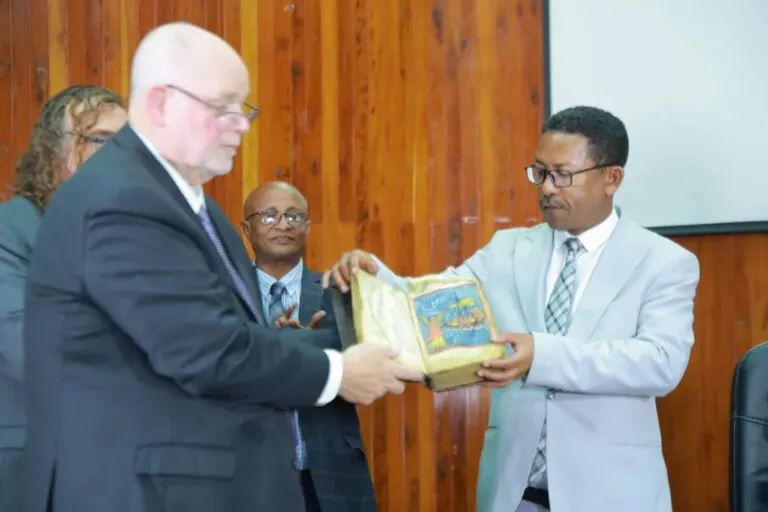
Abreha Kiros reports: The return from the USA of 17 ancient spiritual parchment manuscripts to Ethiopia marks an important achievement in the recovery, preservation, and responsible stewardship of the country’s cultural heritage.
The Association on American Indian Affairs is seeking proposals for panels, workshops, training and other sessions that will support the 12th Annual Repatriation Conference theme “Tending the Fire – Sustaining the Journey Home.” The Conference will be completely virtual and take place Thursdays and Fridays in the month of February 2027.
The Toledo Museum of Art (TMA) announced partnership with the Ethiopian Heritage Authority (EHA). At the center of the partnership is the acquisition of a collection of approximately 380 Ethiopian artworks. The museum will immediately return two 15th century religious manuscripts. Further returns will be prepared.
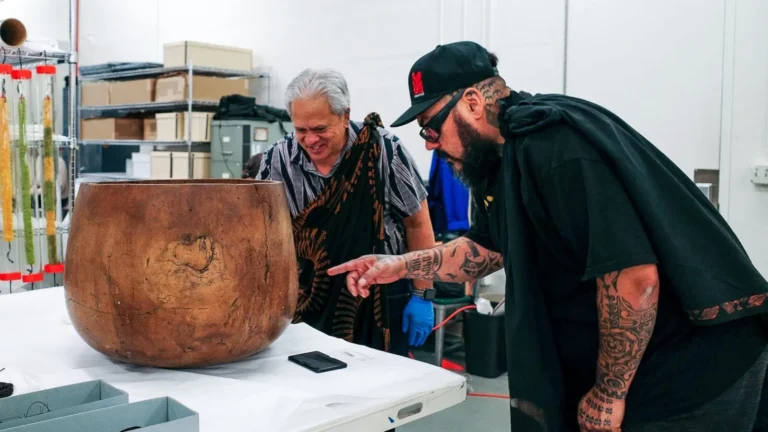
For Native Hawai‘ian advocate Edward Halealoha Ayau, caring for the dead has been a lifelong duty. It has also been a matter of steadily increasing legal traction.
For many years, the American museum community has been pursuing jars, created by enslaved potter David Drake (1800-1870). However, now the Museum of Fine Arts (MFA), Boston, has made a necessary and bold move: it has recognised the jars as stolen objects.
On 1 July 2026, Bolivia Archaeology National Museum (Munarq) reopened its doors with the permanent exhibition ‘Eternal Roots, Living Legacies,’ an exhibition that highlights the connection between pre-Hispanic customs and current traditions of the Andean country. It also has a section about repatriation.
Over 2,000 ancestral remains and sacred objects belonging to the Santa Ynez Band of Chumash Indians have gone home. Dating back thousands of years, they were long confined to wood trays and boxes at Yale and Harvard’s Peabody museums. Chumash representatives called this treatment of their ancestors “cruel and inhumane.”
For many museum professionals, the answer appears self-evident. Collections exist to be preserved. Conservation safeguards objects for future generations. Museums are institutions built around permanence. Johm Moses challenges these assumptions. Rather than taking conservation, collections, or even museums themselves as given, Moses invites us to begin elsewhere: with people, languages, relationships, and the continuity of cultural life.
Decades Late, Museum Scrambles to Return 2,700 Native Remains - The American Museum of Natural History said it would repatriate hair clippings that must be returned to tribes under a 1990 federal law.
The hair clippings were originally collected by anthropologists for an installation at the 1893 World’s Columbian Exposition in Chicago.
This article describes the sensitive historical and cultural contexts of the collection and gives a special place to the significance and relevance of these artefacts for the Mapuche today, and their integration into cultural and social processes in relation to historical events and provenances.
[in French] The UNESCO Chair on the Diversity of Cultural Expressions, in partnership with CELAT and IPAC, is organizing the second Midi de la culture of the year, which will include a discussion on the restitution and repatriation of cultural objects.
This paper is an ethnographic essay on what should not count as collection and how the Mapuche modes of existence exceed the Chilean heritage regime of objectification. Thus, it requires rethinking repatriation as other-than-human politics.
First Nations leaders talked about the need to develop a national repatriation strategy for artifacts, cultural items and ancestral remains at the Assembly of First Nations (AFN) annual general assembly in Winnipeg.
Officials from Canadian Heritage have confirmed the federal government has neither the means nor the ability to acquire any of the estimated 4,400 items in the Hudson Bay Company’s (HBC) collection of art and artifacts.
Hudson’s Bay Company, North America's oldest company, faces bankruptcy and wants to auction objects amassed from its founding in 1670, but it includes many important pieces of Canada’s First Nations and colonial heritage.
South Africa is determined to repatriate the remains of its people taken abroad during the colonial era and those who died in exile as anti-apartheid activists, the culture minister Gayton McKenzie says. Including those of the Khoi-San, who are regarded as among the country's "first people".
Modernity has emphasized the need to disconnect from emotions for the sake of objectivity; the mind as the vehicle for sense-making. However, onto-epistemologies from the Global South discuss the relevance of a holistic integration of the body, mind, heart, and life-force (spirit) for a better understanding.
Argentina has one of the most important and sensitive bioanthropological collections in Latin America. Most of the remains in museums come from Tehuelche and Mapuche victims of the so-called "Conquest of the Desert". However...
This book examines the ways in which law can be used to structure the return of indigenous sacred cultural heritage to indigenous communities, referred to as repatriation in this volume. In particular, it aims at developing legal structures that align repatriation with contemporary international human rights standards.
This report was developed as a response to the Truth and Reconciliation Commission’s Call to Action #67 under the guidance of the CMA Reconciliation Council.
A Mexican delegation is coming to retrieve 84 Mesoamerican axes currently in transit at University de Montreal, underscoring the need to raise public awareness of the looting of archaeological artifacts.