To commemorate years of diplomatic relation—and sure, with an eye to continued trade—France and Mexico exchanged two ancient manuscripts: the Codex Azcatitlán, and the Codex Boturini.
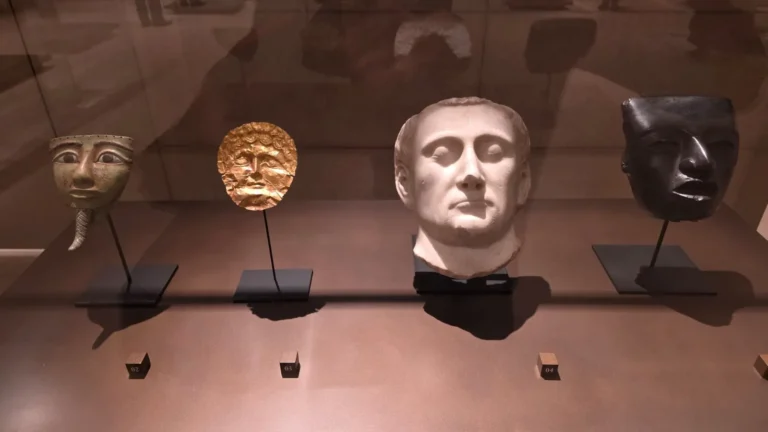
On December 3, 2025, the Pavillon des Sessions at the Louvre reopened its new layout, now called the Galerie des Cinq Continents or Gallery of the Five Continents. In Maria Pia Guermandi’s opinion, the layout continues to express a Western vision that claims to ‘elevate’ other cultures by granting them admission to the sancta sanctorum of European art.
[ in French ] In the 19th century, the concept of "Asian art" gradually gained prominence in the European market, driven not initially by collectors, but by dealers, the true intermediaries between Asia and Europe. This phenomenon took root in a context of forced opening of Asian territories: the Treaty of Yedo (1858) with Japan, the Treaty of Tianjin (1858-1860) with China, and the Treaty of Saigon (1862) with Vietnam.
[ in French ] Marie-Anne Léourier administered a questionnaire focused on these questions to visitors of the permanent collections area of the Quai Branly – Jacques Chirac Museum (MQB).
[ in French ] It was in 2021, after 129 years of plunder by France, that the royal treasure of Abomey was returned to Benin. The restitution of this piece of history is part of a campaign launched by Benin in 2016 to make its heritage the cornerstone of its cultural influence.
The theft of the Louvre’s crown jewels has increased calls for the museum to be more transparent about the colonial origins of the treasures it displays. Their routes to Paris run through the shadows of empire, an uncomfortable history that France has only begun to confront.
[ in French ] The Study and Research Centre for Administrative and Political Sciences (CERSA) organizes a conference entitled “Restitutions of cultural heritage: trends, challenges, perspectives” on November 14, 2025 in Paris.
[ in French ] The French government intends to go further with a bill that could become a landmark law in this area. What are the terms of the bill, and why does it potentially represent a historic turning point? Catharine Titi writes....
The stolen jewels are also products of a long history of colonial extraction. The sapphires, emeralds, diamonds, pearls, and other gemstones they contained were mined across Asia, Africa, and South America.
[ in French and in English ] Claimed for decades by Antananarivo, these bones had been taken as trophies by French colonial troops after a deadly attack in 1897 in Ambiky, the former royal capital of Menabe. 'Their absence was an open wound on our island'.
According to Darius Spierman, France has begun a significant process of confronting its colonial history. This includes the recent return of human remains to Madagascar and a draft restitution bill.
[ French translation ] La France débat actuellement de la création d’un cadre juridique pour la restitution des collections publiques historiques, principalement d’origine coloniale. La Belgique dispose déjà d’une telle loi. Ce court article propose une comparaison entre les deux dispositifs – la loi belge et le projet de loi français – en se concentrant sur trois points :
• l’approche centrée sur l’État,
• le champ d’application,
• la procédure de restitution.
Kwame Opoku writes: The French Minister of Culture presented a legislative text on 30 July to facilitate the restitution of artefacts in French museums by derogating from the principle of inalienability. It will not likely lead to a rush of restitutions from France. Excluding archaeological materials, military materials, and public records eliminates many objects. Archaeological finds from Egypt, Mali, and other African countries, such as those on the ICOM Red Lists, would be excluded.
This call for contributions to Terroirs, African Journal of Social Sciences and Philosophy, aims to give greater consideration to African perspectives by analyzing citizen mobilizations, artistic initiatives, state strategies, and community practices that shape the return of heritage.
[ in English and in French ] The French government has proposed a restitution law. After Belgium, it is the second former European colonial power to do so. Such a law streamlines restitution procedures and offers former colonies more clarity and even legal certainty. This blog discusses the draft-bill and examines whether countries of origin will benefit much from it.
Vanessa Hava Schulmann (Freie Universität Berlin): The stories I will tell you about happened during my work in a Berlin university collection. I was tasked of meeting the deceased whose bones and tissues were stored in those dusty wooden cupboards and figure out how to handle their presence in a dignified way.
On 7 July 2025, the French National Assembly has approved the restitution to Ivory Coast of the Djidji Ayôkwê, an important talking drum, stolen in 1916. In the same period, the British Museum came with a statement that it is unwilling to restitute an equally important drum to the Pokomo council of elders in Kenya.
Eight years after French president Emmanuel Macron pledged to return African heritage to the continent, his government has adopted a bill facilitating the deaccession of cultural items plundered from former colonies. The text will be submitted for a vote in the senate on 24 September.
France's parliament approves returning to Ivory Coast a "talking drum" that colonial troops took from the Ebrie tribe in 1916, in the latest boost to the repatriation of colonial spoils.
The Franco-German Fund for Provenance Research on cultural belonging from Sub-Saharan Africa has announced the funding of networking and parthership initiatives aimed at fostering the creation of international research teams and strengthening existing partnerships between Germany, France, and Sub-Saharan Africa.
The path to true restitution requires more than symbolic gestures, demanding that Britain repeal its obstructive laws, France accelerate its glacial restitution process, and all former colonial powers establish transparent frameworks for repatriation.
Hotel Drouot has auctioned off three Benin objects, without guaranteeing that they are not related to the British invasion of the Kingdom of Benin in 1897. The provenance only goes to the 1950s and 1960s. It also auctioned Nok and Sokoto objects from Nigeria, both of which are on ICOM's Red List for West Africa.
This article postulates that what we have seen in the past decade has been a turning point in memory politics of the colonial past, and it asks whether a new Franco-German paradigm in memory politics has emerged?
Adéwolé Faladé, PhD candidate in History at the Central European University (CEU) in Vienna, highlights and analyzes the traces left by the 26 repatriated artefacts by France to the Republic of Benin in 2021.
[ in French ] France Culture interviews historian Benjamin Storashares about some of the issues with the restitution of documents and objects that were looted during the 1950's war of independence of Algeria.
Deliberate avoidance, lack of interest, or lack of sources, African arts have found themselves to the margins of the history of spoliations, destruction and displacement of works of art during the 1933-45 period, with research largely focusing on European art. Conference on 13 November 2025 in Paris.
“Black Paris” retraces the presence and influence of Black artists in France from the 1950s to 2000. The exhibition celebrates 150 black artists coming from Africa, the Americas and the Caribbean.
The repatriation of African art is gaining momentum, but a number of highly important and symbolic pieces remain in the hands of the continent’s former colonisers.
The Paris museum has invited African researchers to study the archives of the expedition, which took place between 1931 and 1933, and to carry out field studies to retrace the conditions of the undercover raid on artifacts.
France will repatriate the skulls of King Toera and two Sakalava warriors to Madagascar, marking the first return of human remains under a new French law passed in 2023.
Algeria submitted a list of items held by France since the colonial era in order to restore them as part of the joint memory committee to look into that historical period.
European governments negotiate restitutions only with the governments of countries of origin. The collections they negotiate usually are state-owned and contain valuable, not rarely iconic objects. The path followed by governments of former colonies is quite similar. It is the path of what Laurajane Smith called the authorized heritage discourse (AHD), where only a limited part of a country’s heritage dominates in national narratives and public policies. This approach has serious limitations.
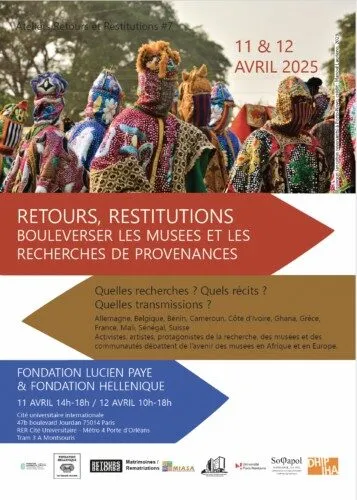
[ conference in French ] Germany, Benin, Cameroon, Ghana, Greece, France, Ivory Coast, Mali, Sénégal, Switzerland - Academics, activists, artists, experts from communities and museum actors debate the future of museums in Africa and in Europe.
Until 25 May 2025, the Louvre Abu Dhabi unveils 'Kings and Queens of Africa: Forms and Figures of Power', an exhibition celebrating 350 works of African art and majesty, most of them on loan from Musée Du Quai Branly-Jacques Chirac. Is this a manner to postpone their restitution?
This article presents recent provenance research on the Indigenous ancestral human remains gathered by Alphonse Louis Pinart (1852-1911) during his journey in Oceania on board the French navy cruiser Le Seignelay.
In Morocco, the post-colonial power has implemented cultural policies aiming for a return to the precolonial times with a conception of tradition that was produced by the colonial gaze, thus continuing the colonial epistemology and policies.
Kwame Opoku comments on the report that former director of the Louvre Museum and current Ambassador for International Cooperation, Jean-Luc Martinez, delivered on 25 April 2023 to the French Minister of Culture.
[ in French, Italian subtitles ] This year it is seventy years ago that Alain Resnais, Chris Marker, and Ghislain Cloquet released their documentary Les statues meurent aussi about historical African art and the effects colonialism has had on how it is perceived.
A long bloody and painful colonisation of Indochina by the French should lead to more antiques to be identified and repatriated in the future.
It will be difficult to get a true handle on just how much the nation has been plundered.
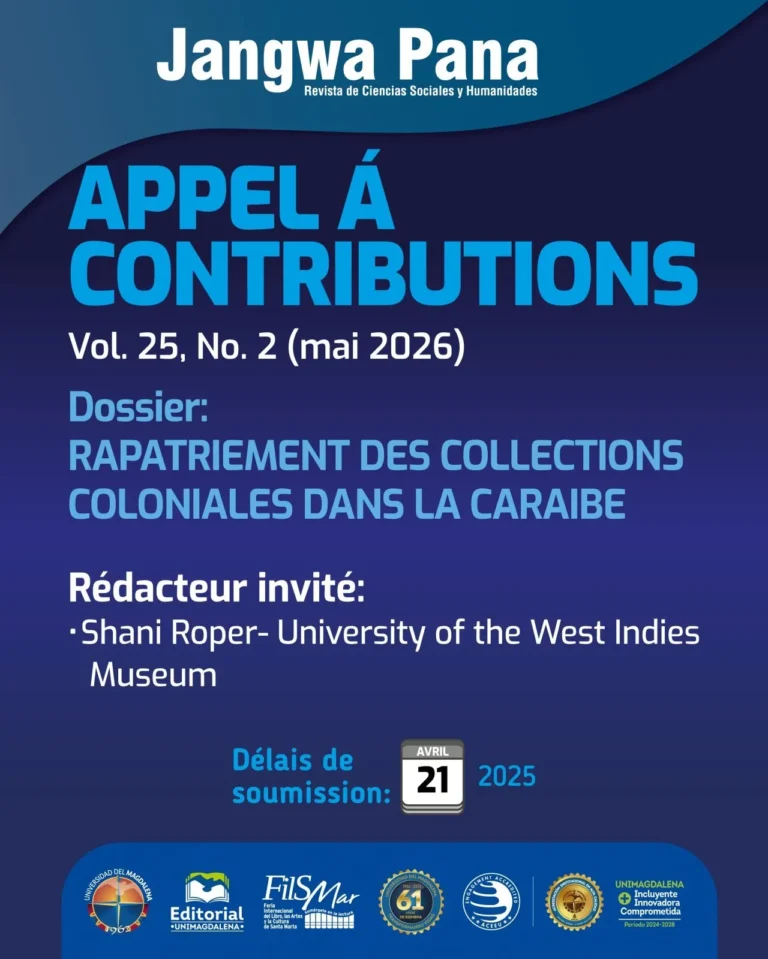
[ in English, French and Spanish ] This call invites researchers and academics from all areas of social sciences and humanities to submit their work for a special issue of Jangwa Pana dedicated to the repatriation of colonial collections in the Caribbean. Deadline 21 April 2025.
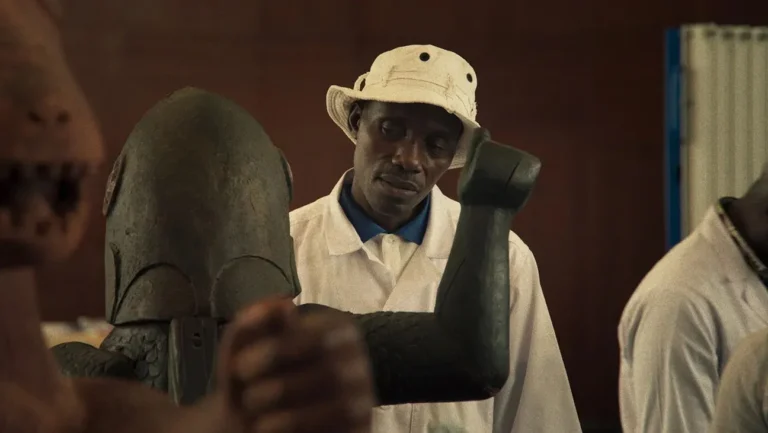
[ in English but also available in French ] With the release of the documentary film Dahomey, which follows France’s restitution of twenty-six works of art to Benin, various research teams continue to work on the return of African cultural property to their communities of origin.
[ in French ] Just before the major exhibition "Dakar-Djibouti, counter-investigations", scheduled for 2025 at the Musée du quai Branly-Jacques Chirac, in France, Sotheby's is selling part of the collection of the art dealer Hélène The Wolf. A collection built up between the end of the colonial era and the beginning of Mali's independence.
Why is research into colonial collections in the private sector - I mean art dealers, auction houses and private collectors - so tough? The main reasons is that most of them have built a wall around themselves, and there is rarely a hole in this wall through which an outside observer can look inside their closed bulwark.
Political turmoil across the continent is hampering plans for national structures to return colonial-era heritage. But the UK, once a laggard, appears to be preparing to review laws
During the European expansion constant fighting and violence and the taking of spoils of war went hand-in-hand. Palaces, shrines, homesteads and entire villages were plundered and destroyed. In the restitution debate, the focus is mostly on state-collections resulting from these confrontations. There is ample evidence, however, that many more parties were involved. This blogpost has some of the evidence.
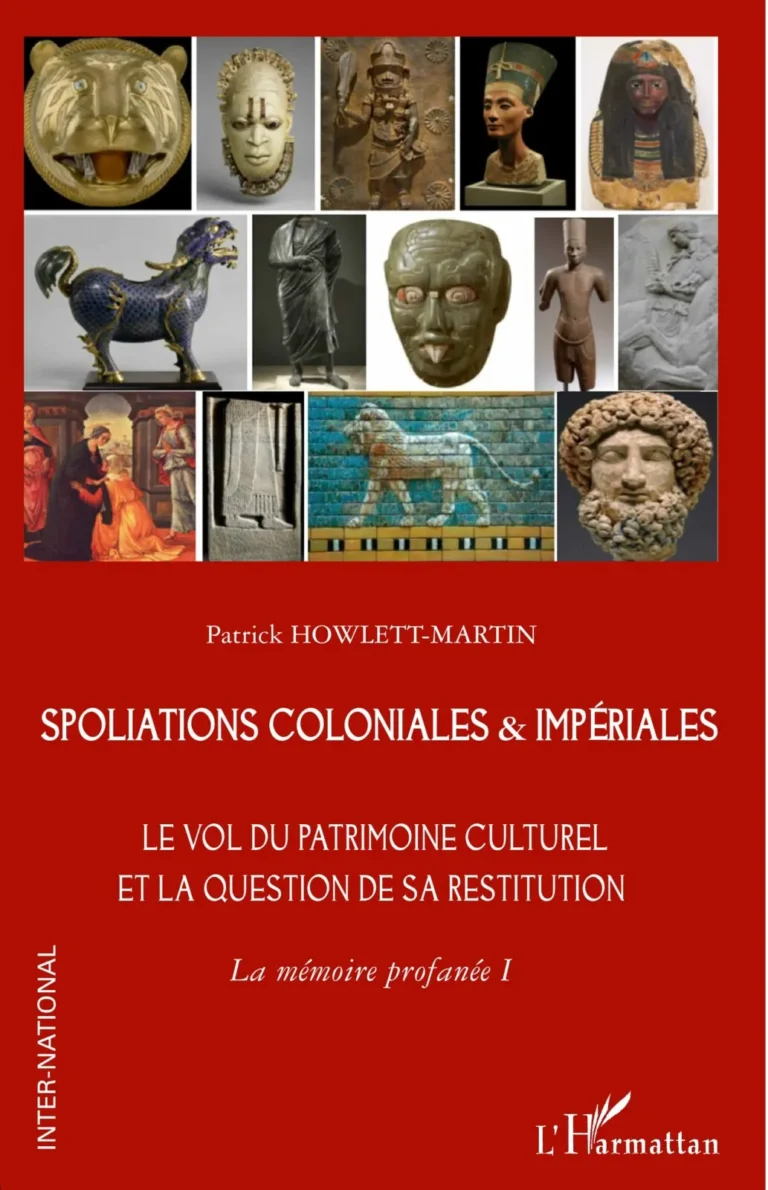
[ in French ] French historian Patrick Howlett Martin focuses on colonial spoliations and those committed during conflicts and military interventions with their procession of enslavement, repression and pillage exercised on the peoples and cultures that suffered the rule of the conquering powers.
[ in French ] Relations between ethnographic museums and African and Oceanic art markets in France, Switzerland and Belgium : building value(s) and appropriating otherness
Aurora Hamm argues that restituted objects are instruments of soft power through public and cultural diplomacy. The (former) coloniser states utilise them, with geopolitical considerations in mind, as a means of ‘restarting’ their bilateral relationships and thus obtaining a certain form the restitution
On August 26, 2016, the Minister of Foreign Affairs and Cooperation of Benin, in a letter to his French counterpart, made an official request calling for the restitution of cultural goods brought back to mainland France by French colonial troops during the conquest of the kingdom of Danhomè. [ in French ]
Human remains held in French public collections and less than 500 years old, can now be returned to their countries of origin by a decision of the prime minister.
Germany and France will jointly spend €2.1m (£1.8m) to further research the provenance of African heritage objects in their national museums’ collections, which could prepare the ground for their eventual return.
In Mati Diop’s film Dahomey, which premiered at the Berlin film festival, the director documents the 2021 journey of 26 treasures that the commander of French forces in Senegal looted from the royal palace of the kingdom of Dahomey, part of modern-day Benin, in 1890.
An exhibition at the Foreign Ministry Museum in Mexico City is displaying more than 100 stolen pieces that have been recovered, thanks to intense work by the country’s diplomats.
A commission of French and Algerian historians created to reconcile colonial difficulties has agreed proposals for the exchange of archives, remains and artefacts.
Two great granddaughters of a Sakalava king, who was beheaded in 1897 by colonial troops, publicly addressed the French ambassador, asking him to speed up the repatriation of their ancestor’s skull.
An indigenous Mexican nation, the Nahñu people in the central Mexican state of Hidalgo, has written to the Assemblée Nationale in France seeking the return of its codex, arguing that the centuries-old manuscript describes traditions it still continues.
Chief Charles Taku has made an impassioned call for the “urgent and unconditional restitution of the Bangwa Queen in Dapper Foundation in France, the Bangwa King in Metropolitan Museum in New York, USA and the cultural heritage artefacts which are in the National Ethnological Museum in Berlin and Municipal Museums in Germany, in the Netherlands and other parts of the world.”
With tens of thousands of African artworks in French museums, curators face a huge task in trying to identify which of these were plundered during colonial rule in the 19th and 20th centuries and should be returned.
Felwine Sarr and Bénédicte Savoy discuss what African cultural objects are in French publicly owned collections, why so few have been repatriated and what measures should be taken for restitutions to their countries or communities of origin.
The fact that the government and elected representatives are unable to reach a consensus on large restitutions raises questions about the future of a framework bill designed to facilitate such transfers, writes columnist Michel Guerrin.
Kwame Opoku writes: President Macron of France had promised in 2017 to restitute Africa artefacts in French museums, and in 2021, twenty-six artefacts were returned to the Republic of Benin.
Beninese President Patrick Talon has an ambitious development plan with culture and heritage at its core. “It is at the end of the old rope that the new one is best woven,” he said recently, citing an old African proverb.
[ in French ] Algeria has made a request for the return of objects that belonged to Emir Abdelkader, a great resistance fighter in the conquest of Algeria in the 19th century, who was defeated in 1847.
Some French parties pressure their country’s authorities to prevent them from responding to the requests submitted by the Algerian-French mixed commission concerning the restitution of some “symbolic” property that France had looted from Algeria during the occupation period.
It is seven years since President Emmanuel Macron of France announced his revolutionary plan to return African heritage to the continent. But following his declaration in Burkina Faso in November 2017 that “African heritage can’t just be in European private collections and museums”, the restitution journey has been arduous.
The Ayôkwé djidji or talking drum, confiscated in 1916 by the French army from the Ebrié community, will be exposed in its home country, but France has yet to pass legislation allowing for it to be formally restituted.
The prize-winning documentary film Dahomey continues to evoke reactions. In ARTnews, Alex Greenberger writes: If the 2016 statement by Andre Frasier that prisons and art institutions are “two sides of the same coin of inequality” seemed provocative eight years ago, it appears only mildly controversial now, at a time when museums are commonly seen as appendages of racist, colonialist, and deeply unfair systems.
Algeria has made a request for the return of objects that belonged to Emir Abdelkader, a great resistance fighter in the conquest of Algeria in the 19th century, who was defeated in 1847.